
Muhsin Hendricks
he/him1967 – 2025
South African religious leader Muhsin Hendricks offered LGBTQIA+ Muslims worldwide a community and a safe place. Hendricks enjoyed international renown for his pioneering role in unifying faith and sexual and gender diversity.
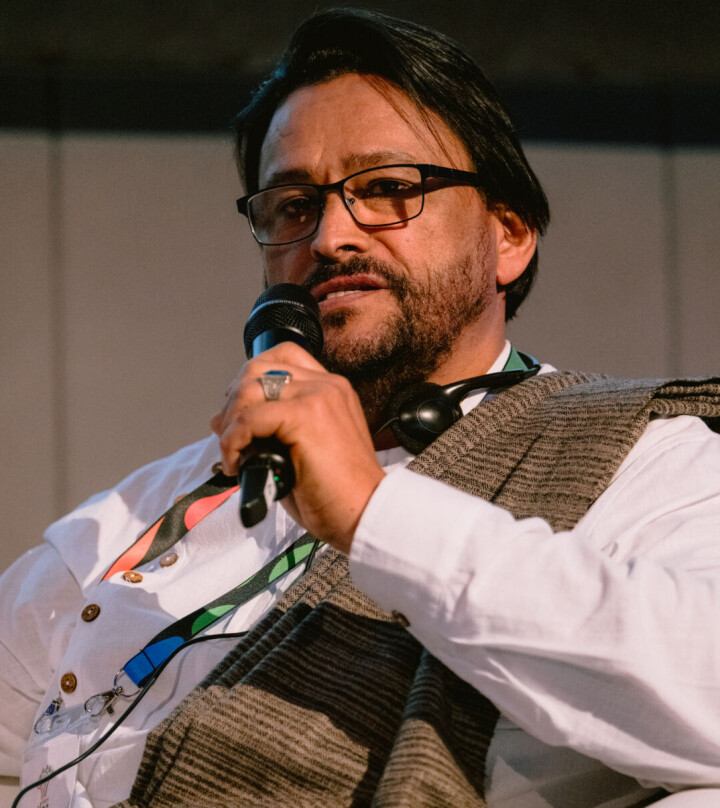
Photo credits
“Muhsin Hendricks ILGA World”
Year: 2024
Photographer: Jodi Windvogel
South African religious leader Muhsin Hendricks offered LGBTQIA+ Muslims worldwide a community and a safe place. Hendricks enjoyed international renown for his pioneering role in unifying faith and sexual and gender diversity.
Biography
Muhsin Hendricks was a South African imam, Islamic theologian, activist, and community builder who gained international recognition as one of the world’s first openly gay imams. His work stood at the intersection of Islamic hermeneutics, sexual and gender diversity, HIV activism, gender justice, and transnational emancipation movements. Hendricks occupied a unique position as a religious leader who advocated inclusion not not outside of faith, but from within it. Through alternative interpretations of Islamic sources, ethical reflection, and spiritual guidance, he created space for lesbian, gay, bisexual, transgender, and queer Muslims. In doing so, he became one of the most influential voices in the global debate on Islam, sexuality, human rights, and religious pluralism.
Hendricks was born in Cape Town, South Africa, and grew up within a conservative Muslim community. He received a traditional Islamic education and went on to study in Pakistan, where he specialized in Qur’anic studies, fiqh (Islamic jurisprudence), and religious pedagogy. After returning to South Africa, he worked as an imam and religious educator. His personal experience of navigating sexual identity within a religious context later became the foundation of his theological and activist work. His decision to come out as a gay imam in the 1990s was highly unusual and carried significant social and religious consequences. At the same time, this moment marked the beginning of a lifelong commitment to Muslims who had been excluded by dominant religious interpretations.
In 1996, Hendricks founded the Inner Circle, an organization dedicated to supporting, empowering, and providing spiritual guidance to queer Muslims. The organization offered a safe space for people who often felt forced to choose between their faith and their sexual orientation or gender identity. Within this context, Hendricks developed a form of pastoral care that was widely regarded as innovative. He was among the first Islamic religious leaders to systematically develop a queer Islamic pastoral practice that brought together faith, spirituality, self-acceptance, and community building. As part of this work, he counseled and officiated marriages for same-sex partners and interfaith couples.
His work, however, was not limited to sexual diversity alone. Hendricks was also involved with Positive Muslims, a South African organization that supported Muslims living with HIV. In doing so, he explicitly situated his religious work within broader discussions of stigma, health, embodiment, exclusion, and human dignity. His activism was characterized by a sustained concern for groups that were frequently marginalized within both religious and social contexts.
Theologically, Hendricks became known for his critical re-examination of Islamic texts traditionally used to condemn homosexuality. He argued that many dominant interpretations were shaped by historical, cultural, and patriarchal influences and failed to do justice to core Islamic values such as compassion, justice, and human dignity. According to Hendricks, the interpretation of religious texts must take into account context, power relations, and the lived experiences of believers. His work can therefore be situated within broader currents of progressive and contextual Islamic hermeneutics.
Hendricks’s influence extended far beyond South Africa. Beginning in the early 2000s, he emerged as an international speaker, trainer, and adviser for organizations working in the fields of religion, human rights, and sexual diversity. In numerous countries, he supported initiatives focused on the emancipation of queer Muslims and the development of inclusive faith communities.
Hendricks was of particular importance to the Netherlands. From around 2010 onward, he regularly visited Dutch cities to give lectures, training sessions, workshops, and community gatherings. He became an important source of inspiration for Dutch queer Muslims and for activists working to increase the visibility and organization of queer Muslim communities. His presence not only provided religious legitimacy for individuals struggling with the perceived contradiction between faith and sexual diversity, but also offered practical support for the development of new initiatives. Hendricks trained, inspired, mentored, and supported a number of Dutch queer Muslim activists in establishing projects, networks, and public initiatives. In the Dutch media, he was frequently referred to as the “pink imam,” a designation that reflected both his visibility and his symbolic significance within public debate.
An important component of his international work was the development of sustainable transnational networks. Hendricks was a co-founder of the Global Queer Muslim Network, a collaborative initiative that connected activists, religious thinkers, community organizations, and researchers from different countries. The network created opportunities for knowledge exchange, solidarity, and strategic cooperation among queer Muslims worldwide. Its establishment marked an important phase in the institutionalization of a global queer Muslim movement.
In addition to his public speaking and community work, Hendricks published on topics including gender-based violence, Islamic inclusion, and social justice. He authored a variety of papers, policy documents, and educational texts for organizations in South Africa, the Netherlands, and beyond. His publications provided practical and theological frameworks for community building, emancipation, and religious inclusion.
The significance of Hendricks lies not only in his personal courage or public visibility. His most important contribution may have been the institutional, spiritual, and intellectual infrastructure that he helped build. He created spaces in which queer Muslims did not have to abandon their faith in order to be themselves. At the same time, he challenged religious communities, human rights organizations, and academic institutions to think more deeply about religion, sexuality, identity, and authority. His work demonstrated that queer Muslims do not stand outside Islam, but are an integral part of its history, diversity, and future.
Muhsin Hendricks was killed in South Africa in February 2025. His death prompted expressions of grief, reflection, and recognition around the world for his exceptional contribution to both religious and social emancipation movements. His legacy lives on in the organizations, networks, publications, and communities that he helped shape. For many, he was more than an imam: he was a mentor, theological thinker, community leader, and spiritual guide. From a historical perspective, Hendricks can be regarded as a pivotal figure in the development of a global queer Muslim movement. His life and work made a lasting contribution to redefining the relationship between Islam, sexual diversity, and religious authority in the 21st century.