
Sarah Hegazi
zij/haar1989 – 2020
After publicly displaying a rainbow flag in Cairo, Egyptian activist Sarah Hegazi was arrested and tortured. Hegazi wrote about the need for united resistance against oppressive systems and norms.
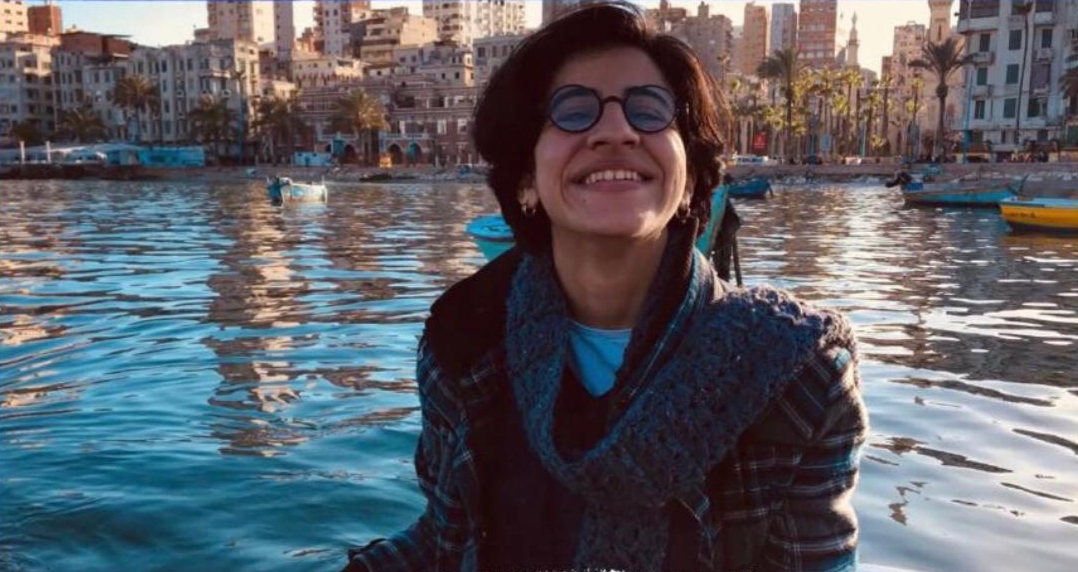
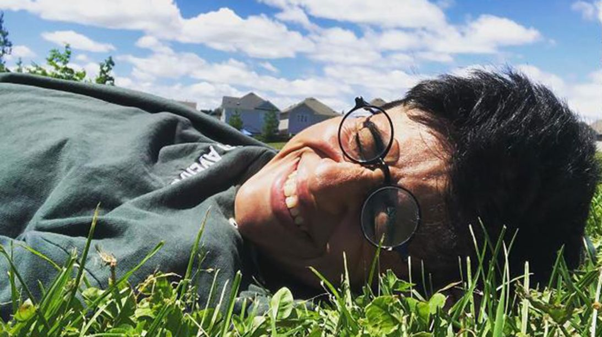
Photo credits
“Sara Hegazi, Egyptian human rights activist”
Year: 2020
Source: Humena for Human Rights and Civic Engagement
The last photo Sarah Hegazi posted on her Instagram
Year: 2020
Source: Instagram @sarahhegazi89
After publicly displaying a rainbow flag in Cairo, Egyptian activist Sarah Hegazi was arrested and tortured. Hegazi wrote about the need for united resistance against oppressive systems and norms.
Biography
Author: Maaike Jansen
Trigger warning: this text refers to homophobia, sexual violence, abuse, and suicide
Joy, pride, hope—they were all visible on Sarah Hegazi’s face as she was waving a rainbow flag during a concert she attended in 2017 in Egypt’s capital, Cairo. It was a brave act that had major consequences.
Super communist, super gay, and feminist
Sarah Hegazi (also spelled Hegazy or Higazy) was born into a conservative, middle-class Egyptian family on October 1, 1989. Still young when her father died, she helped her mother raise her three younger siblings. In 2010, Sarah earned a bachelor’s degree in information systems and then went on to work in the technology sector.
During that period, partly in response to the Egyptian uprising of 2011, she became increasingly outspoken as a communist, a supporter of Egypt’s Democratic Socialist Party and an opponent of President Abdel Fattah el-Sisi, who began ruling the country with a heavy hand in 2014.
In 2016, Sarah came out as a lesbian, and that became an important part of her public identity and activism. She described herself as “super communist, super gay, and feminist” and linked her growing queer visibility to criticism of what she called a “class struggle.”
Showing who she was
That visibility reached a peak on September 22, 2017, when Sarah attended a concert by popular Lebanese band Mashrou’ Leila, whose lead singer is openly gay. Sitting on a friend’s shoulders, she rose above the crowd, holding the rainbow flag and smiling into the camera. Omar, the friend on whose shoulders she sat, called the moment a statement to show: “We are here.” Sarah herself described it as “a beautiful moment,” because she showed who she was “in a society that hates everything that deviates from the norm.”
As beautiful as the moment was—and should have remained—it became a turning point with far-reaching consequences. Others were also carrying rainbow flags at the concert, as they had done at an earlier performance by the band. Whereas that occasion had drawn no reaction, this time photos and videos were widely picked up by the media, which condemned the waving of the flags. The timing played an important role: the media attention provided a distraction from the country’s economic problems. Following the media storm, the Egyptian government intervened and arrested dozens of people, including Hegazi.
She was arrested at home, in front of her own family, and taken to prison, where she was held for three months. In that period she was tortured with electric shocks, not allowed to speak to anyone, and sexually abused.
Free but not safe
Following her release, the traumatic events during her imprisonment led to post-traumatic stress disorder (PTSD), panic attacks, and hallucinations. The fear of being arrested again led Sarah to flee to Canada in 2018, where she was granted asylum. It was a difficult decision since it meant leaving behind her family, friends, and country.
That decision became even more painful when her mother died of cancer shortly after Sarah arrived in Canada. Sarah could not return to Egypt to mourn with her siblings, fearing she would lose her asylum status or be arrested again.
In Canada, Sarah underwent psychiatric treatment, but after two years of internal struggle and unbearable pain, she died on June 14, 2020, at the age of 30, after attempting suicide. In a letter she had written to those she left behind, she explained: “To my brothers and sisters—I tried to survive and failed, forgive me. To my friends—the experience was harsh and I am too weak to resist it, forgive me. To the world—you were extremely cruel, but I forgive you.”
On her Instagram, she posted a final photo of herself lying in the grass with a smile, beneath a blue sky. Beneath the photo she wrote: “The sky is more beautiful than earth; I want the sky, not earth.” Sarah was buried in a coffin shining with the colors of the rainbow flag, just as she herself shone while waving the flag at the concert.
How one moment continues to resonate
Sarah’s death sent shockwaves through the LGBTQIA+ community and far beyond. Alongside the homophobic reactions that the news provoked, there were memorials and Pride events held in her honor, a fellowship named after her, a song written by the frontman of Mashrou’ Leila inspired by her final Instagram post, and murals and street art—some of which, unfortunately, were later painted over following controversy on social media.
She dedicated herself fully to equal rights, to the LGBTQIA+ community, and to every human being. During her life, she made it clear that she did not want all attention to focus on her personally, but rather on the consequences of oppression, patriarchy, and state violence, and on the many thousands of people who, like her, were imprisoned—and still are—because of their political views or sexual orientation.
Although Sarah’s story became world news through one visible act—waving the rainbow flag—visibility was never her ultimate goal. She used that act to show others how power works and to make clear how important it is for people to stand up for one another and to care for each other.
Her legacy therefore asks us to do more than mourn her or remember her name: it asks us to work towards building a world in which she could have continued to exist. A world in which everyone is free to wave the rainbow flag, wherever and whenever they wish. A world in which every person is allowed to be themselves.
Literature and sources
I want Sky. Een verzameling aan gedichten en teksten ter ere van Sarah Hegazi en het leven van lhbtqia+-mensen uit de SWANA-regio en de diaspora. Online te raadplegen of te bestellen als fysiek boek.
‘Sarah Hegazi reflects on her dreams and love for her family’, CBC, 2020.
Hamed Sinno, leadzanger van de band Mashrou’ Leila, zingt Sarah Hegazi’s laatste woorden ter nagedachtenis, X @thebadalpha, 2020.
Meer informatie over het Sarah Hegazi Fellowship, waar ook aan gedoneerd kan worden.