
Bo Laurent
she/herBorn 1956
Intersex activist Bo Laurent founded the world’s first non-medical intersex organization that addressed human rights violations in healthcare. She helped organize the first intersex human rights demonstration.
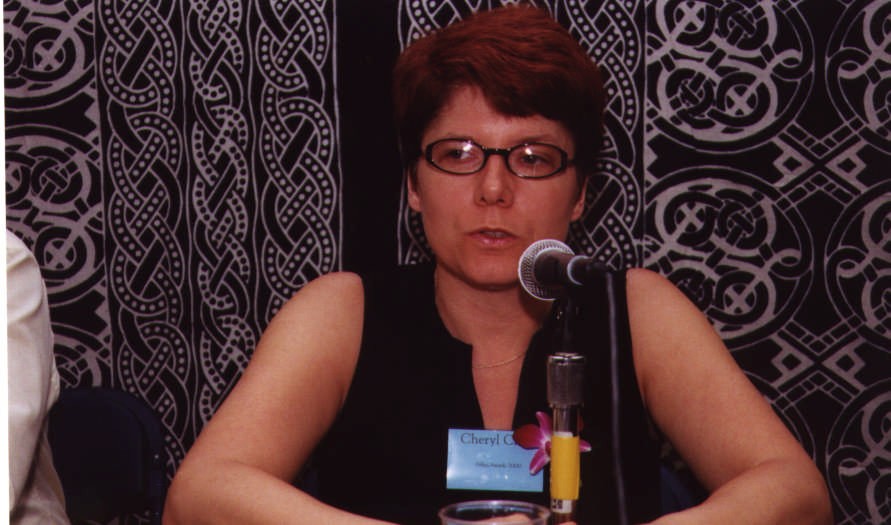
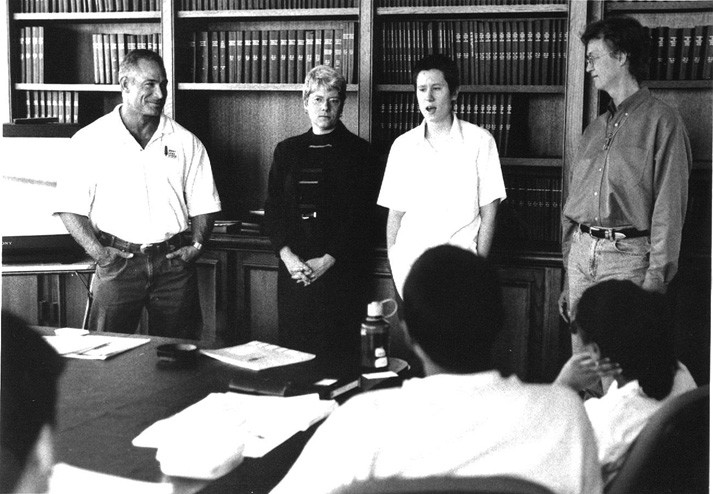
Photo credits
“Tiger Devore, Bo Laurent, Jim Ambrose and unknown inform medical students at the University of Amsterdam”
Year: mid/late 1990s
Collection: private collection
Photographer: Unknown
“Bo Laurent speaking at the presentation of the Felipa de Souza Award, where on behalf of ISNA she received the prize of the International Gay and Lesbian Human Rights Commission”
Year: 2000
Collection: private collection
Photographer: unknown
Intersex activist Bo Laurent founded the world’s first non-medical intersex organization that addressed human rights violations in healthcare. She helped organize the first intersex human rights demonstration.
Biography
Author: Dewi Vrenegoor (with special thanks to Bo Laurent)
Trigger warning: This text contains references to medical procedures, shame, and pathologization as experienced by intersex people.
In 1956, in a small town in New Jersey, in the United States, a baby was born that confounded doctors when they saw it. They considered it problematic that the child did not conform to the prevailing medical standards for either a “girl” or a “boy”. On the doctors’ advice, the parents began raising the child as a boy. Some 18 months later, a second pair of doctors became involved. On their advice, the child underwent a clitoridectomy to have the child’s body conform to the medical standard of “female.” It was highly invasive surgery that caused more harm than good to the child’s body.
The doctors advised the parents never to speak of it again, to move elsewhere, and to raise the child as a girl under a new name. The who intervention had a profound impact on the child: although she had already learned to talk by the operation took place, it would be six months before she would speak again.
That child grew up to become Bo Laurent, a pioneer of the intersex movement that emerged in the 1990s. Drawing on her own experiences and on the wisdom she had gained over the years, she offered the following thoughtful advice to brand-new parents in 2012:
What we know about these very difficult feelings is that nobody stays in crisis forever. When you’re in an emotional crisis, it feels as if it will last forever, but if you can find your way to a support group, you’ll meet parents who remember that time but are now living their lives; for them, almost every day is no longer about intersexuality, and that will help give you some perspective. If you are feeling very confused and frightened about what all this ‘intersex stuff’ means for your family and for your child’s future life, that is a bad time to make irreversible decisions.
For years, the medical establishment had maintained that Bo did not need to know what had been done to her, by whom, or why. Only much later, when she gained access to her medical records, did she discover what had happened. That experience became the driving force behind her later activism.
Knowledge leads to self-determination
After throwing herself into her studies and career—Laurent earned degrees in mathematics and Japanese and spent many years living in Japan—she returned to the United States in the early 1990s. At the age of 35, she demanded answers and began her search for justice. To expand her understanding of the experiences of intersex individuals, she began speaking with researchers and people with lived experience.
In 1993, under the pseudonym Cheryl Chase, Laurent founded the Intersex Society of North America (ISNA). It became the first organization in the world dedicated to advocating for the rights of intersex people. Her mission was clear: to put an end to the medical pathologization of intersex bodies.
She fought against unnecessary and often traumatizing surgeries performed on intersex infants and children in an effort to make them “normal,” just as she herself had experienced. Through her words, the evidence she presented, and her extraordinary determination, she brought about significant change.
For a long time, the stories of people with intersex experiences had been told within a medical or psychological framework. After all, they themselves had learned to remain silent. In the late 1990s, the American intersex movement did everything it could to break that silence. Activists educated medical students and healthcare professionals, shared personal and political stories through ISNA’s website, and engaged in international advocacy.
Laurent, also known as Cheryl Chase, published “Hermaphrodites with Attitude,” a groundbreaking pamphlet that challenged the medical establishment and gave intersex people a voice. A monthly newsletter under the same title followed, providing a platform for sharing stories and spreading knowledge. Later came Hermaphrodites Speak!—the first documentary (released in 1997) in which intersex people spoke about their own experiences. It was a groundbreaking collection of personal stories that revealed the humanity behind medical diagnoses.
Her activism was not only political but also deeply personal. Greater visibility brought people together. A space emerged where experiences could be shared and where healing and activism could develop collectively.
Intersex Awareness Day
On October 26, 1996, together with Max Beck (1966–2008) and Morgan Holmes, Laurent organized the first public demonstration by intersex activists. The protest took place outside the building hosting the annual conference of the American Academy of Pediatrics in Boston.
Carrying banners with slogans such as “Keep Your Scalpels Off Intersex Children” and “Silence = Death,” they drew the attention of both the media and medical professionals. It was a historic moment because, for the first time, intersex people publicly claimed their place and challenged the medical status quo.
The demonstration marked the beginning of a movement that could no longer be ignored. To this day, Intersex Awareness Day, observed on October 26, commemorates that first protest.
Human rights activism
The (international) intersex human rights movement gradually gained real momentum. The movement advocated for an end to non-essential medical interventions and to medical secrecy and deception, while calling for greater social understanding and more space for sex diversity.
In 2000, ISNA received the Felipe de Souza Award from the International Gay and Lesbian Human Rights Committee. The annual award recognizes “individuals and/or organizations that have made an outstanding contribution to ensuring the human rights and freedoms of sexual minorities throughout the world.”
Bo Laurent continued to write, conduct research, publish, and speak publicly in support of intersex rights around the globe. She challenged individuals and organizations that failed to respect the autonomy and rights of intersex children and adults. In doing so, she encouraged medical professionals to reconsider their understanding of and approach to intersexuality.
Through letters, advisory committees, and advocacy, she informed judicial authorities about human rights violations. In this way, Laurent contributed to landmark court decisions and medical guidelines that offer better protection to intersex people.
The future is intersex-inclusive
Today, Bo Laurent lives in California, where she runs a farm and, together with her neighbors, maintains a herd of grazing animals as part of wildfire prevention efforts.
As a pioneer, Laurent has demonstrated that the struggle for a world in which intersex people can be themselves—and in which bodily autonomy is recognized as a human right—is more than worthwhile.
Thanks to her efforts, some American states and other countries now have laws prohibiting unnecessary surgeries on intersex children. Medical guidelines are gradually changing, placing greater emphasis on informed consent and respect for the autonomy of intersex individuals.
And perhaps most importantly, a new generation of intersex activists has emerged, inspired by her courage.
Literature and sources
Beck, Max. “Hermaphrodites with attitude take to the streets,” In: Impossible Hermaphrodites, 1997.
Chase, Cheryl. “Hermaphrodites with attitude: mapping the emergence of intersex political activism,” in GLQ : A Journal of Lesbian and Gay Studies, 1998.’
‘Cheryl Chase‘, Wikipedia.
Hermaphrodites Speak (video), ISNA, 1997.
Intersex Awakening edition of Chrysalis Magazine, 1997 (via Queergeschiedenismaand.nl)
Website: Intersex Society of North America
Website: Bo Laurent Papers (Primary sources from the founding of the intersex movement).