
Andreas Burnier
zij/haar1931 – 2002
Contrarian Jewish feminist, polemicist, novelist, and criminologist, Andreas Burnier rejected the prevailing gender norms and felt most comfortable in a man’s suit. Burnier’s literary work remains of lasting importance to lesbian, transgender, and gender-diverse people.
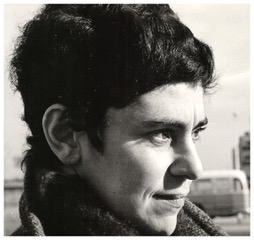
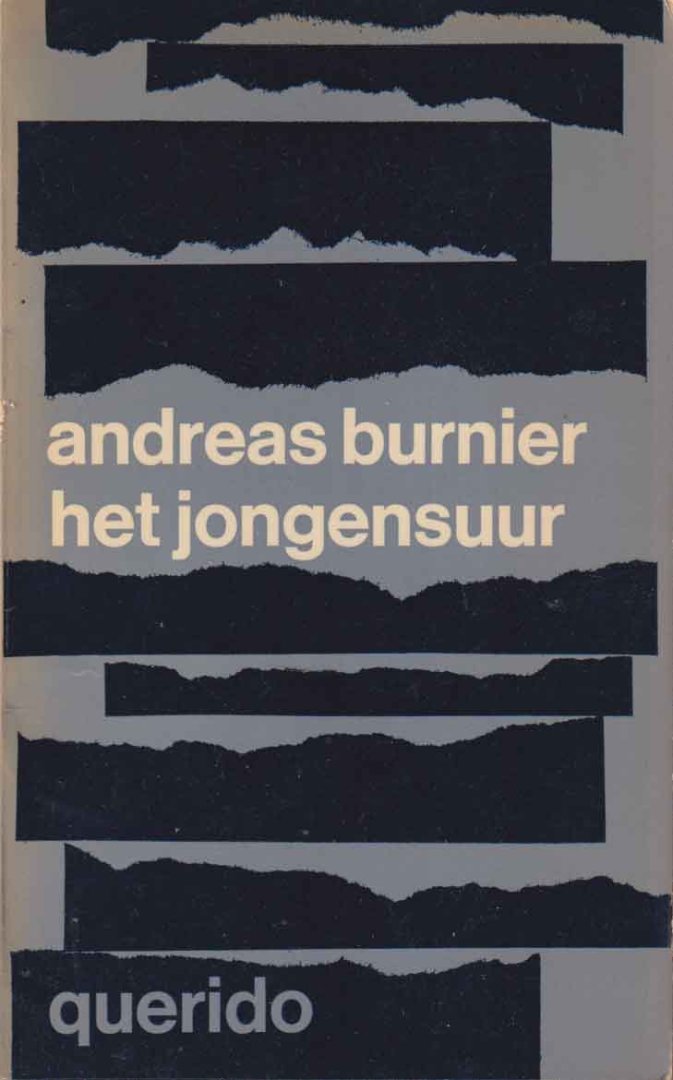
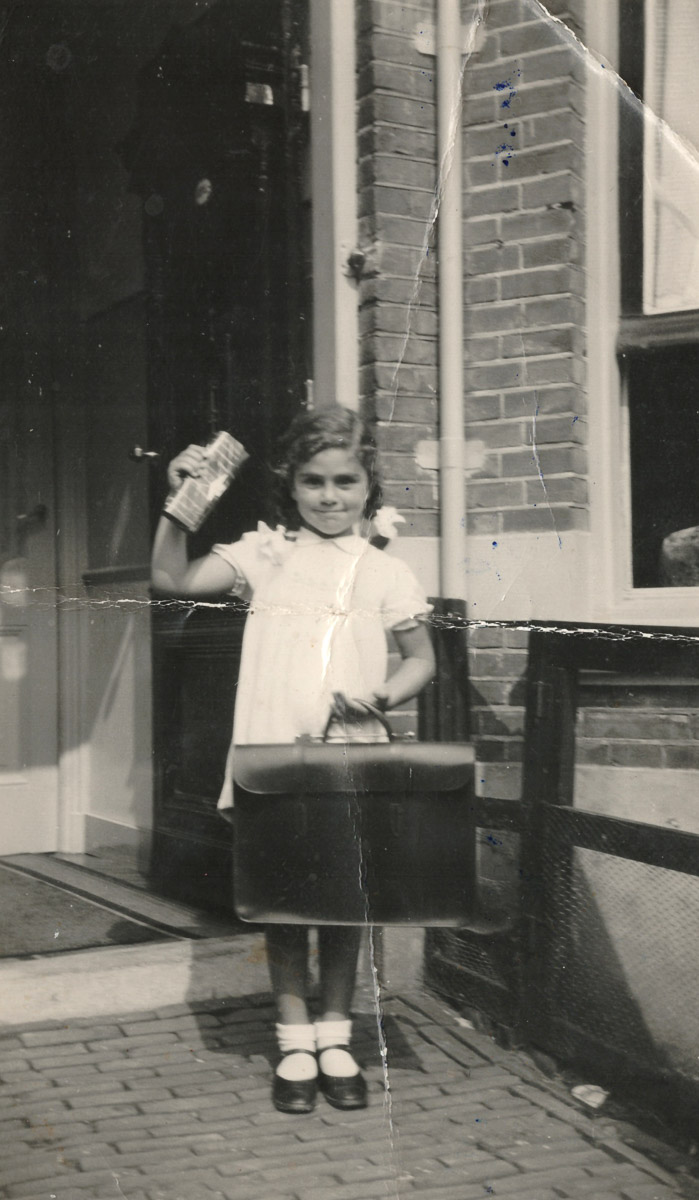
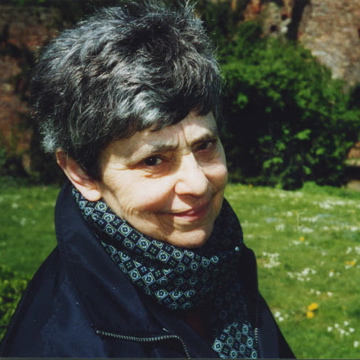
Photo credits
Book cover: “Het jongensuur”
Year: 1969
Publisher: Querido
Author: Andreas Burnier
‘Irma Dessaur in front of her parents’ house on her first day at school. Aged 7.’
Year: 1938
Collection: Private collection
Photographer: Unknown
“In Zutphen”
Year: 2001
Collection: Private collection
Photographer: Daniel van Mourik
Contrarian Jewish feminist, polemicist, novelist, and criminologist, Andreas Burnier rejected the prevailing gender norms and felt most comfortable in a man’s suit. Burnier’s literary work remains of lasting importance to lesbian, transgender, and gender-diverse people.
Biography
Author: Agnes Cremers, with Daniel van Mourik
Preferred to be a boy
Andreas Burnier was born into a liberal Jewish family in The Hague in 1931 as Catharina Irma Dessaur. As a child, in a time when gender roles were still rigidly defined, she did not feel at home in her girl’s body and would rather have been a boy. The Nazi German occupation (1940–1945) had a deep impact on her youth. On account of her Jewish background, she had to go into hiding. This meant being separated from her parents and living at no fewer than 16 different addresses in just a few years. Having used the alias Ronnie van Dijk during the war, she decided to keep using it afterwards. She was able to see her parents again in 1945, but many of her relatives had been murdered.
After the war, Burnier initially wanted nothing to do with her Jewish background. Nor would it have been of any help to her during the post-war reconstruction period in the Netherlands. She began studying medicine and philosophy in Amsterdam but broke off both studies prematurely. In the 1950s, she took refuge in marriage: at the age of 22, she married the publisher J.E. Zeijlmans van Emmichoven. They had two children together. They divorced in 1961, but the marriage had also brought her something valuable besides the children: she had come to know her father-in-law, a pioneer of anthroposophy in the Netherlands. This philosophy, which sees the human being as a unity of body, soul, and spirit, remained influential for Burnier throughout her life.
A lesbian adventure novel
After her divorce, Burnier studied philosophy in Leiden and then earned a doctorate in criminology. While working on her dissertation, she found her first love with a woman, Paul Franssen, with whom she had a relationship for 17 years.
Under the pseudonym Andreas Burnier, she published her debut novel in 1965: Een tevreden lach (A satisfied smile). The book immediately earned her the Lucy B. and C.W. van der Hoogt Prize. The natural and playful way in which Burnier described female homosexuality, was striking and exceptional at that time. With a healthy dose of humor, she carries the reader along in the coming-of-age story of the rebellious and lesbian Simone, who likes to present herself as a boy and refuses to allow herself to be forced into the stereotypical role of woman: “For a woman there is no place in the world but in the kitchen, in bed, and in church. There are no female geniuses, no creative artistic innovators or reformers of society to serve as examples. If a woman achieves something, people ask why she has no husband or why she does not devote her time to him. Blah, blah, baloney.”
But Een tevreden lach is more than a coming-of-age novel. Burnier’s biographer Elisabeth Lockhorn describes it as an adventure novel about the life of a lesbian young woman. Whereas earlier lesbian novels often ended in tragedy, suicide, or hopelessness, Burnier’s approach was entirely new. It is also possible to find signs of Burnier’s inclination towards mysticism within the book. It is not so much about the body as about the discovery of the spirit.
Oppression as a source of inspiration
Burnier described her novel Het jongensuur (The boys’ hour, 1969) as her most autobiographical work. In writing it, she processed her own struggle with identity: the Jewish Simone has to go into hiding during the Second World War and tries to free herself from her girl’s body. At every new hiding address, she plays with her identity, convinced that she really should have been a boy. A fragment:
A little later the lifeguard whistled me out. The boy was standing next to him, and other interested parties came over. All of them in swimming trunks, I saw.
“She has to get out. She’s a girl,” said the fattest boy.
“You heard him,” said the lifeguard. “You have to get out. It’s boys’ hour now. You saw that, didn’t you?”
Humiliated, I got dressed again. The bastards.
Burnier saw the oppression she had gone through as a source of inspiration for her work: “It is always a privilege to be born into an oppressed group. For someone who belongs to the ruling caste, it is much more difficult to ever come to any insight of importance.
Professor
From 1973 to 1988, Burnier was a professor of criminology at the Catholic University of Nijmegen. She held that position under her legal name: Dessaur. Her appointment there as a professor was not without difficulty: two testimonials have been preserved in which her homosexuality and the works of fiction she had published were seen as problematic.
Burnier became known for both her erudition and her recalcitrance. Her appearance was striking, with her cropped hair and her dark-blue suits worn with low black shoes. Students were eager to hear the author of Een tevreden lach and Het jongensuur speak. Her later lover with whom she would live for 19 years, publicist Daniel (Ineke) van Mourik, recalled one of Burnier’s lectures that she attended: “When Prof. Dessaur goes to stand behind the lectern in her sturdy shoes and men’s jacket—which she now and then pulls down over her buttocks—I see a self-assured, yet at the same time shy and awkward woman. She is a remarkable appearance in the male academic world. […] When Dessaur begins to speak, with a voice that is warm, exotically Hague-based, and rich in language, the whole gloomy hall is charged with intelligence, knowledge, wisdom, and humor.”
Not in a box
Towards the end of the 1980s, Burnier began to experience a passionate pull towards Judaism. Driven by her increasing interest in the religion of her youth, she began learning Hebrew, immersed herself in classical Jewish texts, and helped establish Crescas, a Jewish educational center in Amsterdam. Already in her essay Het joodse levensgevoel (The Jewish sense of life), from 1985, she wrote that the aim of the human being was to find “the Unnamable.” Her 1997 novel De wereld is van glas (The world is made of glass) was the first time since Het jongensuur that she had written wrote about her Jewish background in a novel.
Alongside her work as both a novelist and a scholar, Burnier published countless essays through which she engaged in social debate. Among other things, she opposed the Dutch law that allows euthanasia under certain conditions. For her, the human soul and spirit had to be protected. She feared a slide towards easy solutions and argued for better palliative care instead. In doing so, she could sometimes come across quite radically, by equating euthanasia with Nazi practices, She ended one televised debate on assisted suicide with the words: “Thou shalt not kill.”
Emancipation
Feminism was always a self-evident theme for Burnier: “Our culture is so self-evidently masculinist that people have always acted as if feminism were something exceptional.” While Burnier is seen as one of the forerunners of the second wave of feminism, she was not wholly absorbed by the movement. She was not in favor of abortion at will, for example, a position that many feminists held against her.
Burnier was nevertheless praised for her commitment to emancipation. In 1993, she was awarded the Bob Angelo Medal, established by the COC, for her services to the LGBTQI+ community. When the first working group for women who found themselves in the wrong body was founded in 1994, she was asked whether it could be named after her book Het Jongensuur. Burnier considered it an honor.
Andreas Burnier still counts as a source of inspiration for lesbian women, non-binary people, and transgender people, yet she herself resisted such labels. As Dutch literary critic Xandra Schutte has written: “One can wonder whether Burnier’s desire to be a boy was connected to the narrow mold that women were expected to fit into in those days. Perhaps today she would have been transgender, as they say now, or something between man and woman. But more likely Andreas Burnier would have seen those new labels too as signs of ‘rigidity, limitation, confinement.’”
Burnier died of a cerebral hemorrhage at the age of 71. She is buried in the Liberal Jewish Cemetery in Hoofddorp.
Literature and sources
Website: Stichting Andreas Burnier
‘Vrouw met baard,’ Xandra Schutte. De Groene Amsterdammer, 2015 (34).
‘Speech bij de presentatie van Andreas Burnier, Elk boek is een gevaar, samengesteld door
Ronit Palache, zondag 18 september 2022 De Balie te Amsterdam’, Daniel van Mourik, 2022.
Elk boek is een gevaar, samengesteld door Ronit Palache, 2022.