
Janine Wegman
zij/haar1925 – 2007
Many Rotterdammers have fond memories of Janine Wegman, an extravagant street performer. Being trans and intersex, Janine had to fight hard to be legally recognized as a woman. She remained a lifelong advocate for transgender rights.
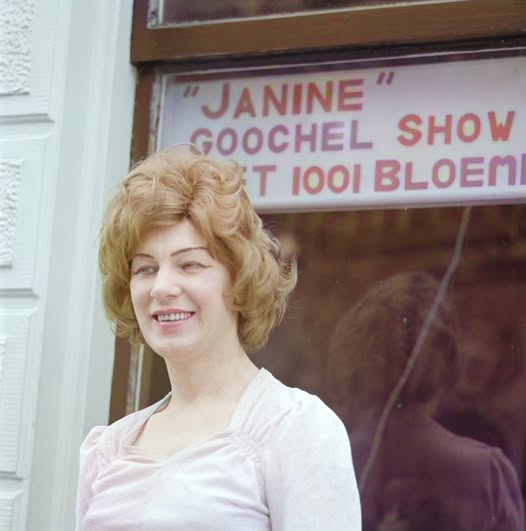
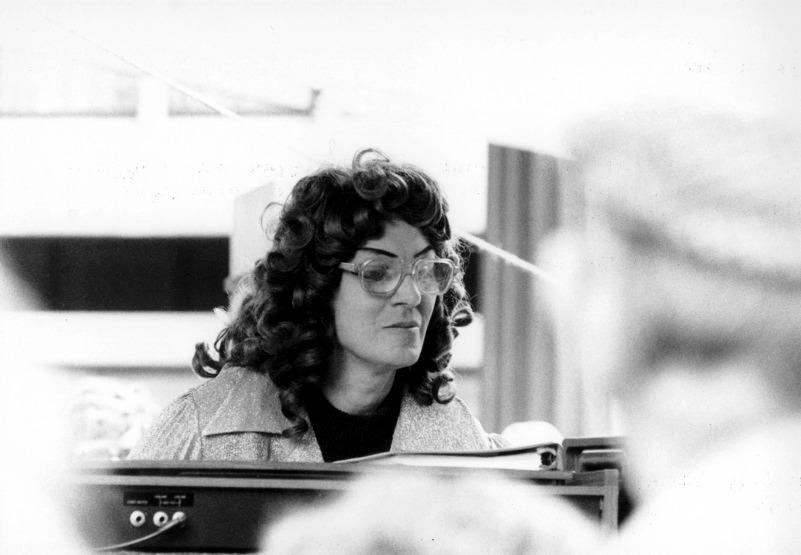
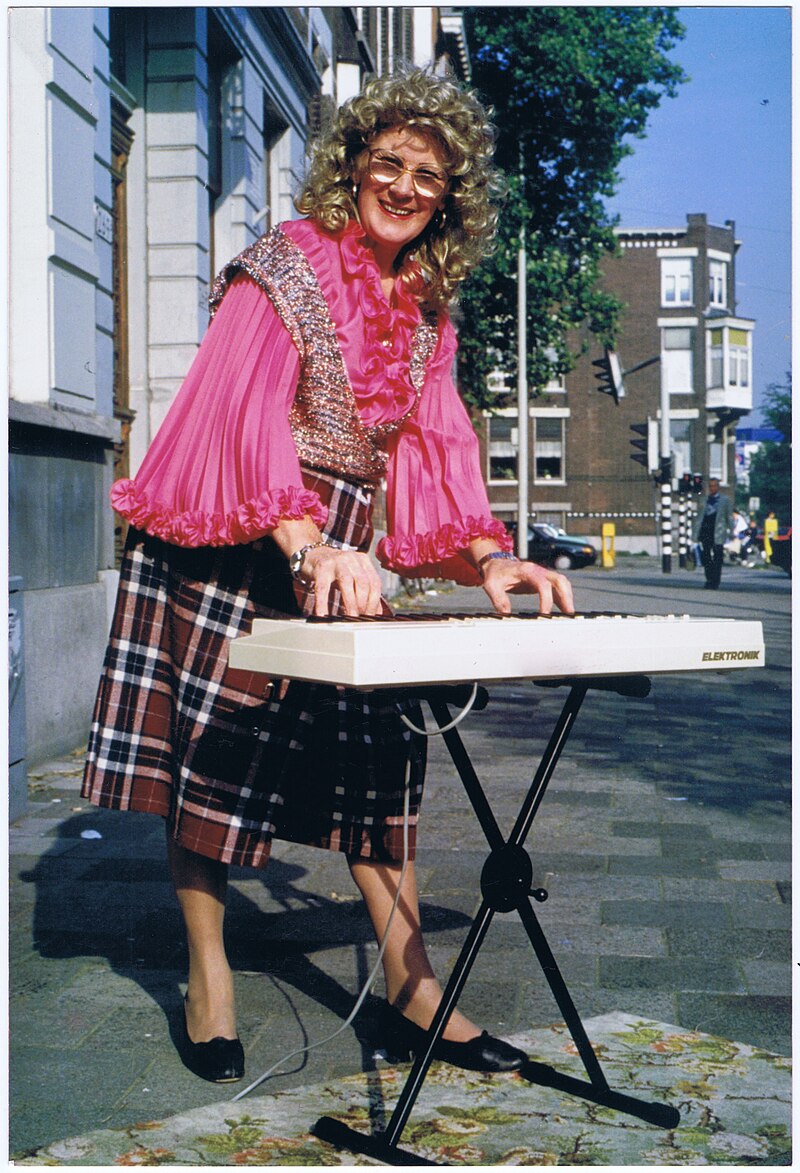
Photo credits
“Portrait of the transgender artist Janine Wegman. On 03-08-1974 an electronic drum kit was stolen from the car while she was setting up the equipment for a performance on the Schouwburgplein.”
Year: 1974
Collection: Rotterdam City Archives
Photographer: Ary Groeneveld
“During the inner-city day, organist Jeanine Wegman plays on the Hoogstraat”
Year: 1977
Collection: Rotterdam City Archives
Photographer: Alex de Herder
“Janine Wegman performs with her keyboard in front of the door of her house on the Bergweg in Rotterdam”
Year: Unknown
Collection: Public domain
Photographer: Roland Vonk
Many Rotterdammers have fond memories of Janine Wegman, an extravagant street performer. Being trans and intersex, Janine had to fight hard to be legally recognized as a woman. She remained a lifelong advocate for transgender rights.
Biography
Author: Arlo van Lierop
Trigger warning: This text discusses transphobia, discrimination and exclusion.
Janine Wegman was born in Rotterdam in 1925. At birth, doctors decided it was not possible to classify her body as being that of either “girl” or “boy.” A binary division was the norm, and the bodily autonomy of the child was not a matter of discussion. This medical norm prevailed until the late 1990s, when courageous people such as Bo Laurent began to publish about intersex experiences and question these medical practices.
For Janine, it was decided that she would grow up as “Rien”. The boy’s name and all the expectations that belonged to both that sex and gender did not suit her. From an early age she began dressing as a girl at home. After being caught at the age of 16 “tinkering with” a seven-year-old girl, she (“Rien”) was sent to Sint Bavo’s, a psychiatric institution. According to her own account, she had not meant any harm with the girl; she merely wanted to discover what a female body looked like. “It was about discovering what you do not have, and she does.” They hardly knew what to do with her at Sint Bavo’s, and the punishments were harsh. Her stay there instilled in her a fear of men.
Janine the Wonder Woman
During the Second World War, Wegman began her career as an entertainer, performing as a magician together with her first wife, Janine, from whom she would later adopt her name. On stage, she (“Rien”) was already appearing in women’s clothing as “Janine the Wonder Woman,” but in her private life she struggled to suppress her desire.
A neighbor spread gossip about a mysterious woman who secretly came to the house when Janine (i.e. the first wife) was alone. That woman was, of course, Janine (“Rien”) herself, dressed in her wife’s clothes. The marriage ended, and a second marriage also did not last—partly because of Wegman’s tendency to wear women’s clothing.
Each marriage produced one child, and neither child wanted any further contact with Wegman which was a source of great sorrow for her. Her parents and older brother rejected her as well. She was not even welcome at her own mother’s funeral.
“I was so disillusioned by all those disappointments that in the end, none of it mattered to me anymore. The only thing I still wanted was to be a woman. And to desire a woman.”
From the late 1950s onward, Janine received hormone tablets from Dr. Otto de Vaal of the Gender Clinic at Amsterdam’s VU University, and she began to live fully as a woman. This frequently brought her into conflict with the police. They used a ban on “appearing in disguise or masked” as a way to suppress cross-dressing and often targeted Janine specifically. Physical confrontations with the police eventually led to a court case in which Janine’s appearance caused a stir.
“I’d colored my lips with red paper, and I’d blackened my eyes with licorice from the Salvation Army—the kind they used to give us at the institution. I’d made earrings from the foil that comes around chocolates. They asked me to remove my disguise, but I told them it wasn’t a disguise.”
Recognition
Over the years, the incidents with the police decreased, and Janine also experienced greater tolerance in public. Now that she had reached this level of social acceptance, it was time for official recognition. From the 1970s onward, she fought for a legal name change and a “V” (for vrouw = female) in her passport. The name change was achieved through legal proceedings, but the “V” proved more difficult. Time and again, she appeared at the city hall to persuade officials to change her legal sex. To reinforce her argument, she would reveal her breasts. At her first attempt, an official manually scratched a “V” into her passport, but this had no legal validity.
In 1995, she was told that she could only obtain a “V” if she provided official documents proving her gender transition—which she did not have. As a result, she underwent surgery, as far as her intersex condition still allowed. It was only in 1996, after she had once again appeared topless at the city hall and threatened to commit suicide, that her gender marker was officially changed. Janine was then 70 years old and would only be able to enjoy her new status for a few more years.
Janine Wegman she died in 2027 at the age of 81, after having been admitted to Rotterdam’s Antonius Binnenweg nursing home four years earlier with dementia. Her theatrics at Rotterdam’s city hall had regularly made the newspapers for years, often accompanied by full-page photographs of her standing topless at the counter. In contrast, her final appearance in a paper—in the Dutch daily Algemeen Dagblad of May 28, 1996—was short: “Wegman finally officially a woman.”
Bird of paradise
In 1992, Janine appeared on the Dutch TV program Paradijsvogels (Birds of paradise), which featured colorful individuals with remarkable life stories. During the broadcast, which followed Janine as she once again attempted to secure recognition at Rotterdam’s city hall, passers-by were asked whether they knew Janine Wegman. Everyone said yes. They knew her as the woman who played the street organ, as a pleasant person, a remarkable woman. Janine was someone who sought out an audience. It is therefore easy to dismiss her decades-long struggle for recognition as a provocation or publicity stunt—and perhaps she secretly enjoyed the attention.
That does not change the fact that her tireless efforts to obtain that “V” in her passport, at great personal risk, laid the foundations for something that has since become almost self-evident for many trans people today. Janine was happy to “finally be able to do justice to her name.” At last, she could travel without worry and share a hotel room with her partner without police officers giving her any more trouble. Every trans person today knows how significant that is—and that it amounts to far more than a spectacle, even for a born performer like Janine Wegman.
Literature and sources
‘Leestip: Dit is het bijzondere levensverhaal van Janine Wegman, mogelijk de eerste openlijke transseksueel van Rotterdam,’ Ronald Vonk. Rijnmond, 2021.
‘De Vrouw met een Foutje,’ Arnold-Jan Scheer. Paradijsvogels, 1992.
‘Janine wil weer werken,’ Het vrije volk : democratisch-socialistisch dagblad, 05 jan 1978.
‘Janine wil opnieuw een V in zijn paspoort,’ Algemeen Dagblad, 18 aug 1995: p.3.
‘Wegman eindelijk officieel vrouw,’ Algemeen Dagblad, 28 mei 1996: p.3.