
Anna Blaman
zij/haar1905 – 1960
Rotterdam writer, playwright, and theater teacher Anna Blaman became a household name by writing candidly about her own life as a lesbian. In doing so, she made a major contribution to Dutch literature and gay and lesbian emancipation in the Netherlands.
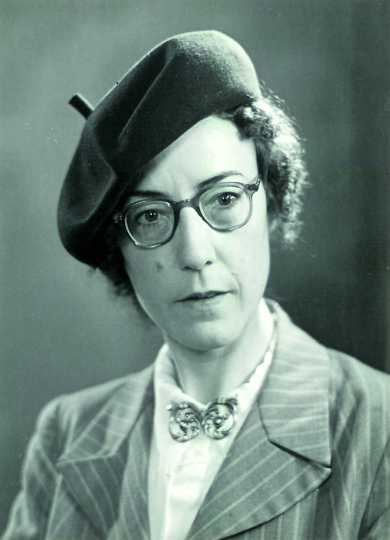
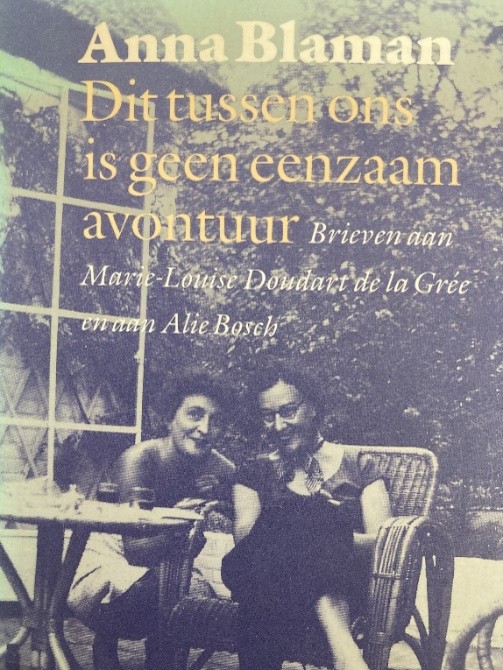
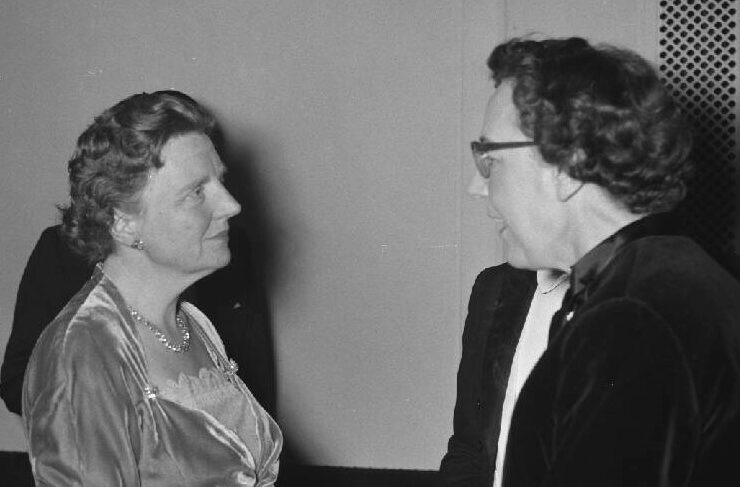
Photo credits
Portrait “Anna Blaman with beret”
Year: 1947
Collection: Literatuurmuseum
Photographer: C. Kramer
Cover Dit is tussen ons is geen eenzaam avontuur. Anna Blaman.
“Book Ball at the Stadsschouwburg in Amsterdam, in the presence of Queen Juliana. Queen Juliana in conversation with the writer Anna Blaman”
Year: 1958
Collection: Anefo, National Archives
Photographer: Joop van Bilsen
Rotterdam writer, playwright, and theater teacher Anna Blaman became a household name by writing candidly about her own life as a lesbian. In doing so, she made a major contribution to Dutch literature and gay and lesbian emancipation in the Netherlands.
Biography
Author: Emma van Zalinge
Anna Blaman wrote poems, short stories, and novels. She was also a courageous and pioneering lesbian role model. Rather than concealing her orientation in a time when people pretended that female homosexuality did not exist, she lived her life openly as a lesbian.
“I swear I will try to be as purely myself as I can”
Anna Blaman, the pseudonym of Johanna Petronella Vrugt, was born in Rotterdam on January 31, 1905. She was the second of three children. Her father, Pieter Vrugt, owned a few bicycle shops. After his death, when Anna was twelve, her mother sold the shops and began running a boarding house. From 1928 onward, her boarding house was located at 50a De Vliegerstraat in Rotterdam; Anna would live there in a room of her own for the rest of her life. At the age of 17, she fell in love with a girl, but their relationship went no further than friendship. Her sister Corrie wrote that their mother had reacted positively to Anna’s coming out and that the topic was not discussed further after that.
After staying with her aunt in Brussels at the age of 18, Anna wrote: “I swear that for the rest of my life I will try to be as purely and courageously myself as I can.” Her aunt had insisted that she go to the theater “looking like a fashionable young woman, in high heels, with carefully styled hair, wearing a lace dress with a low neckline.” Anna recalled sitting in the theater “with death in my heart,” primarily because she had not refused to take part in this “charade.”
Talented and in demand
After secondary school, she attended a teacher-training college and eventually worked as a teacher at several elementary schools. When she was admitted to the Bergweg Hospital in Rotterdam with a kidney condition in 1936, the nurse who cared for her was Alie Bosch, with whom she began a relationship.
Because of her weak health, she did not seek a new job, although she did obtain a secondary teaching qualification in French during the Second World War. She gave private lessons at home and earned her living through her literary and journalistic work, as a dramaturge, and by giving lectures. She was a talented, much sought-after speaker. She was sympathetic, had a sense of humor, and was a good listener to those who had problems.
Toward the end of the war, Alie Bosch fell in love with a dance instructor, which led to a break with Anna. Their friendship would only stabilize again in the early 1950s and lasted until Anna’s death. Starting around 1948 she had an erotic relationship lasting several years with a married writer, Marie-Louise Doudart de la Grée.
Anna died in 1960 from the effects of a cerebral hemorrhage and was buried at Rotterdam’s Hofwijk cemetery. The origin of her pen name is a carefully guarded secret. It is said to stand for “Ben Liever Als MAN” (“I prefer being a MAN”), though other theories also exist.
“Lesbocode”
In 1941 she made her debut with Vrouw en vriend (Woman and friend), in which she processed her (short-lived) relationship with a woman who recited texts on stage. The main character in the novel—Anna’s alter ego—is a man. When it became clear that she had written about her relationship with a woman, the book served as a “code” in lesbian circles. Having it on one’s coffee table signaled that one was attracted to women.
The break with Alie Bosch prompted Anna to write Eenzaam avontuur (Lonesome adventure) in 1948. The book was received with both praise and disapproval. Celebrated Dutch author Simon Vestdijk called it a masterpiece, but its (homo)erotic passages led to a considerable upheaval in the Christian press. Anna remained calm about it and initially even agreed to cooperate in a “book tribunal” held regarding the book in 1949. She had assumed that would be “a serious debate between two literary experts,” so when she saw what charges were being brought against her, she withdrew. It must have caused her pain. She took comfort in the fact that “the press unanimously expressed outrage at such cultural vandalism.”
Veiled
The municipality of Amsterdam awarded the book the Amsterdam Prize for Prose in 1949. She would receive that prize again in 1956 for Op leven en dood (publish in English as A Matter of Life and Death). That same year she was awarded the most prestigious Dutch national literary recognition, the P.C. Hooft Prize, for her entire body of work.
While her novels and short stories are largely autobiographical, she wrote in a veiled manner about being lesbian. When writing about relationships with her lovers, she “disguised” herself as a man involved in a (heterosexual) relationship with a woman. Love between two women was only suggested.
’t Mandje
In real life Anna did not conceal her lesbian orientation at all: she had brief affairs with women, she often wore trousers, and she rode a motorcycle, which was unusual for women at that time. Together with her friends she was a regular customer at Bet van Beeren’s Café ’t Mandje in Amsterdam.
By expressing herself in ways that were considered inappropriate for women in the 1950s, she inspired women to free themselves. Women in that period were not expected to have sexual feelings, let alone to show them, or to write about them. It was already hard enough for women to build an economically independent life at that time, let alone to create a life together with another woman—if such an idea even occurred to them.
Courageous and pioneering
Perhaps her greatest achievements are that she presented herself as she was and wrote about homosexuality as something just as self-evident as heterosexuality Nearly all her novels and stories have homosexual and lesbian characters who are not ashamed about their sexual identity and do not beg for acceptance or understanding. Through her self-confidence and the openness with which she lived her homosexuality, she serves as a courageous and pioneering lesbian role model.
An archive on homosexuality founded in Leeuwarden in 1983 was named the Anna Blaman House. In 1992 it became part of IHLIA LGBTI heritage. At the beginning of this century, renewed interest in her work emerged. To mark the 50th anniversary of her death, 2010 was proclaimed the “Anna Blaman Year” and Eenzaam avontuur was republished.
Literature and sources
Anna Blaman over zichzelf en anderen, Meulenhoff Pockets 122, 1963
Anna Blaman. Dit tussen ons is geen eenzaam avontuur: brieven aan Marie-Louise Doudart de la Grée en aan Alie Bosch, ingeleid en bezorgd door Aad Meinderts, Meulenhoff Amsterdam, 1990
https://www.literatuurgeschiedenis.org/schrijvers/anna-blaman
https://literatuurmuseum.nl/nl/ontdek-online/literatuurlab/online-exposities/anna-blaman/intro