
Jacob Anton Schorer
hij/hem1866 – 1957
In 1912, Jacob Anton Schorer founded the first Dutch organization to confront discrimination against homosexuals and promote knowledge about sexuality, gender and sex diversity.
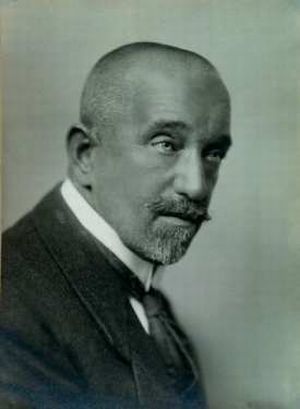

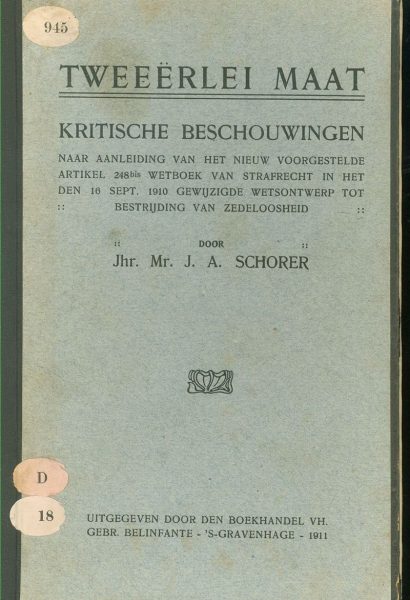
Photo credits
Portrait “Jacob Anton Schorer”
Year: +/- 1920
Photographer: Unknown
Source: Public Domain
Schorer’s desk
Collection: IHLIA LGBTI Heritage
Title: Tweeërlei maat
Author: Jacob Anton Schorer
Year: 1911
Collection: IHLIA LGBTI Heritage
In 1912, Jacob Anton Schorer founded the first Dutch organization to confront discrimination against homosexuals and promote knowledge about sexuality, gender and sex diversity.
Biography
Author: Mark Bergsma
A young nobleman “of highly immoral tendencies”
Jacob Anton Schorer was born into an old and illustrious family in Heinkenszand, in the Dutch province of Zeeland, on March 1, 1866. After his father had been ennobled in 1893, Jacob was himself entitled to use the Dutch noble honorific jonkheer (esquire) before his name. He studied law at Leiden University, earning his doctorate there in 1897. In that same year, he became a lawyer and solicitor in Middelburg. His legal career, however, was short-lived: in 1903, the 37-year-old Schorer was suspected of having had sexual contact with an underage boy. Although no proof was given, being labeled a man “of highly immoral tendencies” damaged his reputation to such an extent that he requested an honorable discharge from his position and left for Berlin.
Scientific activism
In Berlin, he immersed himself in the study of sexology at the Wissenschaftlich-Humanitäres Komitee (Scientific-Humanitarian Committee; WHK), the world’s first organization to advocate for the emancipation of homosexuals. The WHK had been founded in 1897 by pioneering Jewish-German physician and sexologist Magnus Hirschfeld, who was himself homosexual.
The organization fought against the criminalization of homosexuality and worked to promote public education and a broader social acceptance of homosexual people. It was here that Schorer became acquainted with the then-revolutionary—but now outdated—theory of the “third sex,” in which homosexuals were seen as an intermediate sex between men and women. Through Hirschfeld, he also learned that homosexuality was regarded as an innate characteristic and for that reason should not be punishable.
During these years, Schorer remained closely connected with his native country. In 1904, he published an article in a Dutch legal journal, Themis, in which he criticized the lack of knowledge about homosexuality in the Netherlands: “In general, the most absurd misconceptions still prevail in the Netherlands on this matter.” For Schorer, this made it clear that much work still needed to be done in the Netherlands.
Article 248bis
In the initial period after his return, Schorer focused on combating Article 248bis of the Dutch Penal Code, which discriminated against homosexuals. This article was part of the so-called morality law introduced in 1911 by the Dutch minister of justice, Robert Regout, a Catholic. The article prohibited sexual contact between adults and minors of the same sex, raising the age of legal maturity for such contact from 16 to 21 years. For heterosexuals, however, the minimum age for sexual contact remained 16. In this way, the law created a sharp distinction between heterosexual and homosexual people.
Schorer spoke with several members of parliament and published the pamphlet Tweeërlei maat (Double standard), in which—based in part on the knowledge he had gained in Berlin—he protested against Article 248bis. Unfortunately, his efforts were in vain; the article was nonetheless enacted. That summer, he wrote with disappointment: “Wherever ecclesiastical influence asserts itself, any broader, freer conception of life comes to an end.”
Through science to justice
Schorer remained undiminished in his determination. In 1912, in response, he founded a Dutch branch of the WHK. That would continue independently as the Dutch Scientific-Humanitarian Committee (NWHK) after 1919. Like its German counterpart, the NWHK fought for equal rights for homosexuals. For that reason it is regarded as the Netherlands’ first advocacy organization for homosexuals.
Schorer was the driving force behind the NWHK. Despite the difficult path he followed with the organization, he remained optimistic. He was convinced that knowledge was the key to breaking down prejudices regarding homosexuality and to building a more tolerant society. This conviction, which he held throughout his life, was also reflected in the organization’s motto: “Through science to justice.”
Accordingly, the NWHK focused primarily on the distribution of scientific literature, annual reports, and pamphlets among students and certain professional groups, such as lawyers and physicians. The first pamphlet—outlining what everyone should know about ‘Uranism’ (a term from those days denoting homosexuality)—set out the organization’s mission. Schorer’s passionate tone is clearly recognizable there: “[…] We undertake this struggle, sustained by the firm and unwavering conviction that it is necessary, that true morality demands it, and that it must and shall one day lead to victory.”
His belief in the collection and dissemination of knowledge inspired Schorer to build his own library. In 1922, he published a catalogue describing numerous scholarly works on (homo)sexuality as well as works of literature. Schorer’s library was thus a valuable addition to existing Dutch collections, which at the time contained scarcely any literature on homosexuality. His catalogue remains highly important for contemporary research: it shows how much had already been written about homosexuality before the Second World War.
Honorary member of the COC
Schorer destroyed the archives of the NWHK in the spring of 1940. This decision proved not to have been premature: the Nazis confiscated his library within the first month of the German occupation. At that moment, the collection had comprised 1,880 works. Only later in the war did Schorer discover that the library had been transported to Berlin. After 1945, he made several attempts through Dutch authorities to recover his collection, but without success. It remained a lasting source of frustration for him.
With the end of the war, Schorer also ceased his activities for the NWHK, apart from a final pamphlet, Equality of Rights, Here Too! (1946). In that same year, the work of the NWHK was continued by the so-called Shakespeare Club, the precursor of the later COC, of which Schorer was made an honorary member. By then, he was living in Harderwijk, where he spent his final years in various boarding houses. Although he became increasingly isolated, he continued to follow developments in LGBTQ+ emancipation closely. He died in 1957 at the age of 91.
The legacy of Jacob Schorer and his early struggle for emancipation was not forgotten by the next generation. Ten years after his death, in 1967, the Schorer Foundation was named in his honour. From 1984 onwards, streets bearing his name also began to appear in the Netherlands. In 2000, IHLIA took on the task of reconstructing his cherished library, consisting of books, grey literature, journals, and journal articles. Dutch scholar Theo van der Meer published a biography of Schorer in 2007.
Literature and sources
Th.A.M. van der Meer, ‘Schorer, jhr. Jacob Anton (1866-1957)‘, in Biografisch Woordenboek van Nederland, 12-11-2013.
IHLIA LGBTI Heritage, Schorerbibliotheek.
John Töpfer, Roze adel: jonkheer mr. Jacob Anton Schorer (1866-1957), 3 augustus 2024.