
Mary Zeldenrust-Noordanus
zij/haar1928 – 1984
Under the leadership of Mary Zeldenrust Noordanus, the Dutch Society for Sexual Reform (NVSH) played a vital role in promoting the acceptance of sexual diversity and the fight for equal rights.
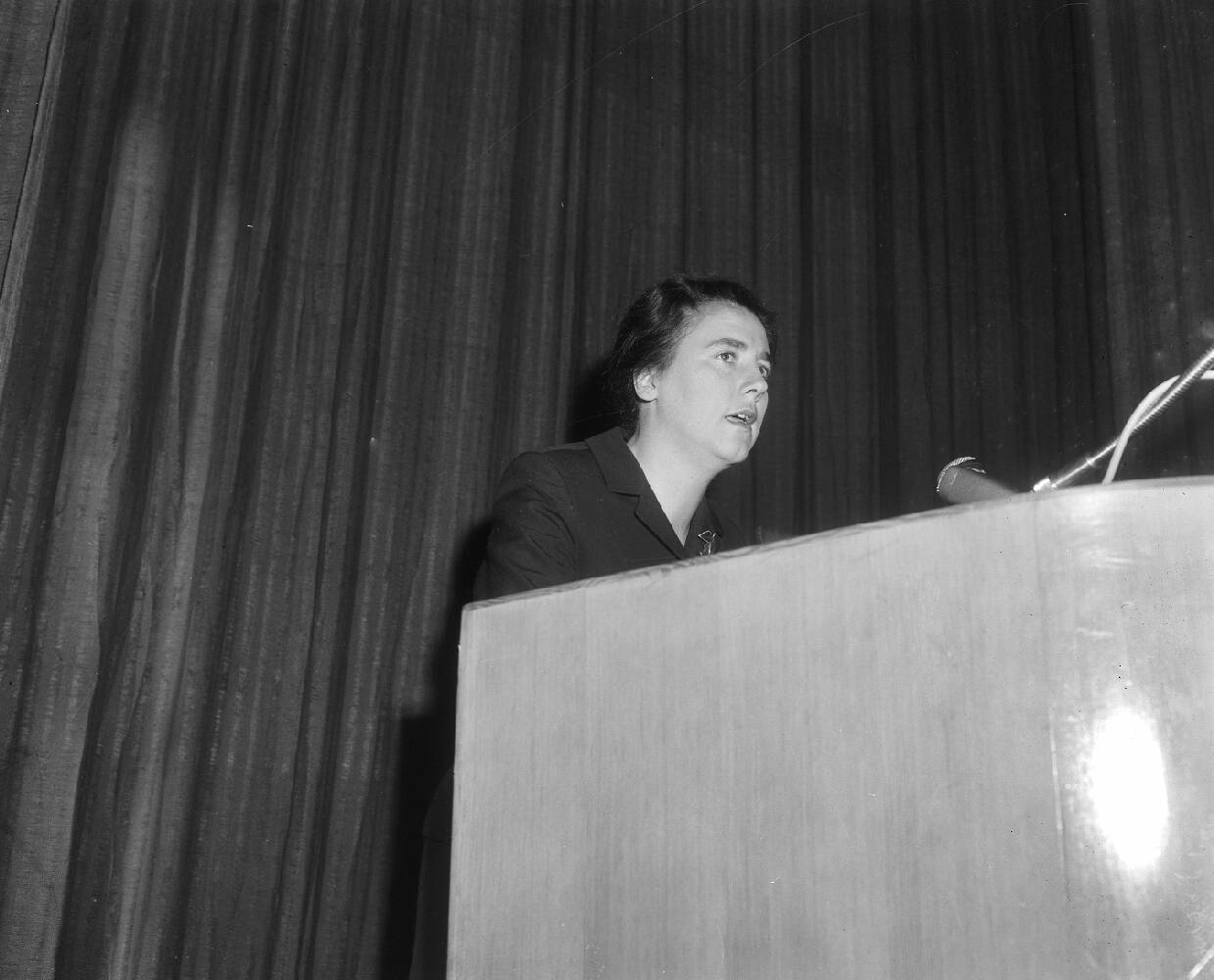
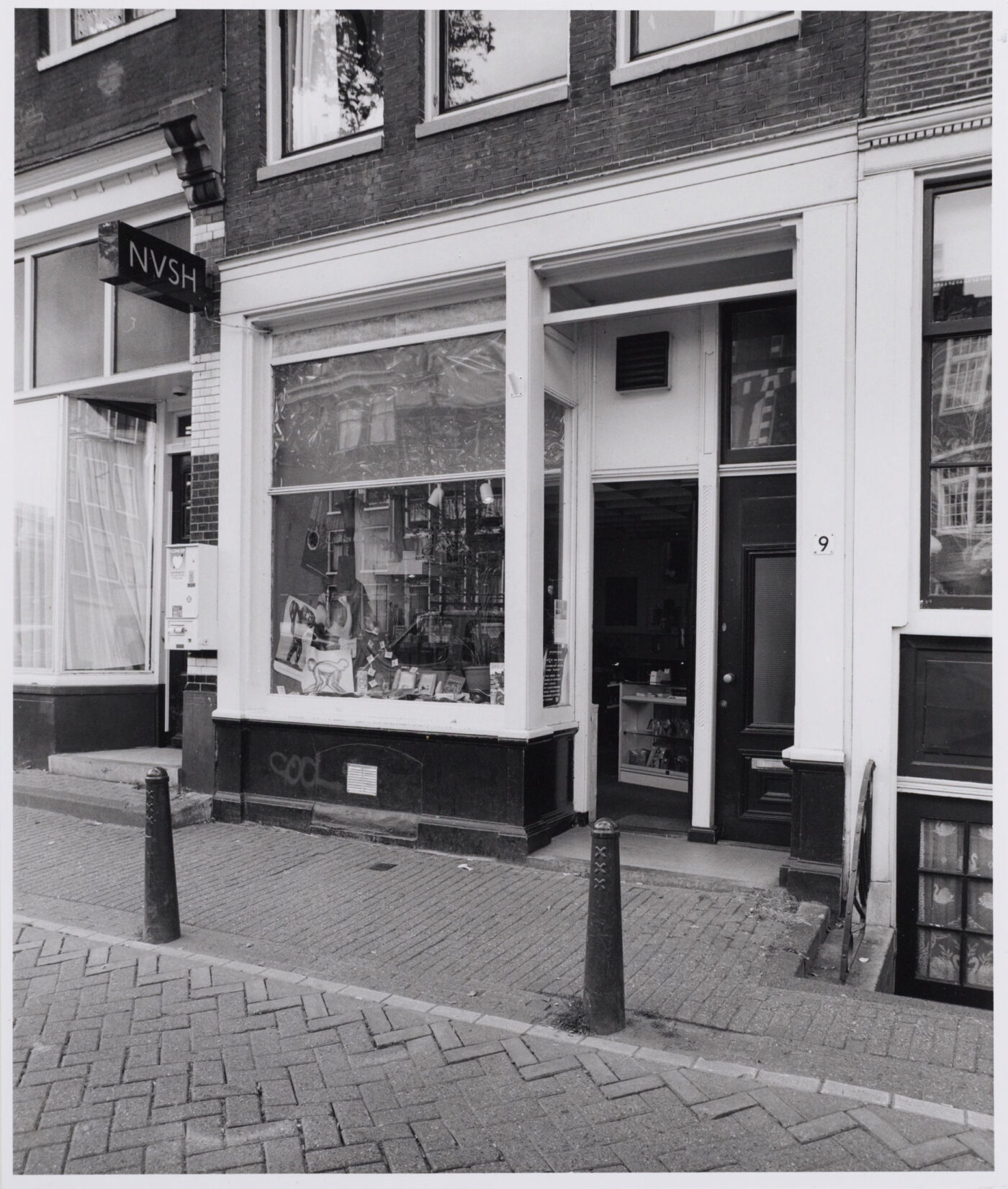
Photo credits
“Studieconferentie van de NVSH, de Nederlandse Vereniging voor Seksuele Hervorming, in de RAI te Amsterdam”
Year: 1965
Collection: Anefo, National Archives
Photographer: Joop van Bilsen
“Kantoor en informatie centrum van NVSH (Ned.Ver.voor Sexuele Hervorming)”
Year: 1998
Collection: Amsterdam City Archives
Photographer: Martin Alberts
Under the leadership of Mary Zeldenrust Noordanus, the Dutch Society for Sexual Reform (NVSH) played a vital role in promoting the acceptance of sexual diversity and the fight for equal rights.
Biography
Author: Agnes Cremers with Larissa Pans
Family
Mary Noordanus grew up in a broad-minded family in a well-to-do part of Amsterdam. During the Second World War, she was confronted with injustice at an early age. She lost many of her friends: “It was a dreadful time. Practically all my friends were Jewish. The reality was that Jewish teachers and students disappeared. It was a very direct confrontation with the people around you, who could be gone the next day.” From the war years, Mary would carry a lifelong aversion to what she referred to as “racial discrimination.”
In 1944, her father, Wim Noordanus, was arrested. Mary, then 16, took matters into her own hands and went to a high-ranking member of the German Sicherheitsdienst (SD) to plead for her father’s release. It was a bold move, but she succeeded in securing his release from Amsterdam’s Weteringschans prison. This made a strong impression on those around her, including her neighbor, the later writer and columnist Renate Rubinstein, who recalled: “For this girl I felt great admiration (…) A daughter with courage. I was tormented by self-reproach. Why did I do nothing?” Rubenstein’s own father had likewise been arrested by the Nazis but did not survive.
After the war, Mary studied psychology at the University of Amsterdam. At her part-time job—as an assistant in the psychology laboratory—she met her future husband, Dick Zeldenrust. They married and had two children: Michiel and Maartje Zeldenrust.
NVSH
Mary Zeldenrust-Noordanus would never become a housewife. She set up a practice as a psychotherapist and in 1958 became director of her own company: the Institute for Psychological Market Research. She also gave courses at the Dutch Society for Sexual Reform (NVSH), teaching birth control techniques to couples who were engaged to be married.
The NVSH had been founded in 1946 as a continuation of the Neo-Malthusian League (1881), which advocated birth control to counter overpopulation. This message was controversial in a Christian country like the Netherlands, where the prevailing belief was that it was up to God whether or not a couple would be blessed with children. The use of contraceptives was therefore a sensitive issue. For a long time, the Netherlands remained bound by a strict sexual morality, reinforced by the morality laws of 1911, in which abortion was heavily punished and homosexuality was discriminated against.
Sex education on television
In 1962, Zeldenrust-Noordanus became chair of the NVSH. There was widespread ignorance about sexuality. Mary therefore advocated better sex education and an open, democratic upbringing. In 1963, in one of the first television broadcasts on medical topics, she explained what a condom was and how it worked: “It’s a kind of latex sheath. That sheath is placed over the male sexual organ so that the semen, during ejaculation, does not enter the woman’s body but ends up in that sheath, thereby preventing fertilization.”
She also promoted the modern message of freedom of choice in sexuality and relationships. People should decide for themselves how they wanted to live and whom they fell in love with. She became the leading figure of the sexual revolution in the Netherlands, speaking at teach-ins (large public meetings) about sex and “homophilia,” as homosexuality was then called.
Opponents called her “Filthy Mary” because she spoke openly about condoms, abortion, and premarital sex. In her view, sex need not be aimed solely at reproduction; it could also be about pleasure and desire.
From the mid-1960s onward, society began to change rapidly. Religious divisions weakened and the influence of religion declined, including in matters of sexuality. The introduction of the contraceptive pill in the Netherlands in 1963—in cooperation with the NVSH—created new possibilities for family planning. Contraceptives were no longer only available through the NVSH. Under her leadership, the organization experienced substantial growth. By 1966, the NVSH had 200,000 members and 60 clinics throughout the country.
Through her media appearances, Zeldenrust-Noordanus became a national figure. The national newspaper Algemeen Dagblad even called her “the most talked-about woman in the Netherlands.” Her clear positions and openness provoked strong reactions. She received much praise but also fierce criticism and hate mail. This did not leave her unaffected: “I wasn’t prepared for that. You can easily ignore the first anonymous letter (…), but the number of those that I received—I really found that painful.” She nevertheless continued to speak out in favor of abortion rights, the acceptance of prostitution and homosexuality, and the breaking down of sexual taboos.
Fight against discrimination
In 1967 she made an important appearance at the NVSH congress “SEXtant ’67” in Amsterdam’s RAI convention center, where she pleaded for a genuine acceptance of homosexuality and the abolition of Article 248bis, the stipulation in the Dutch Penal Code that raised the age of consent for same-sex sexual behavior compared to that for heterosexual sex: “Article 248bis is therefore completely unacceptable. The acceptance of homosexuality does not mean that somewhat pitiable acceptance, because it simply cannot be otherwise, but rather the recognition of many—more than just heterosexual and homosexual—ways of being human.” The controversial article of law was ultimately abolished in 1971. In that same decade, the entire system of morality legislation was modernized.
Zeldenrust-Noordanus saw the COC—like the NVSH also founded in 1946—as a sort of younger sibling of the NVSH. When they both celebrated their respective 15th anniversary in 1962, the organizations exchanged congratulations and gifts. The COC received flowers and an envelope containing 200 guilders for its film fund; the NVSH received an electric clock.
For the emerging gay and women’s movements, Zeldenrust-Noordanus was seen as a pioneer, although she herself remained critical: “It has been set in motion, but it is far from complete.” For that reason she preferred not to use the term “sexual revolution”. As she put it: “It is not true that you can have a different way of life (…) without it provoking aggression in people.”
Private life
In her private life, too, Zeldenrust-Noordanus lived unconventionally. Not only was she a full-time working mother, but she was also bisexual. She and her husband had an open marriage and she had a passionate, long-term relationship with a married woman, An Muijlwijk. From 1969 onward, the two families formed a close, shared household in the spacious Zeldenrust home in Rotterdam.
In 1969 she stepped down as chair of the NVSH. “The Dutch are not very tolerant,” read a newspaper headline at the time, quoting the departing chair. By then, her Institute for Psychological Market Research had grown into a large company, and she would devote her time to that fully in the 1970s.
She remained committed to emancipation, but in the early 1980s, incurable breast cancer forced her to stop working. Characteristically, she spoke openly about this as well, once again on national television, intending to break the taboo surrounding cancer. She herself said that her illness gave her “greater attention to life itself,” and she took up gardening.
Mary Zeldenrust-Noordanus—the “instigator of the sexual revolution”—died in 1984 at the age of 55.
Larissa Pans is working on a biography of Mary Zeldenrust-Noordanus, to be published in Dutch by Balans in spring 2027.
Literature and sources
Larissa Pans werkt aan de biografie van Mary Zeldenrust-Noordanus, die in het voorjaar van 2027 bij uitgeverij Balans verschijnt.
‘Historicus en journalist Larissa Pans vertelt over Mary Zeldenrust.’ NPO Radio 1 Extra, 6 juli 2025.
‘Larissa Pans over Mary Zeldenrust.’ Illustere levens. 12 september 2025.
‘Mary Zeldenrust-Noordanus,’ Patrieck de Haan. With Pride, IHLIA LGBTI Heritage.
‘Interview met Mary Zeldenrust,’ VARA, 1983.