
Titia van der Tuuk
1854 – 1939
As a writer, translator, and activist, Titia van der Tuuk, a feminist freethinker from Groningen, played a special and decisive role in promoting both a healthy lifestyle and especially equal rights for women and homosexuals.
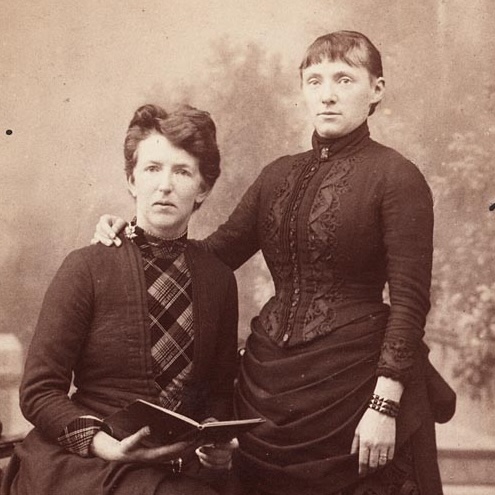
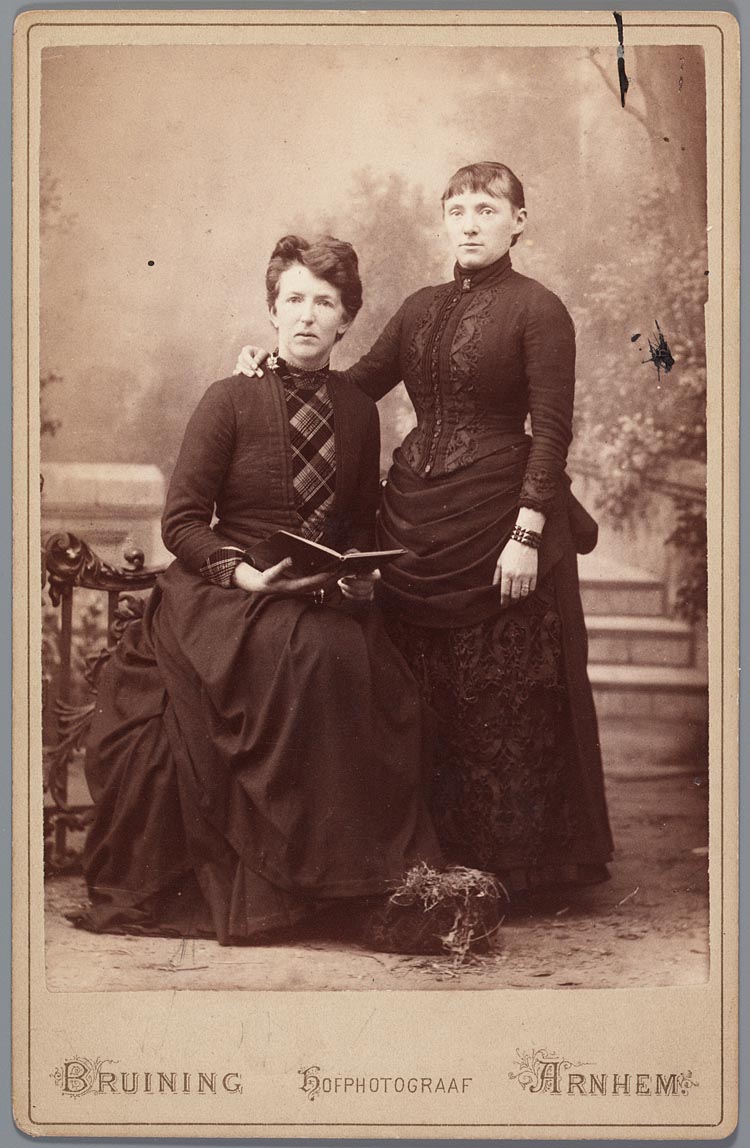
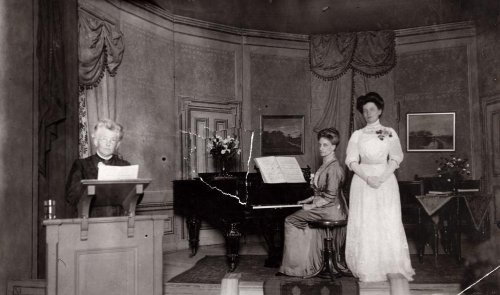
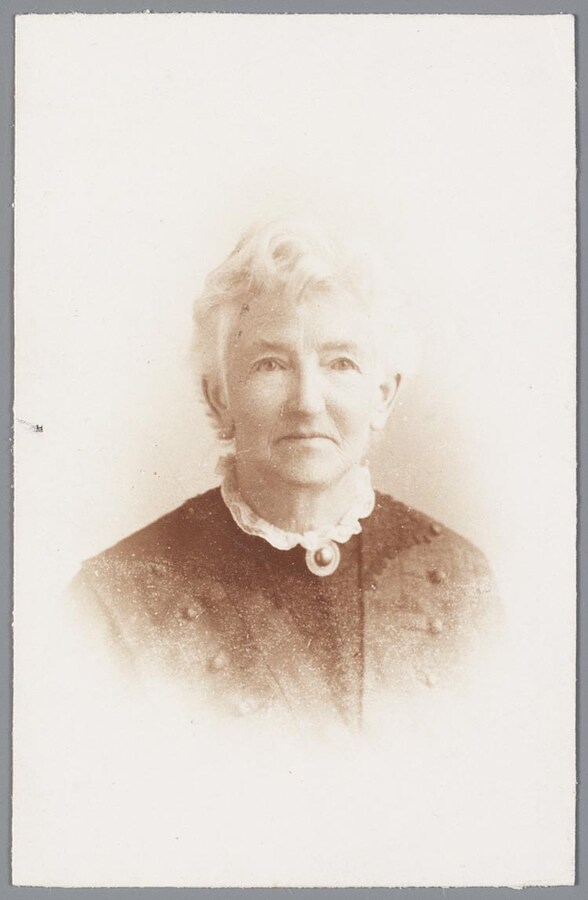
Photo credits
“Titia van der Tuuk and unknown woman”
Year: c. 1885
Collection: IISG
Photographer: Bruining fotografen, Arnhem
“Performance by the singer Alida Bertels during a meeting for women’s suffrage”
Year: 1911
Collection: Spaarnestad, National Archives
Photographer: Unknown
Portrait “Titia van der Tuuk”
Year: Unknown
Collection: Unknown
Photographer: Unknown
As a writer, translator, and activist, Titia van der Tuuk, a feminist freethinker from Groningen, played a special and decisive role in promoting both a healthy lifestyle and especially equal rights for women and homosexuals.
Biography
Author: Mark Bergsma, with thanks to Myriam Everard
An unconventional childhood
Titia van der Tuuk was born in 1854 in the tiny village of ’t Zandt in the Dutch province of Groningen. She was the fourth of seven children born to Nicolaus van der Tuuk and Petronella Helena Clasina Lenting. Her father came from a long line of Dutch Reformed ministers and was himself a minister. Her mother, who came from a well-to-do and liberal Dutch Reformed family, was a writer of children’s books, which she published under the name Helena. Despite her fragile health and a congenital limp, Titia grew up in a free and unconventional atmosphere in the parsonage in Nieuwolda, a slightly larger village not far from ‘t Zandt.
Titia was 13 when her father died in 1867. The family moved to the city of Groningen, where she would received training as a teacher, earning teaching certificates in German, French, and mathematics. In 1874, she left her home province and began her career in education, first in Borculo and later in Baarn and Deventer. Her teaching career did not last long, however. Her hearing impairment played a role in that, but her outspoken and, for that time, highly progressive views will have been at least as decisive.
“The great upheaval”
As a young woman in her early twenties, Van der Tuuk was captivated by the work of Dutch writer and free thinker Multatuli (the pen name of Eduard Douwes Dekker). Multatuli is best known for his novel Max Havelaar (1860), in which he sharply criticised Dutch colonial rule in Indonesia. He also wrote about the disadvantaged position of women, among other themes, and he openly criticised religion.
Although Van der Tuuk would later speak out as a freethinker on various social issues, her intellectual emancipation began with religion. Letting go of her religious beliefs did not happen without a struggle: she wrestled and doubted for two years. A decisive moment came when she encountered a Dutch freethinkers’ journal called De Tolk van den Vooruitgang (The Interpreter of progress). The ideas expressed in it confirmed her convictions.
Determined to encourage other women to think independently as well, she sent the editor of De Tolk van den Vooruitgang a piece in which she described her newly chosen path in life. Writing to him in 1877: “I have freed my mind from the already half-torn bandages of faith, which so greatly obstruct the freedom of thought. I am an atheist, a freethinker!”
Her story was published under her own name. Van der Tuuk realised that there would be pushback. Shortly before publication, she wrote in her diary: “These ideas meet with little acceptance here, so a struggle will be my lot—a struggle unequal in number, but not in motives; for I feel strong, strong through my deep conviction, which no one can take from me.”
After this, Van der Tuuk joined Dutch freethinkers’ association De Dageraad (The dawn). She soon took a seat on the board of that organization and on the editorial board of its journal. This step made her life as a teacher virtually impossible, as members of De Dageraad were excluded from government positions on account of their atheistic views. Van der Tuuk decided to take a completely different path: she resigned and became an independent writer and translator.
Nearly ten years later, in a lecture in 1886, she looked back on this decisive moment in her life. Addressing her audience, she spoke of “the great upheaval that took place in my entire inner existence.”
A radical feminist
Through De Dageraad, she came into contact with leading Dutch feminists such as Aletta Jacobs, the Netherlands’ first female physician, and writer Elise Haighton, the first woman to serve on De Dageraad’s board. In this environment, her feminist convictions were further strengthened. Although she initially focused primarily on children’s books as a writer and translator, she also began publishing in feminist journals such as De Huisvrouw (The housewife) and De Vrouw (The woman), the latter an initiative of her like-minded contemporary Wilhelmina Drucker.
Both in theory and in practice, Van der Tuuk grew into a self-assured and fearless radical feminist. She addressed socially sensitive topics such as female sexuality and sharply criticised the double standards of her time. In her writings, she encouraged women to lead more independent lives. She also translated influential works including Das Geschlechtsleben des Weibes (The sexual life of women) by German physician Anna Fischer-Dückelmann. In 1894, she became one of the first members of the Dutch association for women’s suffrage, for which she regularly spoke in public.
In her personal life as well, she deviated from the conventions of her time: she traveled by train on her own, without a chaperone; she learned to ride a bicycle; and she wore her hair short. She was also an early opponent of the corset, having discarded hers.
Beyond sex
Shortly after 1900, Van der Tuuk joined the Rein Leven Beweging (Pure life movement), a reform movement that advocated a new sexual morality and a conscious, healthy way of life. She played a very active role and stood at the forefront of the struggle for sexual reform. In 1912, she was among the few female signatories of the appeal for an equal legal treatment of homosexuals, an initiative by Jacob Schorer. It is not unlikely that this appeal also resonated with her on a personal level.
From 1897 onward, Van der Tuuk lived with Rose Roosegaarde Bisschop. Earlier, in her diary, she had already confided her love for a female friend, whom she referred to as her “bridegroom.” She wrote: “It may be strange, but I do not believe I could love a male bridegroom more than I love her; others may call that exaggerated because they do not understand it.” She added: “Be that as it may, I would not know how to manage without her here, if I could not see her every day. (…) It seems to me as if I am writing love letters! Why not—Multatuli did it too.”
When Titia van der Tuuk died in 1939 at the age of 84, several Dutch newspapers devoted considerable attention to her passing. After that, however, she largely faded into obscurity. It was only in the 1980s, with the rise of women’s studies, that interest in her life and work returned. Credit for this renewed attention is due in large part to independent researcher Myriam Everard, who conducted extensive research on Van der Tuuk and published widely about her.
According to Everard, Van der Tuuk’s ideas can still be a source of inspiration today. For one thing, she embraced the radical notion that sex is not a predetermined destiny. She did not see the boundary between male and female as natural and fixed, but as historically shaped—and therefore changeable. That boundary, she believed, could be broken, a conviction she also put into practice in her own life. In this respect, her thinking shows a clear affinity with contemporary non-binary views of gender.
Literature and sources
‘Tuuk, Titia Klasina Elisabeth van der,’ Myriam Everard. Digitaal Vrouwenlexicon van Nederland, 2015
‘“De waarheid te bevorderen, altijd en overal”. Titia van der Tuuk en het vrije denken als feministisch program’, in: Myriam Everard en Ulla Jansz red., De minotaurus onzer zeden. Multatuli als heraut van het feminisme, 2010: p. 85-106.
‘De dingen van Titia van der Tuuk. Dr. Phelan’s Health Exerciser en de materiële politiek van een feministe’, Myriam Everard en Mieke Aerts. Jaarboek voor Vrouwengeschiedenis 31, 2011: p. 31-53.
‘Vier feministen en het Nederlandsch Wetenschappelijk Humanitair Komitee. De historische verhouding tussen de Nederlandse vrouwenbeweging en het lesbische,’ Myriam Everard Socialisties-Feministische Teksten (8), 1984: p. 149-175.