
Gesina Dekker
zij/haar1772 – 1801
Gesina Decker/Dekker left her husband, choosing instead for physical intimacy with other women. She was one of for women convicted of “indecent acts” and was sentenced to six years in Amsterdam’s Spinhuis, a house of correction for women.
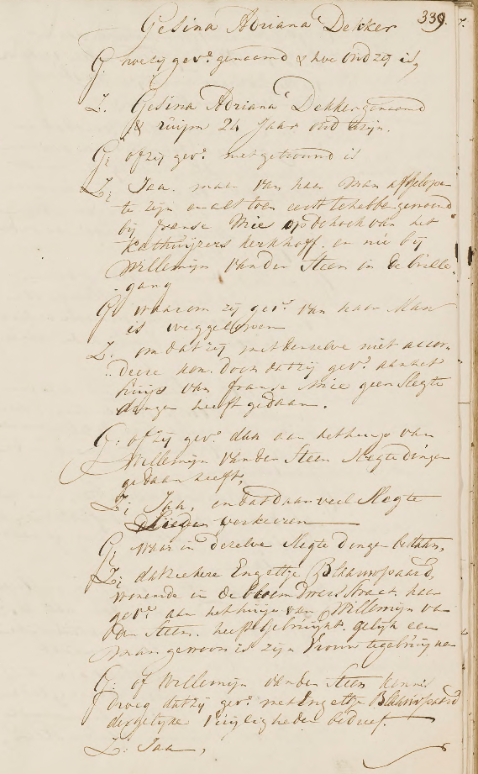
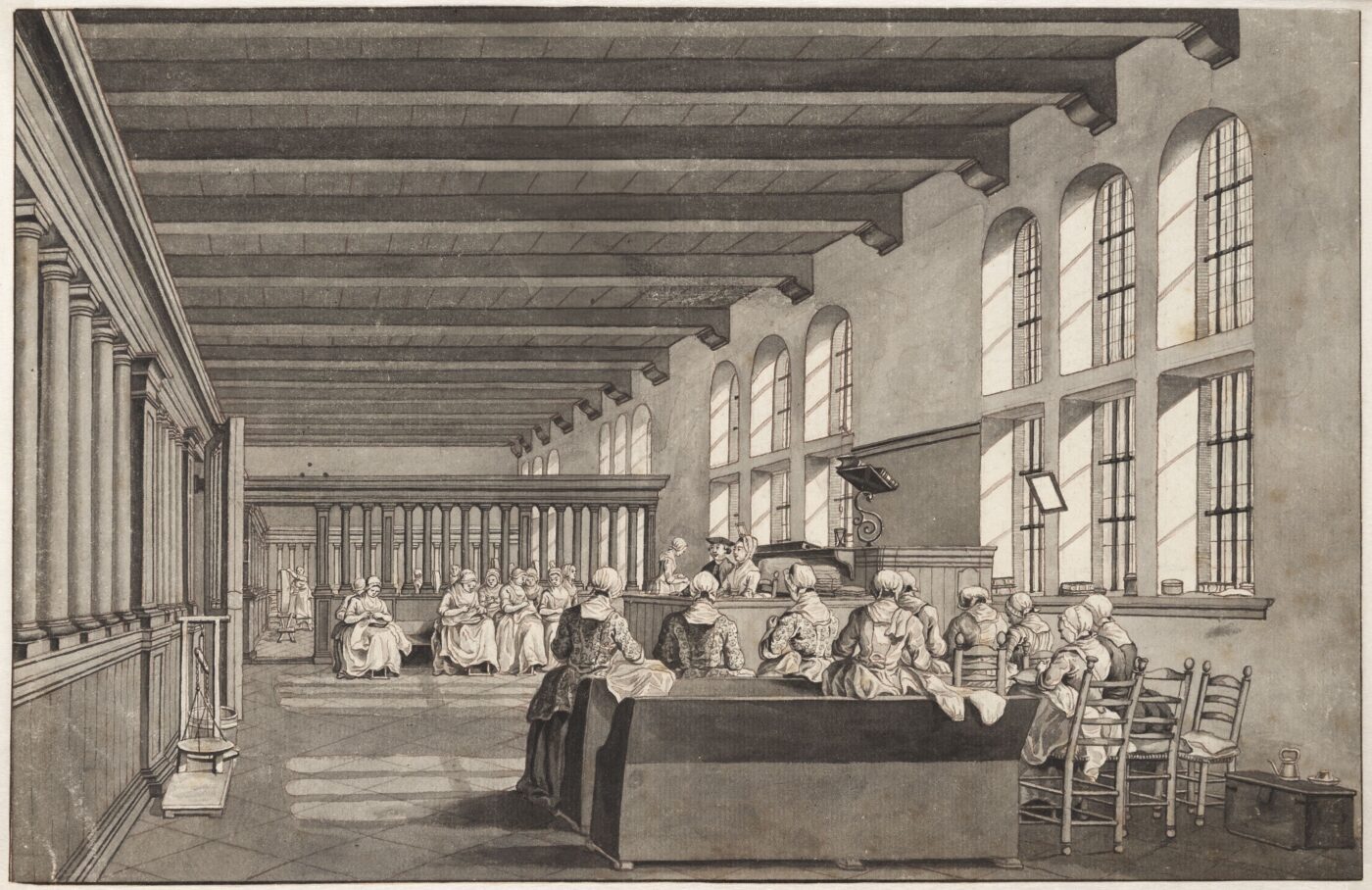
Photo credits
Scan from “Secret Confession Book 1765-1796,” p.171.
Year: 1796
Collection: Archives of the Bailiff and Aldermen. Amsterdam City Archives
The interior of the Spinhuis, Spinhuissteeg 1, on the side facing Korte Spinhuissteeg. The women at work.
Year: 1783
Artist: H.P. Schouten
Collection: Atlas Splitgerber, City Archives, Amsterdam
Gesina Decker/Dekker left her husband, choosing instead for physical intimacy with other women. She was one of for women convicted of “indecent acts” and was sentenced to six years in Amsterdam’s Spinhuis, a house of correction for women.
Biography
Author: Walt Esquina
At first glance, this particular case in the records of the sheriff of Amsterdam from September 1796—in the early years of the Batavian Republic—seems to be just another brief legal file, yet on closer inspection it offers vivid images of women’s lives in the city’s Jordaan district of those days. The “Secret Confession Book of the Archive of the Sheriff and Aldermen” records the names of four women: Gesina Adriana Dekker, Engeltje Blauwpaard, Willemijn van der Steen, and Pieternel Groenhof. Aside from their names, little more is mentioned, but behind those administrative lines lies a world of work, poverty, social dependency, and urban control.
Married life
Gesina Adriana Dekker (also spelled Decker) was about 24 years old when her name pops up in this case. She had married Jan Hendrik Willink in 1789, bringing a considerable dowry into the marriage, including jewelry, clothing, and money. Carefully catalogued, her possessions included, among other things, a clasp purse, a snuffbox, an eau de reine box, a sewing case, and various pieces of jewelry. She also owned numerous items of clothing, including 19 neckerchiefs, three cloaks, and ten caps. All this suggest that, despite her social position, she did not enter marriage without resources of her own.
She and her husband had two daughters: Mina Francisca Willink (born 1791) and Gesina Willink (born 1793), who died young. Yet by 1796, the marriage had effectively broken down, and Gesina no longer lived with her husband. In her own words, she had “separated” from him because she no longer “agreed” with him. While they remained legally married, the relationship had in fact come to an end.
The women of the Brillegang (Amsterdam, 1796)
Like so many single women in Amsterdam in those days, Gesina entered a period of moving around the city, staying at various places. At one point she lived with a woman known in the sources as “French Mie.” Eventually she ended up in the home of Willemijn van der Steen on the Brillegang, an alleyway off Anjeliersstraat in the city’s Jordaan district.
Willemijn van der Steen, in whose house the story unfolds, was a seamstress. Her very small dwelling was in a densely populated part of the Jordaan, where living and working were often intertwined. Various women stayed at or came to this house on a regular basis. One who was often there was Engeltje Blauwpaard, aged 27 and the daughter of a porter. She moved around between work and social contacts. Another was Pieternel Groenhof, aged 46. She was dependent on church charity, was socially/economically vulnerable and often relied on temporary accommodation and social networks. Rather than a formal community, this house offered informal living arrangements for a variety of women who supported one another, worked together, and sought each other out, whether out of necessity or simply for company.
In the overpopulated Jordaan district of those days, with its narrow streets and small houses, privacy was limited and social control was strong. What took place behind the front door would rarely remain entirely hidden. It was in this context that a situation arose that would eventually attract the attention of the city authorities.
Moral judgment
In September 1796, the Amsterdam sheriff came into action. There is no record of any individual plaintiff, and the case was prosecuted ex officio. This means the city authorities themselves decided to take measures, presumably based on signals from the neighborhood or observations of behavior that was considered morally or socially problematic. In 18th-century Amsterdam, what was deemed “indecent” behavior was not only a matter of private life but also of public order. There was only a fine line between moral judgement and legal prosecution.
The sheriff and his officers entered the house on the Brillegang, taking the women who were present into custody. The records describe the event not as a violent raid, but as a formal and inevitable intervention by the urban authorities. The private living space was suddenly transformed into a legal situation. Interrogations followed.
Gesina was the first to be questioned, and her statement forms the core of the file. She described how women regularly gathered in the house and that physical intimacy took place between those present. Her words were carefully recorded in the confession book, which contains not only facts but also moral and legal interpretations.
Between reality and judgment
The next to be interrogated was Engeltje Blauwpaard. She admitted that she had been present but positioned herself as a visitor and helper. Willemijn van der Steen, the official resident of the house, initially also attempted to distance herself from the events, but later acknowledged that she had not been entirely unaware of what had taken place. She mentioned the atmosphere in the house and the possible consumption of alcohol among other explanatory factors. Pieternel Groenhof framed her involvement as a matter of dependency and social vulnerability. Her statement emphasized not so much her personal responsibility as the circumstances in which she found herself. Taken together, the testimonies do not form a single coherent narrative, but rather a mosaic of perspectives. In this context, truth emerges not as a fixed fact but rather as the result of questioning, memory, and legal structuring.
The Spinhuis
After the interrogations came the ruling by the aldermen. The sentences were severe. Gesina Adriana Dekker and Engeltje Blauwpaard were both sentenced to six years’ confinement. Pieternel Groenhof got four years and Willemijn van der Steen ten years. The differences in sentencing reflect the role each woman had within the household but also the authorities’ interpretation of responsibility.
The women were transferred to the Spinhuis in Amsterdam, a correctional institution for women where labor and discipline were central. The Spinhuis was not a prison in the modern sense, but an institution in which women were put to work spinning and sewing under strict supervision. Its purpose was both punishment and re-education. In this environment, individual lives disappeared into a collective structure of labor, regularity, and control.
For Gesina, this meant a profound break in her life’s course. Where she had previously moved between marriage, urban networks, and personal relationships, she now became part of an institutional system in which her identity was reduced to her status as a convicted woman. Her personal history was absorbed into an administrative framework that no longer described her life but classified it.
The vulnerable position of women
What makes this case significant is that it offers a rare glimpse into the lives of women in the urban lower classes of the 18th century. Gesina Adriana Dekker is not an exceptional historical figure; precisely for that reason, she is representative. Her life shows how vulnerable and changeable the position of women could be in a city where social control, economic dependence, and legal authority were closely intertwined.
The archives contain only fragments: a house on the Brillegang, four women who found each other temporarily in a shared space, and a system of urban justice that intervened and reshaped their lives. Gesina stands at the center, being the first voice in the file—not because she was the most important or influential, but because her statement forms the beginning of the story that preserved them all in the archives. Her life thus remains in the form of a record: not as a complete narrative, but as a moment in an ordinary existence that becomes visible through the language of the law and then disappears again into the silence of history.
On labels
In the 18th century, love between women was understood differently than it is today: modern identities such as “lesbian” or “bisexual” did not yet exist. People spoke instead of “immorality,” “sodomy,” or “tribadism.” The latter is an old term for lesbian love or sexual acts between women, derived from the Greek tribein, meaning “to rub.”
Such behavior was viewed as a moral deviation or a criminal offence, not as a form of identity or an expression of love. It was only in the 19th century that the term “lesbian” became common in a sexual sense, derived from renewed interest in the poetry of Sappho. The term “bisexual” first appeared in 1892 in the work of German psychiatrist Richard von Krafft‑Ebing.
Literature and sources
‘Vier Lesbiennes,’ Stadsarchief Amsterdam.
‘538 1765 apr. 6-1796 dec. 29‘, Confessieboek, Archief van de Schout en Schepenen, Stadsarchief Amsterdam.
‘Homoseksualiteit in het Spinhuis,’ Gert Hekma, Het Spinhuisboek, 2014: p. 48-50.