
Benno Premsela
hij/hem1920 – 1997
Forced to hide as a Jew during the War, Benno Premsela later refused to hide his sexuality. As chair of the COC in 1964, he was the first to openly discuss the organization’s activism on Dutch TV, opening up the public discourse on sexual diversity.
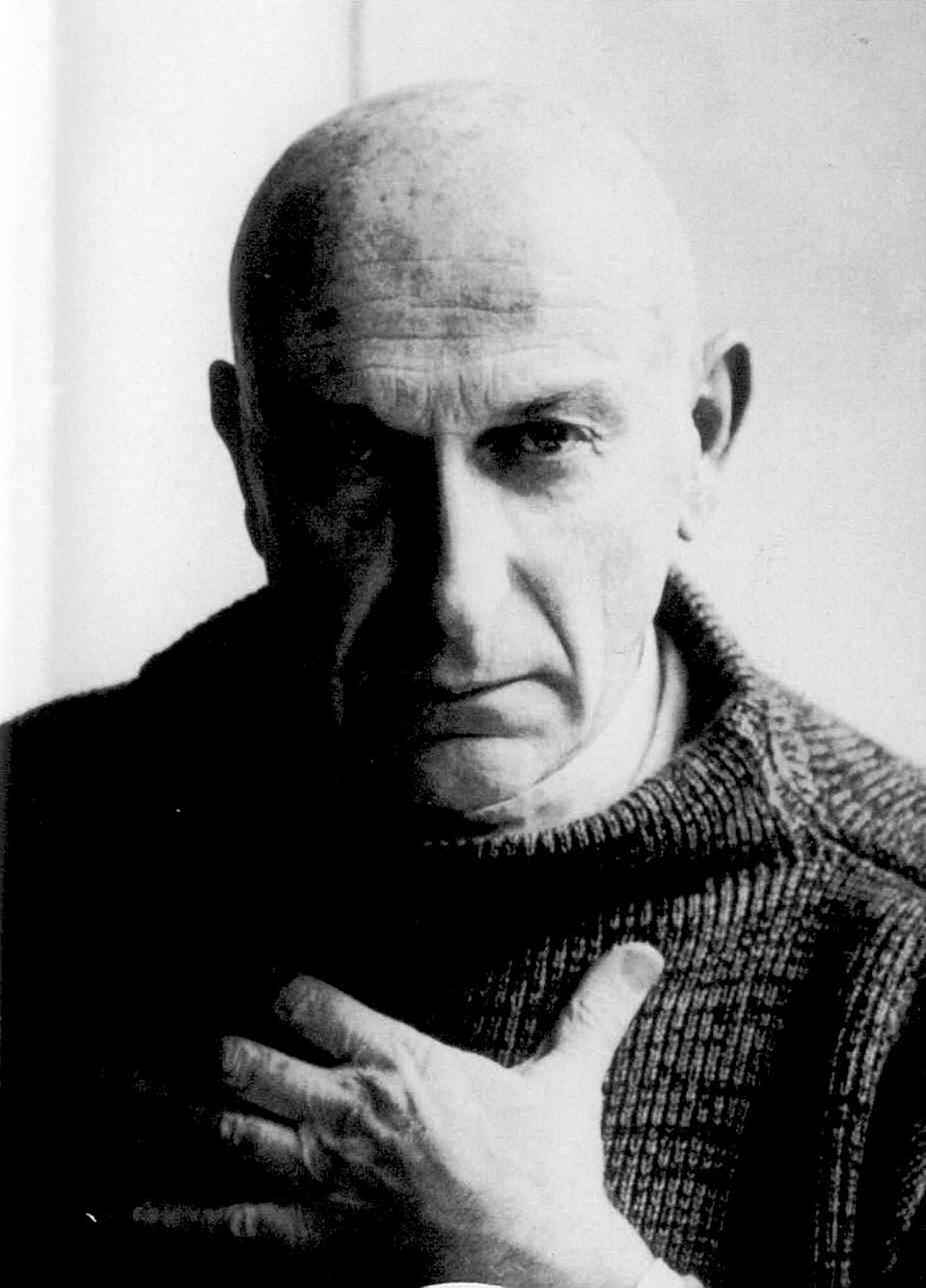
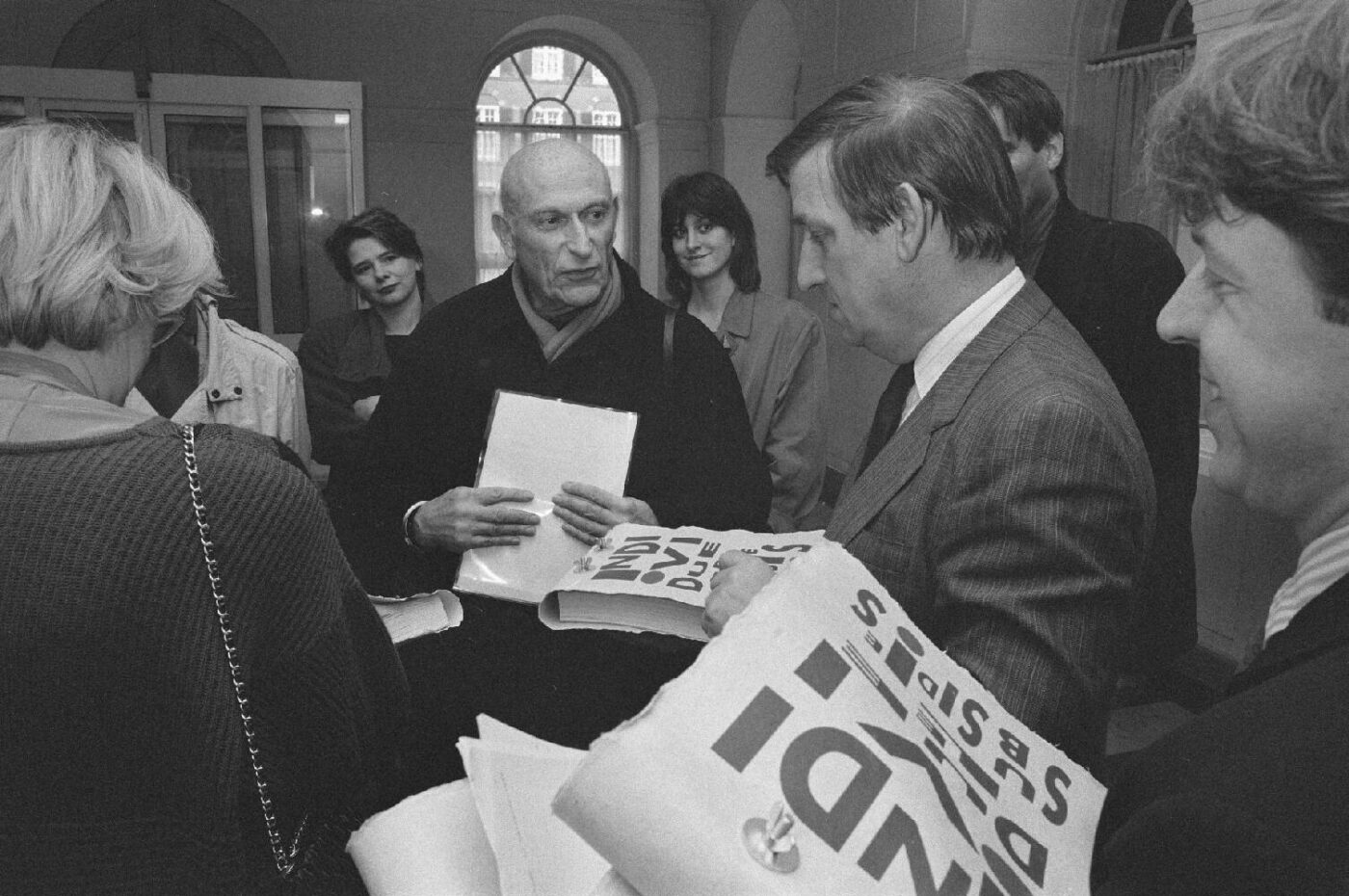
Photo credits
Portrait photo “Benno Premsela”
Year: 1997
Collection: Public domain, with permission of the Amsterdam Museum
Photographer: Philip Mechanicus
“Benno Premsela (l) hands a petition against cuts to individual visual-arts grants to the parliamentary committee.”
Year: 1988
Collection: Anefo, National Archives
Photographer: Rob C. Croes
Forced to hide as a Jew during the War, Benno Premsela later refused to hide his sexuality. As chair of the COC in 1964, he was the first to openly discuss the organization’s activism on Dutch TV, opening up the public discourse on sexual diversity.
Biography
Author: Mark Bergsma
A taboo-free environment
Benno Premsela was born in Amsterdam in 1920, the youngest of three children in a Jewish family. By his own account, he had a carefree childhood in an open and taboo-free environment. His parents, Bernard Premsela and Rosalie de Boers, gave their children a great deal of freedom and taught them from an early age to make independent choices. His father was a family physician, but also the Netherlands’ first sexologist; already in the 1930s he spoke about sexuality on a Dutch radio program. Benno would later say of his upbringing: “My parents never imposed anything on me and hardly forbade anything. There were no closed doors for us. That kind of upbringing is like a free train pass for life.”
Premsela began studying interior design at the Nieuwe Kunstschool but had to break off his studies when Nazi Germany occupied the Netherlands in 1940. Following the momentous “February Strike” of 1941, he and his brother Robert went into hiding. During that period, Premsela occupied himself with designing and making leather handbags for women. Both survived the war, but their parents and their sister Elly did not. They had been deported to the Auschwitz extermination camp in Poland, where they were murdered.
Designer
After the war, Premsela began working in the furniture department of the renowned Dutch department store De Bijenkorf. Thanks to his keen sense of interior design, he was appointed head of the display department in 1956. He and his fellow designer Anni Apol formed a close duo whose window displays so striking that they became widely known. People would come especially to see their work whenever they redid the displays. Central to their design work was the use of contemporary art, including works by the Cobra group.
In a 1962 interview, Apol gave insight into Premsela’s unconventional vision in Het Parool: “He brought about a revolution when he began six years ago, because he approached the shop window from interior architecture and sees the display case as a space in which something must happen.” Minimalism was the magic word.
In 1956, he also began collaborating with designer Jan Vonk. In the very early 1960s, they joined forces to found Bureau Premsela Vonk, through which they handled the design and corporate identity of various companies, including the redesign of the headquarters of Dutch bank ABN AMRO. In 1965 they also created a metamorphosis for De Schakel, a gay bar near Leidseplein that was home to the COC in that period. His best-known design is the Lotek lamp from 1982: a simple, square lamp made of iron wire and paper, which he designed out of frustration with lamps that were unpleasant to read by. The user was always the starting point in Premsela’s designs.
No role models
During his time in hiding, Premsela had become fully aware of his sexual orientation. Once the country had been liberated, his experience of the war and being the object of discrimination gave him the courage to be open about his homosexuality: “After what I had been through during the war, I thought to myself: ‘What could possibly happen to me now?’” Everything that came afterward felt less threatening than what he had already gone through. Being fearful—also on a social level—was no longer a factor of importance: “I no longer cared what people thought of me.”
Premsela found himself in a homosexual subculture that operated largely in secrecy. He acknowledged that there was something appealing about that world, but he also saw that it offered little support to people in forming an identity of their own, or as he put it: “The most difficult thing for people in a situation like mine was that we had no role models. [And] if you live without role models, you have to invent everything yourself, and that involves some bitter lessons.” In 1947, for that reason, he became a member of the Shakespeare Club, from which the COC emerged in 1949.
COC and Dialoog
The early years of the COC, under its first chair, Niek Engelschman (alias Bob Angelo), were marked by a cautious line of adaptation, aimed at acceptance and at avoiding provocation. Premsela had very different ideas. Already in the 1950s, through the cultural committee within the COC known as the Kleine Kring (small circle), he worked to make the organization more visible to the outside world. From 1954 onward, for example, the Kleine Kring organized meetings to which outsiders were also invited, including family members and journalists.
In 1962, Premsela replaced Engelschman as chair of the COC, a position he would hold until 1971. Under his leadership, the national board began to present itself more emphatically to the outside world. Thus, on New Year’s Eve 1964, Premsela appeared on Dutch television program Achter het Nieuws (Behind the news), where on behalf of the COC he introduced the Dialoog Foundation as well as that organization’s periodical, Dialoog (Dialogue). That appearance was revolutionary: after controversial Dutch author Gerard Reve, Premsela was only the second man to speak openly and recognizably on television about his homosexuality. Looking back on that moment he later said: “In ’64 I came on television for the first time with my own name and surname. I did that deliberately. Before that, homosexuals were filmed from behind or in shadow. My predecessor used a pseudonym. (…) People who used pseudonyms did so for a reason. No one can imagine that now, but with the pressure of society back then…you would lose your job. It simply wasn’t an option.”
Art pope
After he stopped working as a designer and interior architect, he had his hands full serving on countless boards and doing assorted side jobs. According to his friends, he simply could not say no. He was on the board of the Dutch National Ballet, served as chair of the board of the Fund for the Visual Arts, and was a member of the acquisition committee of Amsterdam’s Stedelijk Museum, just to name a few. It is no wonder that he was sometimes described as the “art pope.”
During his lifetime, Benno Premsela grew into a household name—and not only within cultural and emancipatory circles. In 1995, Prince Bernhard presented him with the Silver Carnation for his many board activities. The following year, in a packed Carré Theater, he was awarded the Municipality of Amsterdam’s Silver Medal as a token of appreciation for all he had done for the arts and for emancipation.
He himself remained levelheaded about all the attention. Shortly before his death at the age of 76, he declared: “You die in the way you have lived. Positively. Without pomposity. With a certain nonchalance. Prior to 1920 I was not there for a very long time—and soon I will not be there for a very long time again.” This was Benno Premsela, a one-time flash in the cosmos.” His cremation therefore took place—at his own request—in silence.
Literature and sources
‘Premsela, Benno (1920-1997)‘, E. Broeksma-van Capelle. Biografisch Woordenboek van Nederland, KNAW Huygens, 2013.
Dialoog 1, 1 (1965).
‘Koninklijke goedkeuring na tien jaar. COC wordt erkend’. In de Volkskrant, 18 september 1973.
‘Het publiek stond vol spanning te wachten als de Bijenkorfetalages van Benno Premsela onthuld werden,’ Sjeng Scheijen. Parool, 30 december 2023.