
Niek Engelschman
he/him1913 – 1988
In 1946, Niek Engelschman, a member of the resistance, founded the COC, the world’s oldest still-operating organization for the rainbow community. He aimed to unify the community and promote social dialogue on sexual diversity.
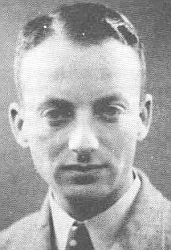
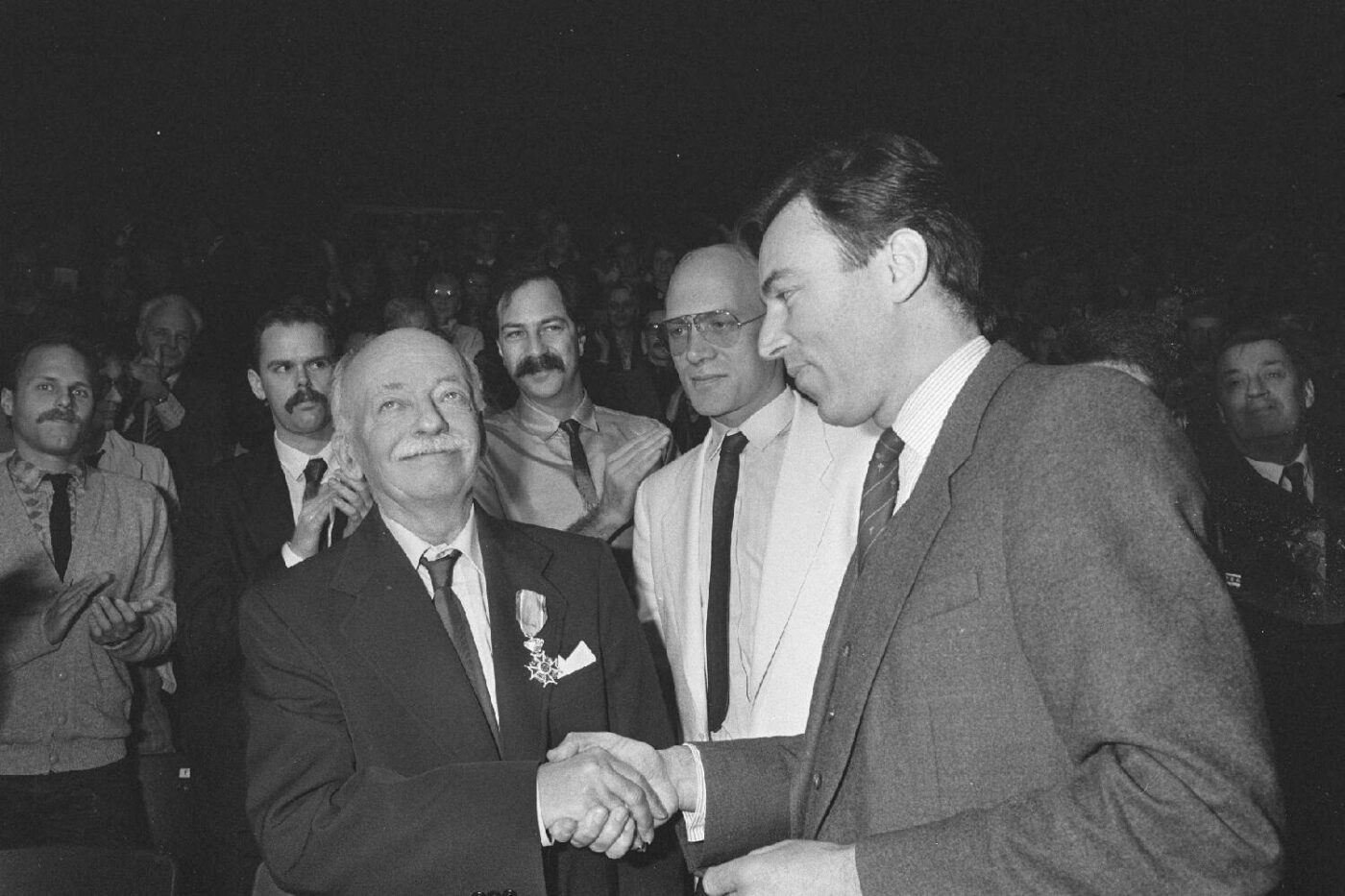
Photo credits
“Nico Engelschman”
Year: c. 1930s
Collection: Public domain
Photographer: Unknown
“Outgoing COC chairman N. Engelschman (l) receives a Royal decoration from minister Brinkman on the occasion of the COC’s 40th anniversary”
Year: 1986.
Collection: Anefo, National Archives.
Photographer: Rob C. Croes
In 1946, Niek Engelschman, a member of the resistance, founded the COC, the world’s oldest still-operating organization for the rainbow community. He aimed to unify the community and promote social dialogue on sexual diversity.
Biography
Author: Mark Bergsma
Revolutionary socialism as a training ground
Born and raised in Amsterdam, Nico (“Niek”) Engelschman was the eldest of the five sons born to his Jewish father, Nathan Engelschman, and his Lutheran mother, Hendrika van der Star. While religion played no role in his family, their chronic lack of money certainly did. The family was so poor that Nico was unable to attend secondary school.
At the age of 13, he began working as an office clerk and joined the General Dutch Union of Commercial and Office Employees. At the same time, he developed a growing awareness of social and class inequality. That drew him, in the early 1930s, into the sphere of socialism. Through the Social Democratic Workers’ Party (SDAP), he gradually moved further to the left, eventually ending up in the Leninist Youth Guard (LJG), the youth organization of the Revolutionary Socialist Workers’ Party (RSAP) led by politician and trade unionist Henk Sneevliet.
Nico immersed himself completely in the revolutionary socialist youth movement. In addition to sports, singing, and attending lectures and study weekends, he held leadership positions at both local and national levels and worked as an editor for socialist publications such as Arbeidersjeugd (Workers’ youth) and De Jonge Leninist (The young Leninist). He also wrote a pamphlet about youth unemployment and a short play about fascist terror.
His commitment went beyond the words he wrote. After Hitler had come to power in 1933, he helped German socialists escape to the Netherlands.
“I wanted to fight”
The whirlwind of activities he was involved in had allowed Nico to neglect his emotional life for a long time, but by the age of 24 he could no longer ignore his homosexual feelings. He felt lonely, particularly because he had to keep his sexual orientation hidden. Moreover, Nico felt little connection to the very limited gay scene in Amsterdam in those days:
I remember being endlessly irritated by the gay men who would go out at that time, and who only seemed interested in clothes and the latest song by Zarah Leander. I wanted to fight for the social acceptance of homosexuals.
Nico first threw himself into a quest for self-recognition. He studied the history of homosexuality and read the works of homosexual authors. He also came into contact with the early Dutch homosexual activist Jacob Anton Schorer, who had spent years campaigning against the notorious Article 248bis of the Dutch Penal Code, which discriminated against homosexuals.
This inspired him to take an entirely different path. With the blessing of Henk Sneevliet, he abandoned political activism as a socialist in order to devote himself completely to advocating for the rights of homosexuals, whom he regarded as an oppressed minority.
Levensrecht (Right to live)
In 1939, Dutch attorney Benno Stokvis published Homosexueelen: 35 autobiographieën (Homosexuals: 35 autobiographies), in which he called attention to the difficult position of homosexuals in the Netherlands. Nico was one of those whose life story was featured in the book. He later described it as “a revolutionary publication that very few publishers dared touch at the time.”
It gave him the idea of founding a magazine. Under his pseudonym Bob Angelo, Nico sent out a circular letter to potential readers he had met through personal ads. The response was positive, and in March 1940 the first issue of Levensrecht (Right to live) appeared. The magazine quickly attracted the attention of Amsterdam’s vice squad. Its chief ominously remarked:
I’ll be keeping an eye on you, you filthy perverts.
When the Germans occupied the Netherlands in May 1940, the magazine soon came to an end. At the urging of Jef Last, Nico destroyed the entire address list—but only after he had memorized it. Remaining true to his activist nature, he then joined the resistance.
The Shakespeare Club and the COC
Together with one of his brothers, Nico produced underground newspapers, including De Vonk (The spark), and arranged hiding places for Jewish friends during the war. In 1946, having emerged from the war with his fighting spirit intact, Nico revived Levensrecht:
I thought the prejudices from before the war would be over, and as a committed socialist I wanted to claim the constitutional rights of freedom of assembly, association, and the press for homosexuals as well.
This soon proved to be a misconception. Post-war Dutch society was perhaps even more prudish and hostile toward homosexuality than it had been before the war.
Nico wanted to do more and bring together “people from our emotional world.” This led him, in December 1946, to found the Shakespeare Club, together with Jaap van Leeuwen and Jo van Dijk. The authorities kept the organization under close surveillance. Plainclothes police officers would regularly attend its meetings. Nico also frequently had to report to the police station.
But they never managed to catch us violating any regulation. In The Hague, attempts were made at a high level to ban the organization, but the Amsterdam police commissioner argued that it was wiser to regulate the matter.
In 1949, the Shakespeare Club morphed into the C.O.C., short for Cultuur- en Ontspanningscentrum (Center for Culture and Recreation). At that time, with about a thousand members, it was one of the world’s largest homosexual organizations.
The Universal Declaration of Human Rights
Under Nico’s leadership, the COC initially adopted a cautious strategy of accommodation. It was the organization’s priority to be seen as respectable, so overtly flamboyant behavior was discouraged.
At the same time, Nico remained fully committed to equality. He wanted homosexuals to participate in society as fully respected citizens. In doing so, he drew on the United Nations’ Universal Declaration of Human Rights (1948), which from 1951 onward served as a guiding principle for the organization.
In 1962, he handed over the chairmanship of the COC to Benno Premsela, after which the organization took on a more public role. Nico was appointed honorary chair. When Nico was awarded a knighthood in the Order of Orange-Nassau in 1986, he reflected on his early activism:
I thought I would have achieved my goal if Article 248bis disappeared. I never imagined I would live to see that happen. But of course it was about much more than that one article.
Two years later, he died at the age of 74. His significance was by no means forgotten, however. In 1991, the COC honored him posthumously by establishing the Bob Angelo Medal, which is awarded annually to a person or organization that has made an outstanding contribution to LGBTQIA+ emancipation.
In 2025, on the occasion of Amsterdam’s 750th anniversary, Nico Engelschman was also named one of the 14 greatest Amsterdammers by the city’s daily newspaper, Het Parool.
Literature and sources
Short film about the early days of the COC. In dit teken. Directed by Jan Lemstra and Piet Henneman, 1949.
Methorst, Henri. “Oprichter en erevoorzitter COC overleden: persoonlijke ontmoeting met Niek,” Sek 12 (1998) 4.
Warmerdam, Hans. Levensvreugd door levensrecht: de beginjaren van de Nederlandse Vereniging tot Integratie van Homoseksualiteit COC, 1946-1961. Dissertation (supervisor: D.F.J. Bosscher). Groningen: RUG, 1985.
Wiegman, Marcel. ‘De veertien grootste Amsterdammers,’ Parool, 2025.
Magazine: Vriendschap, 1949–1953.
Website: Bob Angelo Fonds.