
Shinta Ratri
zij/haar1962 – 2023
Spiritual mentor, Muslim woman, and human rights activist Shinta Ratri fought for the right for transgender people to exist and for their religious freedom. She founded the first boarding school in Indonesia for transgender Muslim women, where they can practice their faith.
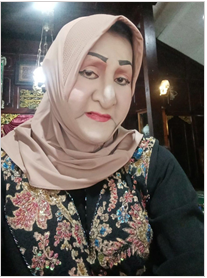
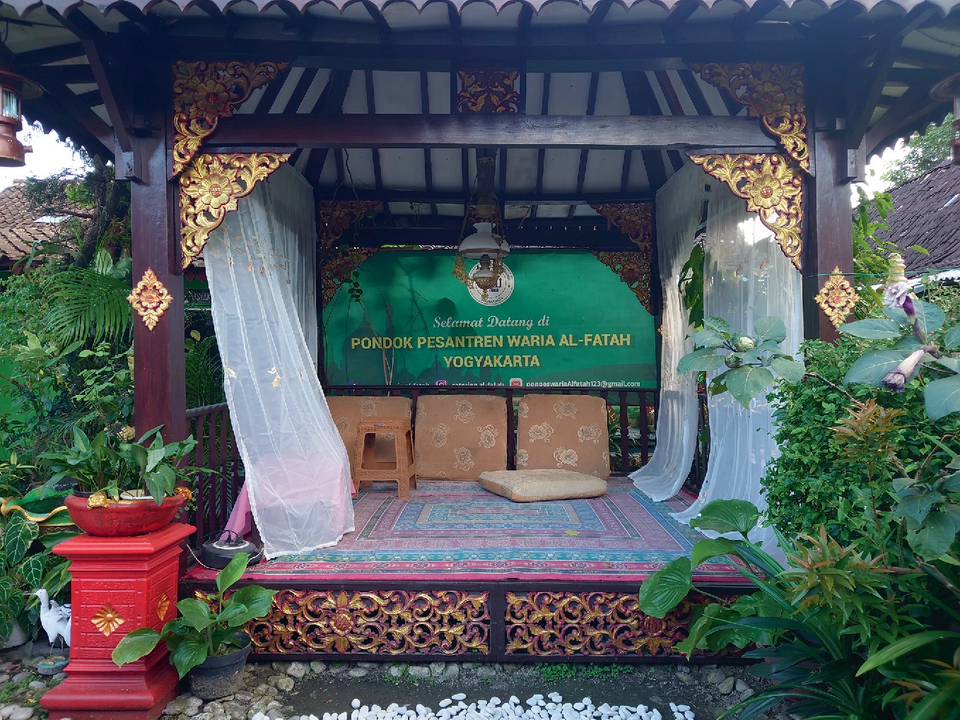
Photo credits
“Shinta Ratri. Oprichter van de Al-Fatah Transgender Islamic Boarding School in Yogyakarta, Indonesië en mensenrechtenactivist”
Year: Unknown
Collection: Public domain
Photographer: Ulumarifah
“Kostschool Al-Fatah”
Year: 2022
Collection: Public domain
Phographer: Anwar Kholid
Spiritual mentor, Muslim woman, and human rights activist Shinta Ratri fought for the right for transgender people to exist and for their religious freedom. She founded the first boarding school in Indonesia for transgender Muslim women, where they can practice their faith.
Biography
Author: Dewi, with special thanks to Miss Rully
Always a proud woman
Shinta Ratri was born into a warm family of traders in Central Java, just south of Yogyakarta, in 1962. As one of nine children, she grew up in an environment where affection and bustle went hand in hand. From early childhood, she felt herself to be a girl—a feeling that never left her, even though at birth she was labeled as a boy on account of her body. Yet for “Ibu Shinta,” as she would later be respectfully called, there was no doubt: this was who she was.
At the age of 18, she took a courageous step: she began living openly as a waria, an Indonesian portmanteau combining the words wanita (woman) and pria (man) into a culture-specific term for a transgender woman. While so many other waria were rejected, sent away by their families or cast out by society—often with the Bible or Qur’an wielded as a weapon—Shinta found support within her own family. She wore her headscarf with pride, said her daily prayers, and lived her faith with deep conviction. At the same time, she saw the harsh reality: despite the long history of gender diversity in the Indonesian archipelago, tolerance and intolerance existed side by side. For many waria, life is not easy: no education, no job, no home.
A rich spiritual life
Shinta dreamed of a place where waria could be themselves, not only physically, but also spiritually. “Waria felt uncomfortable in regular mosques,” she explained. “So I thought: it is better for us to be together than to sit at home alone with all those spiritual questions in our hearts.” And so it came to pass: in 2008, together with others, she opened Pesantren Waria Al-Fatah—the world’s first Islamic boarding school intended for and run by transgender Muslim women. On her family’s land in Yogyakarta, she created a safe place: a place where waria could pray without fear, study the Qur’an, and be themselves.
Under her spiritual leadership, they learned not only religious practices, but also English, gardening, painting, and traditional Javanese dance. For students who were illiterate, she devised ways to memorize Qur’anic verses. Her approach to Islam was imbued with compassion. She taught her students that the foundation lies in living an ethical life, with love and respect for others. Shinta Ratri created a place without taboos. She also spoke openly about sex work by making space for the experiences of those who depended on it and by refraining from judgement. In doing so, she lifted an enormous burden from their shoulders.
A national backlash
But with her courage, Shinta Ratri also attracted the attention of those who could not appreciate her efforts. In 2016, the mood in Indonesia shifted: politicians began loudly expressing their aversion to LGBTQ+ people, dating apps such as Grindr were banned, and surveys showed that LGBTQ+ people were among the most disliked groups in the country. Legislative proposals were introduced to criminalize homosexuality. The moderate Islam that had set the tone for decades seemed to be drowned out by a harsher, more intolerant voice—a voice that used the same rhetoric as anti‑LGBTQ+ movements elsewhere in the world.
Islamic hardliners threatened to raid Al-Fatah. They demanded that the school be closed. With her head held high and supported by her unshakable belief in an inclusive Islam, she entered into confrontation with them. Fundamentalist militants called her “mentally ill.” For several months, the community sought safety at the Legal Aid Bureau in Yogyakarta. Despite months in hiding, Ibu Shinta did not give up. Thanks to support from human rights organizations, progressive religious leaders, and local authorities, Al-Fatah was allowed to reopen.
Strong together
The attack in 2016 only made her more determined. She became more active in advocating for the rights of waria: the right to pray, to work, and to access public facilities. She joined SOBAT KBB, an alliance of religious minorities, and forged alliances with academics, clerics, and activists. She even signed a memorandum of understanding with a Christian university, so that Christian and Muslim waria could find a safe space together twice a month. To this day, students from the Jakarta Theological Seminary (see: Stephen Suleeman) visit Al-Fatah for a compulsory internship.
In 2019, Shinta received international recognition for her work. She was awarded the Front Line Defenders Award, an international prize for human rights defenders. Her courage was also recognized in Spain, where she received the Casa Asia Award for Diversity and Social Development in 2022.
Shinta Ratri died of a heart attack on 1 February 2023 at the age of 60, but her vision lives on. Al-Fatah still exists and remains a symbol of hope for transgender Muslims in Indonesia and far beyond. The legacy of Ibu Shinta is not only a school, but also a message: faith and gender identity do not have to exclude one another. Her students and colleagues remember her as a pioneer, a mentor, a woman who gave others the courage to be proud of who they are.
Literature and sources
The Piety of Shinta Ratri , Human Rights Watch, 2016.
‘Homorechten onder druk in Indonesië’, NPO Radio 1, 2016.
‘Merekam Jatuh Bangun Satu-Satunya Pesantren Khusus Transpuan di Indonesia’, Vice, 2019.
‘Membuka Ruang Inklusif dalam Pesantren Waria’, Katolikana, 2021.
‘Behind political homophobia’, Hendri Yulius, 2017.
Fotoboek ‘Ekspresi dan Identitas’, Hartoyo et al., 2014.