
Alje Klamer
hij/hem1923 – 1986
In the early 1960s, Alje Klamer, a Dutch Reformed radio pastor from Hilversum, took up the cause of homosexual members of Christian congregations. In doing so, he broke a major taboo. In addition to lending them an ear, he advocated for their support, care, and recognition.
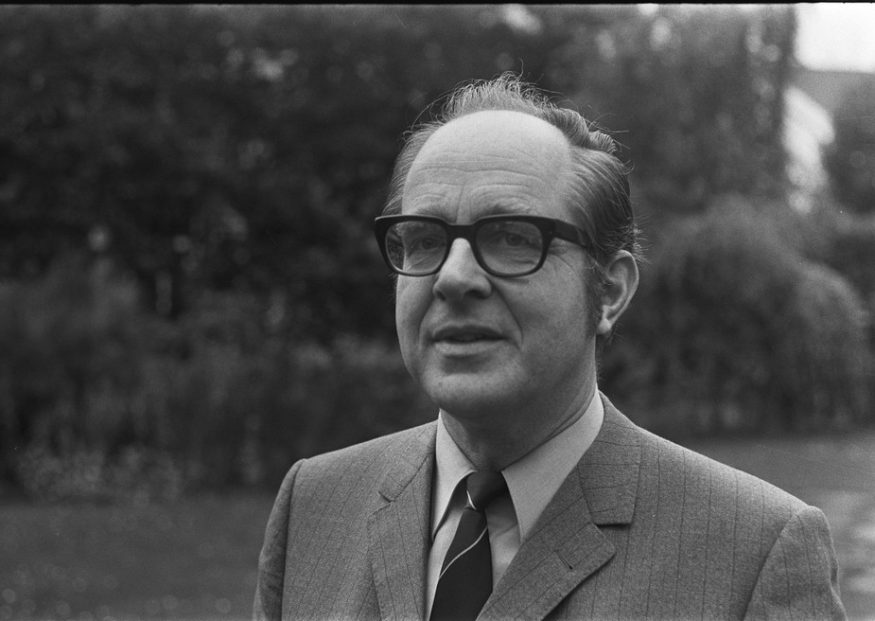
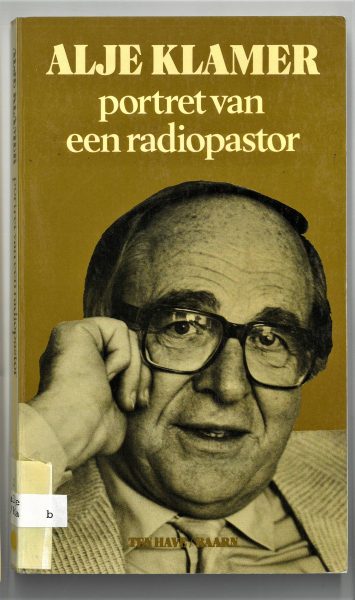
Photo credits
“Assignment Eva; Rev. Klamer, Hilversum, head”
Subject: Alje Klamer
Year: 1970
Collection: Anefo/National Archives
Photographer: Erich Koch
Book cover: “Alje Klamer. A portrait of a radio pastor”
Author: Arjo Klamer et al.
Year: 1987
Collection: IHLIA LGBTI Heritage
In the early 1960s, Alje Klamer, a Dutch Reformed radio pastor from Hilversum, took up the cause of homosexual members of Christian congregations. In doing so, he broke a major taboo. In addition to lending them an ear, he advocated for their support, care, and recognition.
Biography
Author: Johan Meester
“I am the megaphone for those who have no voice”
This was the mission that well-known Dutch radio pastor Alje Klamer set for himself: he wanted to give a powerful voice to the countless people who remained unheard in the Netherlands of after the Second World War.
Klamer was born in the city of Groningen in 1923. While a student of theology at the local university during the war, he refused to sign a so-called Declaration of Loyalty, which the Nazis had made compulsory for students. As a consequence, he was sent to Berlin to do forced labor. When he returned in 1944 he had tuberculosis and had to spend a year in a sanatorium. Once he had recovered, he was able to resume his studies. In 1949 he received an appointment as a Protestant minister.
Even during his studies, Klamer had resisted the narrow-minded spirit of the Church; he advocated cooperation between the liberal and orthodox adherents of Dutch Reformed Protestantism, who had been divided and even antagonistic toward each other. He had little interest in philosophical or academic discussions, but was far more concerned with the practical functioning of the Church.
At that time, Dutch society was still strongly segregated into different political and religious “pillars,” and Christianity played a major role. Difficult issues were not discussed. Homosexuals were considered sinful and were largely invisible. Article 248bis of the Dutch Penal Code raised the legal age for same-sex sexual contacts for homosexual contact than that for heterosexual contacts. Homosexuals who became known as such could lose their jobs and be ineligible for housing, which made them vulnerable to blackmail.
When one of Klamer’s church services was broadcast on the radio in 1954, it attracted attention. This led to his becoming, in 1959, the first radio pastor for the IKOR, the Protestant public broadcasting corporation in the Netherlands. While there were still very few televisions in those days, every household owned a radio.
Linked to his radio sermons was a pastoral service: listeners could write or call Klamer after the broadcast. Although he initially viewed this anonymous form of pastoral care with skepticism, it turned out that its anonymity was exactly what made it so successful.
Bags full of letters
Klamer received bags full of mail and countless phone calls, precisely because those who sent the letters or made the calls knew that their family or neighbors would not be able to read along or listen in. Already in the first week, he was confronted with the story of a homosexual listener—but also with his own prejudices. After all, during his training, Klamer had been taught that a minister should advise a homosexual to undergo castration.
At that moment, Klamer realized that the Church was excluding people instead of welcoming them in love. For him, everything in the Church revolved around the love of Jesus. He immediately he held a sermon that was sympathetic towards homosexual people. This was unprecedented and resulted in even more mail: positive letters from homosexual listeners, but also a great deal of hate mail from other listeners.
“God wants you to live as a free person”
The booklet De Homoseksuele Naaste (“The homosexual neighbor”) was published in 1961 in Dutch Reformed circles. It provided a lot of information and did not pass immediate moral judgement on homosexual people. In that same year, Klamer aligned himself with this approach in two radio talks: one on prejudice and the other on ignoring people in silence versus showing them love.
He began the second of those talks with the words: “This afternoon I want to speak with you about ignoring the hundreds of thousands of homosexual people in our country in silence,” and continued with “Do not despise the love of a homosexual person.” To homosexual listeners, he said: “God wants you to live as a free person. Do not let anyone persuade you that the Bible is against you.”
In an article he wrote in the Haagsche Courant, a daily newspaper from The Hague, Klamer pointed out that 400,000 homosexual people were being ignored in silence and that countless men and women felt alienated from the Gospel because they have the idea that they do not count. He also advocated for education for young people. This was not only revolutionary for that time but also exceptionally courageous.
From words to action
It would not remain a matter of words alone, for Klamer was both a bridge-builder and a doer. In 1962, he initiated an ecumenical working group of pastoral caregivers for homosexual people. Together with Protestant minister Brussaart and Roman Catholic priest Gottschalk, he set up discussion groups for homosexual believers. These groups were an overwhelming success and still exist today through an organization called De Kringen (The circles). He also established similar groups for parents of homosexual children.
Klamer and the COC
Under the chairmanship of Benno Premsela, the COC had turned its focus outward, and he saw an ally in Klamer. Their goals were the same: to achieve equality through understanding, respect, and tolerance. While many considered “understanding” to be enough, Klamer advocated for equal rights, saying: “understanding is cold love.”
To achieve this, Klamer used all the channels available to him: his sermons, the radio and later television, the written press; he also made use of his extensive network. When the COC was campaigning to gain official recognition as an association from the Crown, Klamer lobbied the then still highly influential Protestant national political parties ARP and CHU. Royal approval was eventually granted in 1973.
“In the Bible, love is not goodwill but an action”
When Klamer spoke of “the unheard,” he meant not only homosexual people, but also all those other groups who were marginalized, such as children of parents who had been “on the wrong side” during the war or even members of the NSB (Dutch Nazi Party). With the war still so fresh in everyone’s memory, this remained a highly sensitive issue.
Perhaps even more sensitive was Klamer’s attention to people with pedophilic inclinations. In a radio talk in 1976, he stated that, in his view, they too, as human beings, had a right to pastoral care and love.
Later, Klamer said that he did not see himself as a champion of “this or that cause,” but that the time was ripe for new insights. Previously, the positions of both Church and society towards people who did not fit the norm had been very harsh.
Klamer emphasized the love with which others should be approached, without prior judgement. With this attitude, he not only gave homosexual people confidence and a voice but also helped to change the pastoral and theological view of sexual diversity. Through his sermons, appearances, and publications, he ultimately reached a broad audience beyond his own Church circles as well.
Klamer was married to a woman and the father of four children. He died of a brain tumor in 1987 before he retired. Few people had known he was ill; he considered treatment pointless.
When the rainbow flag now hangs from the Amsterdam’s Westertoren, located just behind the Homomonument, it is partly thanks to the pioneering work of Rev. Alje Klamer.
Literature and sources
‘De kast, de kerk en het koninkrijk,’ Nieuw Wij, 2019.
De kast, de kerk en het koninkrijk, KRO, 2019.
Alje Klamer. Een portret van een radiopastor. Arjo Klamer et al., 1987.