
Herculine Barbin
she/her1838 – 1868
In her memoirs, French author Herculine Barbin described her experiences as an intersex person. The story of her life, death, and legacy remain fundamental to the intersex movement in its fight against stigmatization.

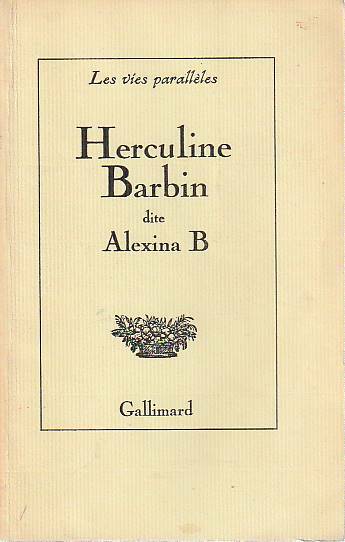
Photo credits
“Herculine Barbin”
Year: Unknown
Source: The Legacy Project
Photographer: Unknown
Book cover “Herculine Barbin dite Alexina B.”
Year: 1978
Collection: IHLIA LGBTI Heritage
Author: Michel Foucault
In her memoirs, French author Herculine Barbin described her experiences as an intersex person. The story of her life, death, and legacy remain fundamental to the intersex movement in its fight against stigmatization.
Biography
Author: Tom Johnston
Herculine Adélaïde Barbin was born to impoverished parents in the rural west of France in 1838. After her father abandoned the family, Alexina, as Barbin would be called, was raised by her mother until she was seven. At that point, thanks to the generosity of a family friend, Barbin went to live in a local convent and attend the school the nuns ran for girls. Her aptitude for learning did not go unnoticed. At the age of 12, she was sent to a larger boarding school for girls. Throughout her years of schooling, she lived exclusively among girls and women, and everyone considered her to be one of them.
As she entered puberty, however, she noticed that she looked different from everyone else. She never really developed breasts, and after an initial, hope-giving event of menstrual bleeding, she never menstruated again. Her voice became throatier and dark hairs began to appear on her upper lip and cheeks and on her limbs.
I felt a strange confusion when I looked at my body. It was not like the bodies of the other girls, and yet I could not say what was different.
To avoid embarrassment, she would avoid bathing or even undressing in front of the other young women at her school. Her teachers and schoolmates noticed these traits, yet aside from occasional teasing, everyone thought of her and treated her as a young woman, not fundamentally different from the girls around her.
Once she had completed her education, she was hired to teach at another boarding school for girls in the region. One of the director’s daughters, Sara, who likewise taught at the school and whose room was next to Barbin’s, won her confidence immediately through a kiss. The friendship between Barbin and Sara would develop into a passionate, sexual relationship that lasted a year before it was ended. The emotional and sexual feelings Barbin had for Sara were intense but also confusing for her. She realized that a sexual relationship between two women was unacceptable in the society they lived in.
Things changed abruptly in 1860, when Barbin was 21. Her health was faltering, yet she had consistently avoided seeing a doctor. She did not want to draw attention to her body. When the pain in her abdomen had become unbearable, she was examined by one doctor, and then by another. The source of her pain turned out to be testicle that had never descended but remained in her groin. In fact, she was intersex, but the doctors felt the need to determine her “true sex,” one that could only exist in the medically enforced binary. In the end they decided for her that, in essence, she was a man.
The doctors’ determination meant the end of her life as she had known it. She was forced to leave the school and her comfortable existence surrounded by other young women, including Sara, the object of her love and desire. There were also legal consequences. She was officially reclassified as a male and assigned a man’s name: Abel. She could no longer be the person she had been until then; the medical and legal authorities had determined that she had never in fact been that person. Both her emotional life and her sexuality as a woman who was attracted to other women were nullified.
From then she would have to present as a man, wearing men’s clothing, walking, talking and interacting as a man. Barbin moved to Paris, found a subsistence-level office job, and lived alone in a drafty attic room. Her so promising future as a schoolteacher evaporated, replaced by a life characterized by anxiety, loneliness, destitution and despair.
At the age of 25, Barbin began writing her memoirs, referring to herself throughout with the androgynous name of Camille. She used female pronouns for herself when writing about life prior to being reclassified as male and male pronouns after that point.
I am twenty-five years old, and, although I am still young, I am beyond any doubt approaching the hour of my death. I have suffered much, and I have suffered alone! Alone! Forsaken by everyone! My place was not marked out in this world that shunned me, that had cursed me. Not a living creature was to share in this immense sorrow that seized me when I left my childhood, at that age when everything is beautiful, because everything is young and bright with the future.
Once she had finished writing her own story, she took her own life. She was 29 years old. After her death, an autopsy was performed, studies were published, and her memoirs were eventually filed away. Barbin’s story resurfaced in the public sphere in 1978 after Michel Foucault, the French philosopher, had discovered her memoirs in the archives of the French Department of Public Hygiene in 1976. He published them, together with a few other contextual documents, as a case study in support of his own rather controversial theories on human sexuality.
Herculine Barbin’s reality was crushed during her own life, but her account of what she went through serves as a reminder that intersex people should be able to determine their experience of life, their sexuality and their place in the world themselves. Her heart-rending memoirs establish her as monumental figure in the intersex movement, which continues to fight against stigma. Barbin’s birthday, November 3, is commemorated worldwide as the annual Intersex Day of Remembrance.
Literature and sources
Barbin, Herculine. Herculine Barbin: Being the Recently Discovered Memoirs of a Nineteenth-Century French Hermaphrodite (introduced by Michel Foucault; translated by Richard McDougall), 1980.
Kroonenberg, Yvonne. “Een eenzame hermafrodiet legt zijn of haar hoofd bij de kolenkachel,” in Het Parool, September 25, 1982.
“Ongelukkige werd man,” in De Volkskrant, May 26, 1982, p. 13.
“Zomaarwatvrouwelijkheid,” in Vrij Nederland, October 11, 1980, p. 11.