
Georgina Beyer
zij/haar1957 – 2023
New Zealand politician Georgina Beyer was the world’s first openly trans mayor and later also member of parliament. A proud Māori and transgender pioneer, she combined her cultural heritage with her fight for the visibility and equal rights of sex workers and queer and transgender people. Her memory lives on in the transformation she brought about in society and in the rule of law in Aotearoa New Zealand.
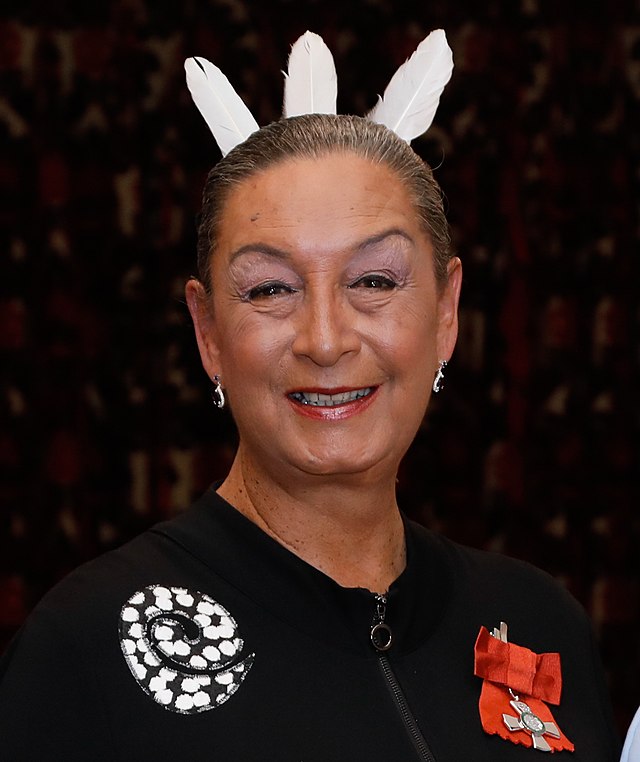
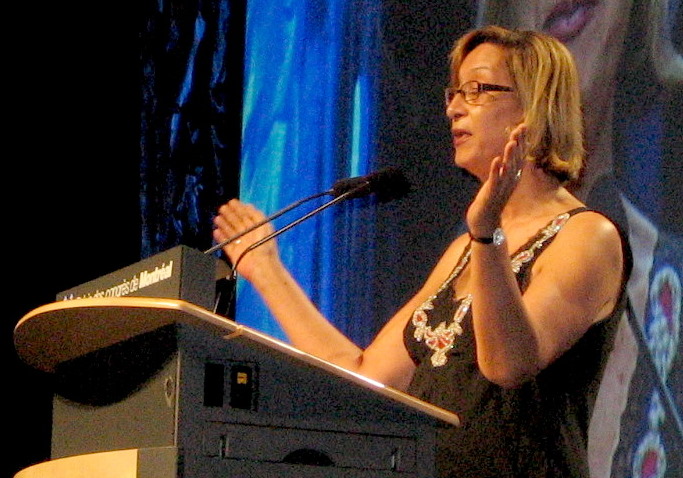
Photo credits
“Georgina Beyer, after her investiture as MNZM, for services to LGBTIQA+ rights, at Government House, Wellington, on 19 October 2020”
Year: 2020
Collection: New-Zealand Government. Office of the Government-General
Photographer: Unknown
“Georgina Beyer, member of the Parliament of New Zealand and the world’s first transsexual MP, addressing the Asia/Pacific plenary session of the International Conference on LGBT Human Rights in Montreal in 2006”
Year: 2006
Collection: Wikimedia Commons, user Montrealais
Photographer: Unknown
New Zealand politician Georgina Beyer was the world’s first openly trans mayor and later also member of parliament. A proud Māori and transgender pioneer, she combined her cultural heritage with her fight for the visibility and equal rights of sex workers and queer and transgender people. Her memory lives on in the transformation she brought about in society and in the rule of law in Aotearoa New Zealand.
Biography
Author: Dewi Vrenegoor
Trigger warning: this text discusses transphobia, suicide, and sexual and gender-related violence.
Georgina Beyer was born in Wellington, New Zealand / Aotearoa on September 17, 1957. Her roots were both European and Māori. As both her parents had problems of their own and were unable to care for her, she had a turbulent childhood. Staying first with the Salvation Army and then with her grandparents, Georgina was finally reunited, at the age of seven, with her mother and her mother’s new partner. That relationship did not last, however, and Georgina was once again sent away—this time to a boys only boarding school. With no one truly there for her, she felt abandoned. She no longer saw any point in living and attempted to end her life. Already from a young age, she had felt that she wanted to live as a girl and later as a woman, but those around her did not understand this. She had been bullied and abused since early childhood.
Taking her own path
At 16, she changed course. She left school and moved to Australia to take control of her own life. It was there that she took on the name Georgina. Forced to rely on herself, she earned an income through sex work and began performing as a drag queen. Her camaraderie with other drag queens and sex workers helped sustain her as a young adult; they depended on one another.
In response to all the challenges she faced in her life, she developed a rather candid sort of humor. Armed with self-mockery and a sharp eye for the absurdity and injustice of social wrongs, her quips hit the nail on the head. After being gang raped in Sydney in the late 1970s, she decided against going to the police. In an interview with the magazine The Spinoff, she explained: “As if the law would protect me, a Māori transgender prostitute. Yeah, right.”
Her perseverance helped her complete her transition in 1984, before she turned 30. It made her feel whole, but she saw little future for herself in Australia. Her anger at the fact that, as a Māori transgender woman, she had nowhere to turn is what later motivated her to enter politics.
Georgina steals the show
Back in New Zealand, she continued to work in the sex industry while also making initial sorties in the entertainment business. She worked as a singer and drag queen in Wellington’s nightlife. Having discovered in secondary school that she enjoyed acting, she applied for an audition. She turned out to have a feel for it. She was cast in the starring role in the television film Jewel’s Darl and for that role she was nominated for Best Female Actor at the Guild of Film and Television Arts (GOFTA) Awards.
The personal becomes political
In her new hometown, Carterton, she began working as a radio host and newsreader. Looking back on her life up to that point, she concluded that no one should have to go through what she had gone through. This was what motivated her to enter politics. Georgina joined the New Zealand Labour Party and was elected mayor of Carterton in 1995, becoming the first openly transgender mayor in the world and first Māori mayor in her district. Four years later, in 1999, she was elected to Parliament, becoming the first openly transgender parliamentarian in the world. With these milestones, Georgina became a role model for many.
During her maiden speech, she devoted a few words to mark the historical significance of the moment: “Mr. Speaker […] I cannot help but mention the number of ‘firsts’ in this Parliament: […] and yes, I have to say it, I guess, [I am] the first transsexual person in New Zealand to be standing in this House of Parliament. This is not only a first in New Zealand, ladies and gentlemen, but also in the whole world. This is a historic moment. We need to acknowledge that this country of ours leads the way in so many aspects. We led the way for women getting the vote. We have led the way in the past—and I hope we will do so again in the future—in social policy and certainly in human rights.”
In Parliament, Beyer translated the personal into the political. She stood up for LGBTQIA+ people, sex workers, and the Māori community. She worked on the Māori Language Act of 2003, for example, which aimed at preserving and revitalizing te reo Māori (the Māori language). She consistently advocated for the use of this language by government and public institutions. Her commitment to Māori emancipation was deeply rooted in her own identity and in the recognition that Māori culture and language are a fundamental part of New Zealand society.
She was straightforward, and with her characteristic humor she managed to break through taboos and barriers. During the debate on the legalization of prostitution in 2003, she began her speech with: “Madam Speaker, I shall take the liberty of assuming that I am the only member of this House with first-hand knowledge of the sex industry.” With her personal approach, she persuaded three Conservative Members of Parliament to vote in favor, allowing the law to pass.
An inner conflict
In 2004, an impossible political situation arose that affected Georgina in her entire being. A bill had been introduced to place the ownership of the foreshore and seabed officially under the New Zealand government, so that oil drilling could take place. Māori communities claimed rights to those coasts and the seabed on the basis of historical traditions and treaties. In contrast to her party colleagues, Georgina had initially spoke out adamantly against the bill. At the last moment, however, she sided with her party and voted in favor—something she later regretted.
It seems to have been a turning point in her political career. Her passion for it withered, and when her term came to an end, she left politics. She no longer wanted to have to choose between her heritage and her political affiliation. Her visibility as a trans woman had made her a role model, but it had also placed her in the firing line of impertinent questions that overshadowed her professional abilities. This frustrated her, and she did not leave that unspoken either.
Being yourself pays off
During her farewell address in Parliament in 2007, she said:
“For all the people who have felt inspired by my presence here in Parliament, I am grateful for that compliment… I could ask for no more than that, and whatever my future holds, this will have to have been the greatest moment of my life. Thank you.”
The years following her political career brought financial challenges and health problems. After kidney problems and endless dialysis, she became eligible for a kidney transplant in 2017. She died in 2023, surrounded by loved ones and, according to a close friend, joking until the very end and with a twinkle in her eyes.
After her death, Georgina Beyer was honored in words and deeds, with statements by politicians and friends and with a street named after her. She is remembered for her resilience, her humor, her generosity, and her inexhaustible commitment to human rights and social change. She never hid who she was. Her honesty and openness earned her respect and gave others the courage to be themselves.
Literature and sources
‘Eerste transgender parlementslid werd gedreven door boosheid maar bleef tot het laatst grappen maken’, Trouw, 6 maart 2023.
‘Georgina Beyer,’ Making Queer History, 30 augustus 2024.
‘Well! : never did I ever think that….?’, Georgina Beyer, Out!, 1993: p. 33-35.
‘Tell me to Shut up and go Away and I’ll Scream Even Louder , Express, 2019, p.28-29.