
Annemarie Grewel
zij/haar1935 – 1998
Annemarie Grewel was an influential Amsterdam thinker, politician, and civic leader who championed the establishment of “gay and lesbian studies” at the University of Amsterdam. With her self-chosen death, she remained an activist until the end.
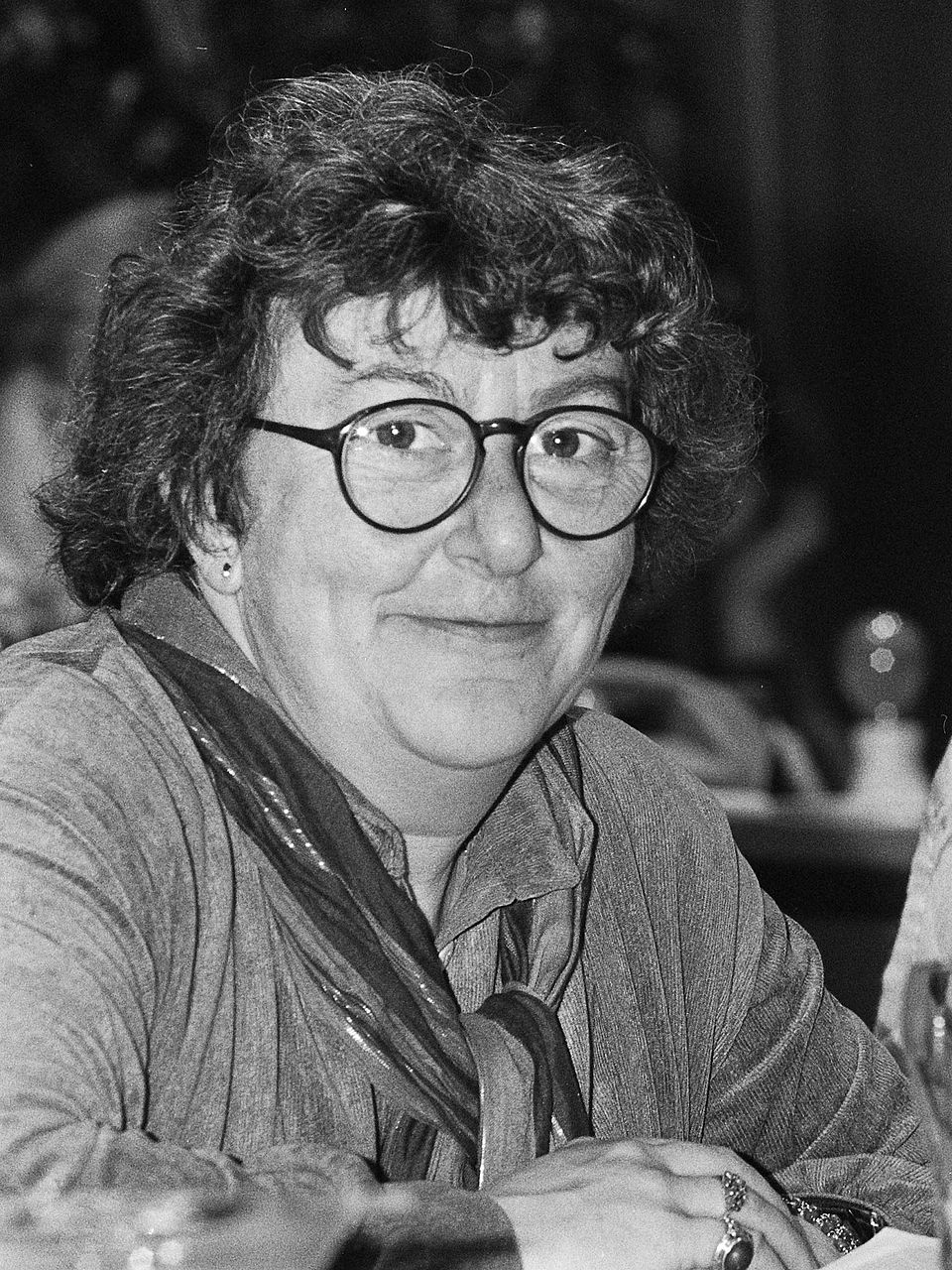
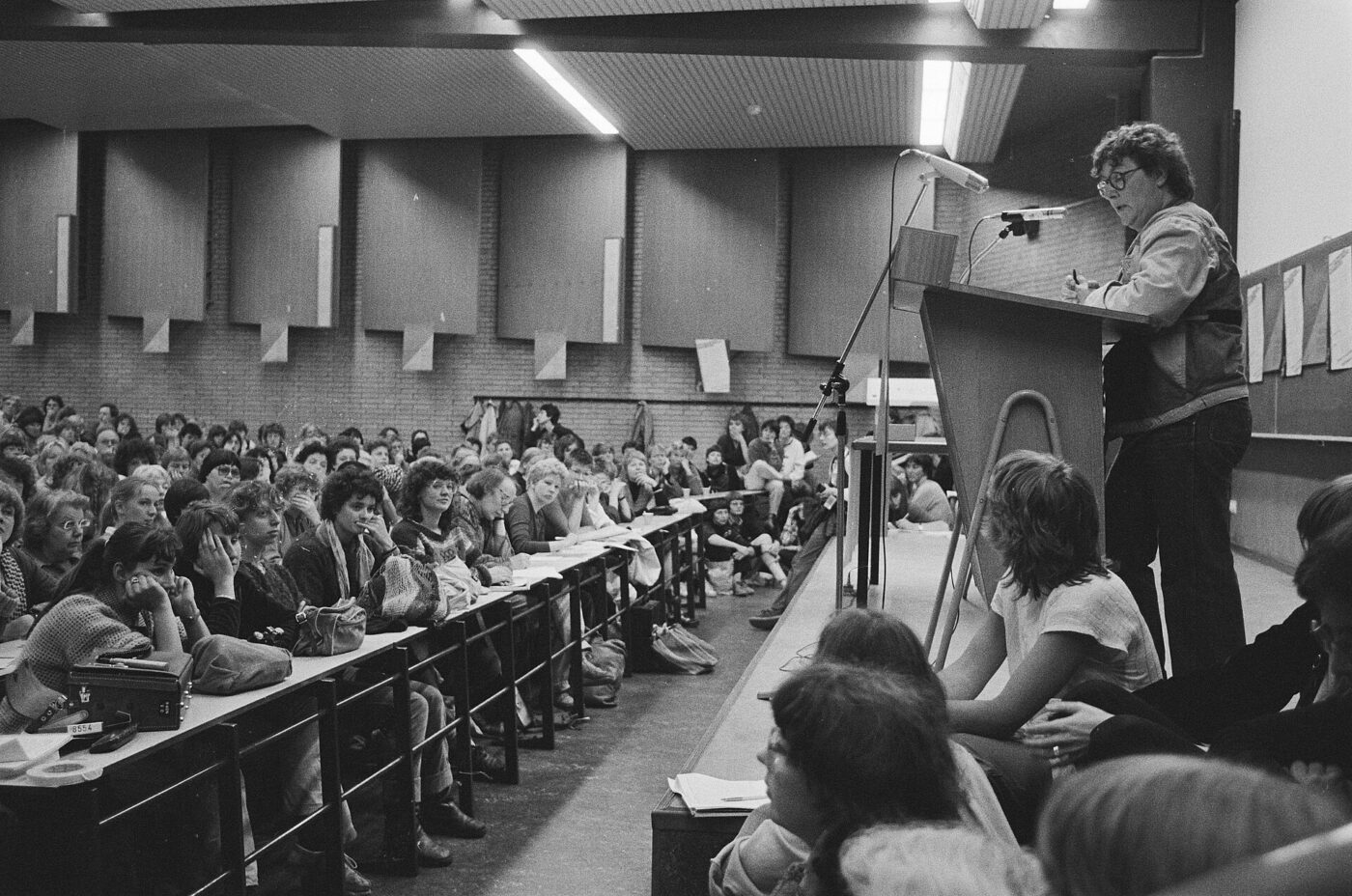
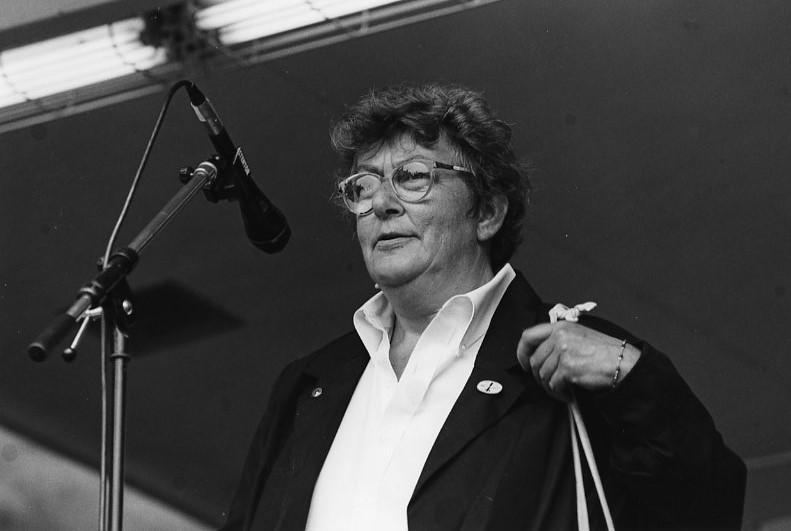
Photo credits
“Congress of the Red Women (Rooie Vrouwen) in the PvdA, at the RAI in Amsterdam”
Subject: Annemarie Grewel
Year: 1983
Collection: Anefo, National Archives
Photographer: Rob C. Croes
“Annemarie Grewel at the opening of the Summer University for Women’s Studies”
Year: 1981
Collection: Anefo, National Archives
Photographer: Rob C. Croes
“Portrait of academic and politician Annemarie Grewel (1935-1998) behind the microphone on the stage at the Grote Markt during Pink Saturday (Roze Zaterdag) Haarlem, 24 June 1989.”
Year: 1989
Collection: IHLIA LGBTI Heritage
Photographer: Marian Bakker
Annemarie Grewel was an influential Amsterdam thinker, politician, and civic leader who championed the establishment of “gay and lesbian studies” at the University of Amsterdam. With her self-chosen death, she remained an activist until the end.
Biography
Author: Agnes Cremers
Warm aloofness
Annemarie Grewel grew up in an elitist family of assimilated Jews on Amsterdam’s well-to-do Willemsparkweg, where artists such as Carel Willink were regular visitors. Her father, Frits, was a child psychiatrist and the first Dutch professor of remedial education. In some of the columns she would later write, Annemarie described her mother, Fiete, as an unbalanced woman. Her parents’ divorce in 1956, after a physical altercation, left deep marks on her. Yet for years she kept a note from her father: “Dear Annemarie, Happy Birthday. I hope you have a pleasant day. On 13 June 1935 I was very happy with you, and I have remained so. Your Father.”
Annemarie Grewel was very closed about her private life and about herself. Dutch journalist Bibeb, who interviewed her in 1980 for the Vrij Nederland (in those days a left-leaning progressive Dutch weekly newspaper on politics and culture), described her as follows: “Small, pleasant hands. Has something of a cat. Catlike aloofness.” Grewel indicated that she still thought about the war every day and that for a long time she had wanted to know everything about that period, perhaps out of feelings of guilt towards the victims of the camps. Apart from that, she acknowledged that she felt constrained when she had to talk about herself and could sometimes remain silent for hours. According to Dutch politician Hedy d’Ancona, with whom she shared a house during her student years, her aloofness functioned as a safety zone: within that zone it was pleasant, but as a friend you constantly had to fight for your place.
Humor and authority
Grewel jokingly called herself “triply handicapped”: Jewish, lesbian, and feminist. She studied pedagogy and became a research assistant at the University of Amsterdam. But her real talent manifested itself not in the office but in the pub, being out among people. Former colleagues remembered her as a drifter who sat at the bar more often than behind her desk. Her drinking was legendary, but it was in a pub that she met Nelly Frijda, with whom she lived openly for ten years.
She found her true calling in 1973, when she became chair of the faculty council. That role suited her so well that she was soon appointed chair of the university council. It was a position she filled for seven years with humor, authority, and a sharp eye, and through which she became known as “the eternal chair.” She also presided over other more public meetings, including the Grand Gala of Emancipation that Dutch public broadcasting corporation VPRO aired on TV in 1978, always steering things in the right direction with a wink and a clear vision. She did that for the conventions of the Dutch Labor Party as well in her characteristic, slightly rasping voice, which her father once compared to the sound of a bumblebee in a watering can.
In 1979, she received the Uilenspiegel award from Joop den Uyl (former Dutch prime minister from the Labor Party) because, as he put it: “in the slack tide of politics, as a sober feminist, she knows how to stand her ground like a Till Eulenspiegel.” Her trademarks were a large pair of glasses that kept slipping down her nose, and a sharp tongue.
Activist
Grewel was one of the driving forces behind the establishment of the Dokumentatiecentrum Homostudies (Homodok), which later became part of IHLIA, now Europe’s largest LGBTQIA+ archival collection. Together with colleague Jim Holmes, she organized a meeting at the end of the 1970s to put lesbian and gay studies on the map. She succeeded in steering subsidy applications for women’s studies, and later for gay studies, through the decision-making process.
Her life was not without controversy. At the beginning of the 1980s, while being interviewed by Dutch talk-show host Sonja Barend, she and another guest were pelted with paint, which produced striking live television. After she had put herself forward for the mayoralty of Amsterdam in 1983 but was not appointed to the position, she called out the discrimination that she felt had played a role: “Even so, I got quite far – leading to sneers from all sorts of people about what a disgrace an unmarried, lesbian mayor would have been!” She hardly lacked visibility thanks to the numerous other positions she held. When she joined the board of the NOS (the Netherlands’ largest news organization and part of the Dutch broadcasting system), Amsterdam’s daily newspaper Het Parool quipped: “Quiet meetings will now be a thing of the past: the NOS board is being reinforced by Annemarie Grewel.”
Positiva
Well into the 1990s, Grewel remained active as a columnist for independent weekly news magazine De Groene Amsterdammer and as a member of the Dutch Senate in The Hague, where she was also second vice-president and thus the first woman to occupy a seat on the Senate’s presidium. In the final years of her life, Grewel suffered from cancer. Even during her illness, she remained active and spoke openly about it. Nevertheless, she also struggled with her approaching end. In her final column for De Groene Amsterdammer, she wrote: “I am a little less mobile, but since I am such a positiva (optimist), I think that this is only temporary. Nonsense, of course, but that is how I keep up my courage.”
She never officially took leave of the Senate or of De Groene Amsterdammer. On February 27, 1998, she died at the age of 62. She was buried in a bright red coffin at Amsterdam’s Zorgvlied cemetery. In the municipal elections held later that year, she still received 2,633 preferential votes posthumously.
Literature and sources
Annemarie Grewel’. Vrouwenlexicon KNAW Huygens.
1982: verfsmijterij bij talkshow Sonja, Leeuwarder Courant, 13 april 1982.
De zwerftocht van Annemarie Grewel. Jojanneke Claassen, Jochem Brouwer; Annemarie Grewel. In: Ons Amsterdam, 47 (1995) 4 (apr), p. 103-106.
Biografie Annemarie Grewel. Parlement.com