
Max Lievendag
he/him1950 – 2017
Max Lievendag co-founded the first Dutch organization for Black LGBTQ+ people, particularly those with a Surinamese background. He was committed to LGBTQ+ emancipation in both the Netherlands and Suriname.
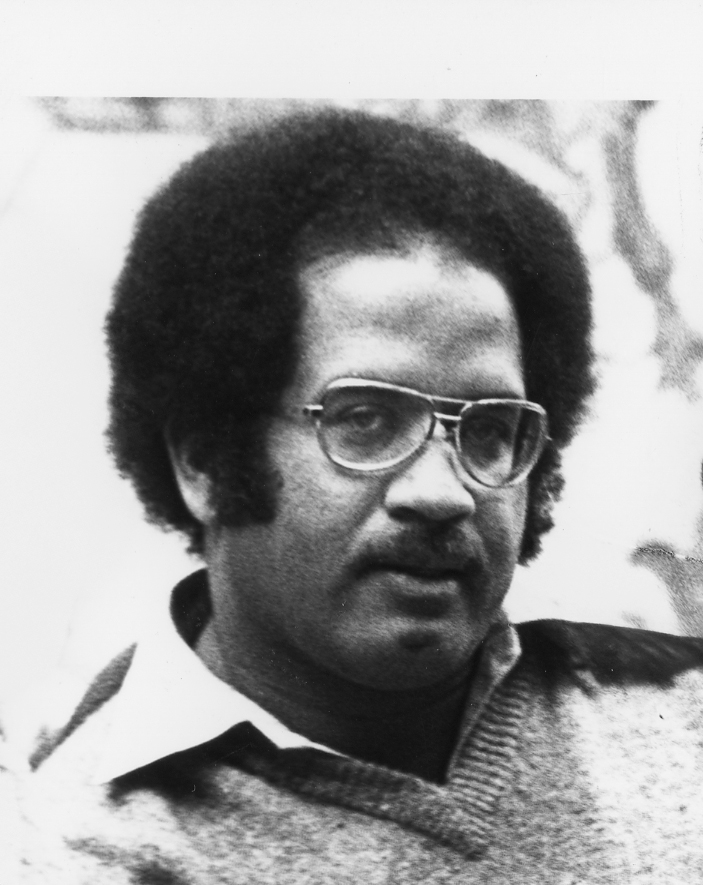
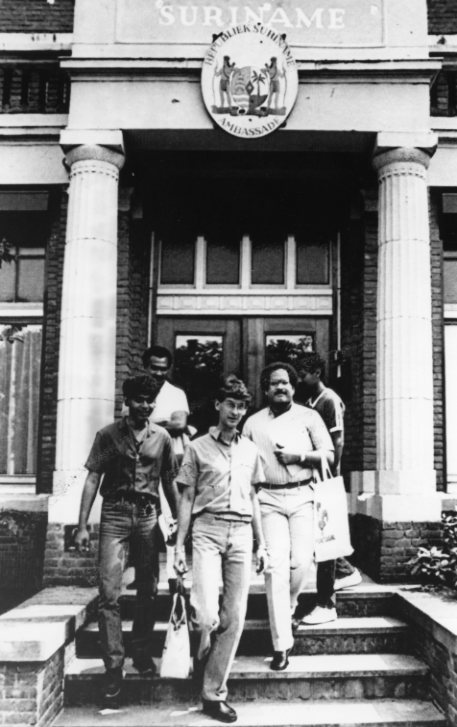
Photo credits
Detail “Max Lievendag” from “SUHO, October 1980”
Year: 1980
Collection: IHLIA LGBTI Heritage
Photographer: Bernard de Wolff
“Members of SUHO leaving the Surinamese embassy in The Hague”
Year: 1983
Collection: IHLIA LGBTI Heritage
Photographer: Bernard de Wolff
Max Lievendag co-founded the first Dutch organization for Black LGBTQ+ people, particularly those with a Surinamese background. He was committed to LGBTQ+ emancipation in both the Netherlands and Suriname.
Biography
Author: Nellie Bakboord (with thanks to Anita Breeveld, Lionel Jokhoe, and Thijs van Praag)
Back when we hard at work increasing the visibility of Surinamese homosexuals in the Dutch society in the 1980s, it never occurred to me to ask Max about his family. None of us within SUHO paid much if any attention to our childhood years in a Surinamese society that was profoundly hostile towards homosexuality. Especially among those of the older generation, the Surinamese word boeler (faggot) left deep scars.
Max Lievendag was born in 1950 in Paramaribo, Suriname, the first son of Eddie Lievendag and Louise Janssen. Two more brothers and a sister would follow. Max was an exceptionally talented pianist. A self-taught musician, he could play classical pieces by Chopin with remarkable ease. He also loved dancing and was a true “prince of the kitchen”—his friends would describe him as a genuine food lover.
Max and the men
When Max met Lionel Jokhoe in high school, the two became lifelong friends. They confided in one another that they both liked boys more than girls. Later, Max would learn the meaning of the term mati-sma. Literally translated from Sranan, it means “friend of people” and is used for people who engage—not necessarily exclusively—in sexual relationships with people of the same sex.
Max was not ashamed of his sexual orientation. According to his niece Anita Breeveld, he never cared what others thought and started living together with his partner Carry. Whatever he undertook, he did wholeheartedly. Although initially there had been tensions some in his family, he would eventually be seen as a family member that everyone was proud of since he stood up for himself so well. With his engaging personality, Max made friends easily. His friends remember him as being a big flirt and a man with a keen eye for “handsome men in the gay pond.” Yet Max also endured considerable heartbreak, including relationships with married heterosexual men. In this respect, he remained extremely discreet.
In 1971, his close friend Lionel left to study in the Netherlands. When Max traveled to the Netherlands for his work at a travel agency a few years later, Lionel took him on a “safari” through the gay scene in The Hague.
Lionel sent him back to Suriname with an LP by Dutch singer Robert Long, who had come out as gay. Max made sure that the album Vroeger of Later (Sooner or later) was played on Surinamese radio. The song “Jezus redt” (Jesus saves) even caused a small controversy in religious circles. These developments encouraged Max to become more active in challenging the taboo surrounding homosexuality in Suriname. He organized house parties for like-minded people in private settings and worked to establish educational programs on the subject in schools. He did that in cooperation with Stichting Lobi, Suriname’s organization for sexual reform.
SUHO in the Netherlands
After having visited the Netherlands numerous times on holiday, Max settled there in the second half of the 1970s. In 1980, Lionel Jokhoe’s Master’s thesis—on Surinamese ‘”homophiles” as a forgotten group in Dutch society—attracted the attention of Zorg en Hoop (“Care and hope”), a Surinamese radio program broadcast by the Dutch public broadcasting corporation. Max and Lionel’s mother went along for an interview. Their collaboration led to the founding of SUHO (Surinamese Homosexuals), the first Black gay organization in the Netherlands and in Europe.
Max did not mind being a public face for this community. He was accustomed to being in the spotlight. In Suriname, he had worked as a newsreader for STVS, the national television broadcaster. Together with the first stonfutu (pillars of support)—Lionel Jokhoe, Frank Consen, Maureen Tardjopawiro, Carawan Groenefelt, Egmond Godfried, Nellie Bakboord, Tieneke Sumter, and Carla Bakboord—he helped give shape and substance to the working group.
From organizing activities to publishing their own magazine and hosting large parties (“mati fesa”) —SUHO did it all. The goals of the working group, as outlined in the first SUHO newspaper, included:
- providing information, education, and advice to LGBTQ+ peers through lectures, discussion evenings, and networking with relevant institutions and groups;
- creating and maintaining opportunities for personal education and awareness;
- promoting scientific research;
- pursuing social action, including demonstrations and public campaigns.
Article 302
SUHO organized unforgettable large-scale parties in Amsterdam, featuring spectacular performances at the building of the association Ons Suriname (“Our Suriname”). The working group operated entirely on a voluntary basis, working hard but also enjoying good food together. Celebration and social connection went hand in hand with political commitment.
On June 24, 1983, SUHO, together with members of the Surinamese Working Group on Homosexuality (SWH) in Paramaribo, submitted a petition to the Surinamese Embassy calling for the repeal of Article 302 of the Surinamese Penal Code. This article was a colonial-era remnant equivalent to Article 248bis in the Dutch Penal Code. It prohibited sexual acts between two people of the same sex under the age of 21. The provision was discriminatory because the minimum age for heterosexual relationships was sixteen. In the Netherlands, Article 248bis had been abolished in 1971. It would take until 2009 before the Article 302 was finally repealed in Suriname.
Memories of Max
Max was diagnosed with Parkinson’s disease. According to his friends, he remained a positive person who sought out and appreciated the beautiful—and delicious—things in life despite his illness. He is remembered as generous, warm, and full of humor. His friend Thijs van Praag recalls:
“When he was working at the travel agency, he was the one who spontaneously told me about an attractive travel deal to Malaysia: one week in a hotel, including a rental car, for the price of an airline ticket. Since only a few seats were available under that offer, you had to act quickly. I certainly would never have thought of going there on vacation. It was typical of Max to think of someone else and, in this case, to approach me about it.”
Nellie Bakboord spoke with Max for the last time on July 24, 2017. At the initiative of Lionel Jokhoe, they gathered for a Surinamese meal together. Lionel, Max, Nellie, and her partner Wilgo shared a sandwich with pom and salt cod at Max’s nursing home in Brielle. It was already clear at that point that Max was living his final days.
Three days later, on July 27, Max Lievendag passed away at the age of 67—a beloved mati-sma, a friend of people. Posthumously, he was awarded the MATIE Award by Suriname’s LGBTQ+ community in gratitude and recognition for his years of dedication and service.
Literature and sources
Isenia, Wigbertson Julian. “SUHO,” on With Pride – IHLIA LGBTI Heritage.
Liesdek, Patrick. “9 Mati’s van Ondro-wowoyo,” Lezen doet je goed. 7a, 2023.