
Betty Paërl
zij/haar1935 – 2022
Radical activist and “provo” Betty Paërl was a taboo-breaking University of Amsterdam teacher, writer, dominatrix, and transgender rights activist. She fought for decolonization and sexual freedom and criticized the prevailing gender norms.
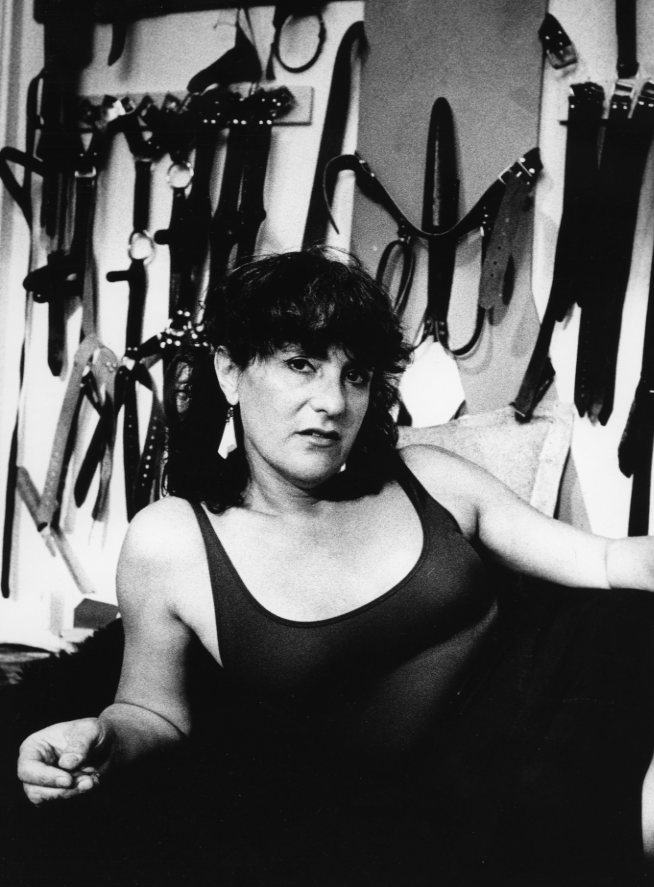
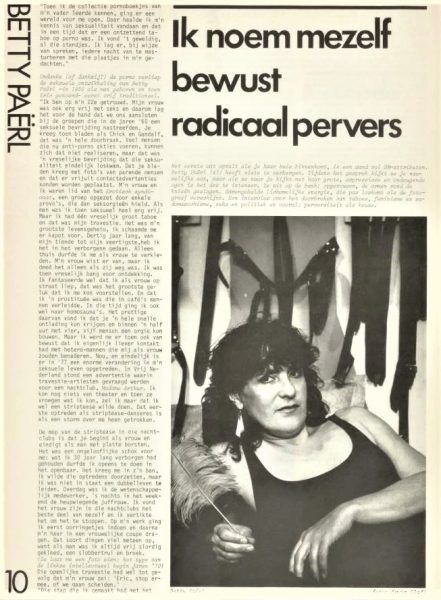
Photo credits
“Betty Paërl”
Year: 1982
Collection: IHLIA LGBTI Heritage
Photographer: Erwin Olaf
Article “Ik noem mezelf bewust radicaal pervers” (I deliberately call myself radically perverse)
Year: 1982
Collection: IHLIA LGBTI Heritage
Author: Maurice van Lieshout for SEK
Radical activist and “provo” Betty Paërl was a taboo-breaking University of Amsterdam teacher, writer, dominatrix, and transgender rights activist. She fought for decolonization and sexual freedom and criticized the prevailing gender norms.
Biography
Author: Fleur Gähler
The enchanted garden of Betty Paërl
Somewhere far, far away, hidden deep in a forbidden place in the city, lies the enchanted garden of a transvestite. The garden is accessible only to a very particular kind of person who possesses mathematical precision—whoever does not possess that will never find it. It is exactly there, in that place, that Betty Paërl’s story starts. It was her own story, her entry in a short story competition that Dutch national newspaper NRC organized in 1981, in which readers were asked to describe their vision of a utopia. The jury divided the 223 entries into various categories, ranging from utter crap to possible prize winners. Most of the entries described utopias where the good-humored inhabitants live in a pleasant climate where it only rains at night, when everyone is asleep. And nearly agreed that the ideal form of government in their paradise would be a democracy.
But Betty Paërl’s story—“Een tovertuin van een travestiet” (An enchanted garden of a transvestite)—is not about eternal life or sunny days. Instead, Betty wrote about the visual stimulation the protagonist gets from seeing provocative women’s underwear in the mirror. She writes about semi-transparent slips, shiny black stockinged legs and pale rounded thighs with black garters and playful ruffles. Her entry did not win a prize, but NRC considered it worthy of honorable mention.
Babylonian temple prostitute
Was Betty born in that enchanted garden, as it were? The young Paërl had come into the world in the Amsterdam of the 1930s. Were her parents already thinking, standing there beside the cradle before going to bed and looking at their sound-asleep newborn and stroking its head: “There lies our little bird-of-paradise chick”?
By her own account, Bettywas born to be a sex worker. If she had had a previous life, she would have been a Babylonian temple prostitute, she proudly declared in Dutch communist daily newspaper De Waarheid on July 7, 1984. A decade earlier, you would not have heard her say that. The road towards becoming a commercial S&M dominatrix and lesbian transsexual had been long and bumpy.
The transition of a communist mathematician
Betty studied mathematics, married Hetty van Driel at the age of 22, and had a son with her in 1962. After Betty completed her doctorate in 1968, she began working as a lecturer at the University of Amsterdam. Together with Hetty, she protested against injustice. She was involved with the Dutch countercultural “Provo” movement and called herself a communist. She and Hetty were both members of the Suriname Committee, and they published a book together: Klassenstrijd (Class struggle). In 1973, they also traveled through Suriname for three months to make documentary films.
Meanwhile, she was engaged in her own inner struggle. For years she had lived a secret life as a trans person. At a certain point, she realized she could no longer do that; she felt that she was in fact a woman in every respect. As she described it:
I had engaged in cross-dressing all my life, but in those days I didn’t yet have the constant need to present myself as a woman. Around the time that I separated from my wife, I became aware that I enjoyed sexually suggestive performances. I went to cabarets around Rembrandtplein and bought myself a wig. My experience as a prostitute in a brothel was a euphoric sensation. That first time you notice that your partner—even if that was a john—accepts you as a woman. The sense of being approached as a woman unleashed a whole bouquet of emotions. It was not only sexual but also emotional. It impacted everything. [From an unpublished interview with N. Pauline, 2013]
The moment of truth arrived in 1980: she began her transition. Even then, waiting lists were long. For that reason she went to London to undergo surgery. In the former Dutch social-democratic daily newspaper Het Vrije Volk in 1987, she explained: “From my tenth to my 40th year I was constantly ashamed of myself. Every time anyone brought up homosexuality or crossdressing in company, I would start trembling with nerves. Once you have overcome that, plus all the complications surrounding the operation, you can handle anything and dare to say anything.”
Her marriage did not survive the transition. The level of acceptance she experienced in her left-wing social circles proved disappointing. But Betty had hidden herself long enough. She had made her enchanted garden accessible and was no longer willing to remain silent. Around the time she separated from her wife, her interest in S&M was awakened. One thing led to another.
A penchant for precision
She wrote candidly about sadomasochism and her experiences as a sex worker. In response to an article by Gaby van der Mee, who claimed that sadomasochism is not at all as liberating as many feminists claim, Betty wrote in De Waarheid in April 1984: “Of course every sexual orientation is liberating the moment you free yourself from heavy taboos and traditional social norms.” In her view, as long as two people voluntarily decide to experience a certain form of sex without harming others, everything is acceptable. Her reaction to Van der Mee’s article ended in clear terms. As far as Betty Paërl was concerned: S&M women did not want to be patronized by “vanilla feminism.”
In De Prothese, a monthly magazine for politics and sexuality, Betty filled the back page promoting dildos and vibrator courses, sex slings and chastity belts. But she also made herself heard on public broadcasting programs. In the emancipatory Dutch TV program Rok en Rol (Skirt and role) with actress and comedian Loes Luca, Betty explained the different kinds of dildos on the market, with and without vibrating elements. “In mathematics everything is exact, and that also applies to a certain extent to sex, too. It is incredibly easy to speak about sex in a veiled way. People tend to use those lifeless words, words that you can’t picture. Like, ‘Intercourse.’ Precisely because of my inclination toward exactness, I can approach sex in a very concrete way. Dildos, for instance: I simply call them by their name.”
PPP vs VVV
That openness was not always appreciated. But Betty did not hesitate to respond to her critics’ “PPP” or puriteinse prietpraat (puritanical piffle). For with “VVV” of vrouwvriendelijke vrijmoedigheid (woman-friendly frankness) it was just as easy for her to explain which size dildo will fit best as was for her to take a stand for greater visibility for sexual minorities. As she saw it, while transsexuality may concern a very small minority group, it is nevertheless closely connected to a larger problem, namely that of “the feminine side of men and the frustration that many men feel with the role society imposes on them as men.” In that respect as well, the 1980s were not that different from the current oat-milk age.
If you are ever fortunate enough to enter the enchanted garden, look up at the sky. There is a good chance that you will see a bird of paradise flying there.