
Dirkje Kuik
zij/haar1929 – 2008
Transgender pioneer, writer, and artist Dirkje Kuik is an important historical figure for the city of Utrecht. In 1985, she secured the right for people in the Netherlands to change their legal gender and name.
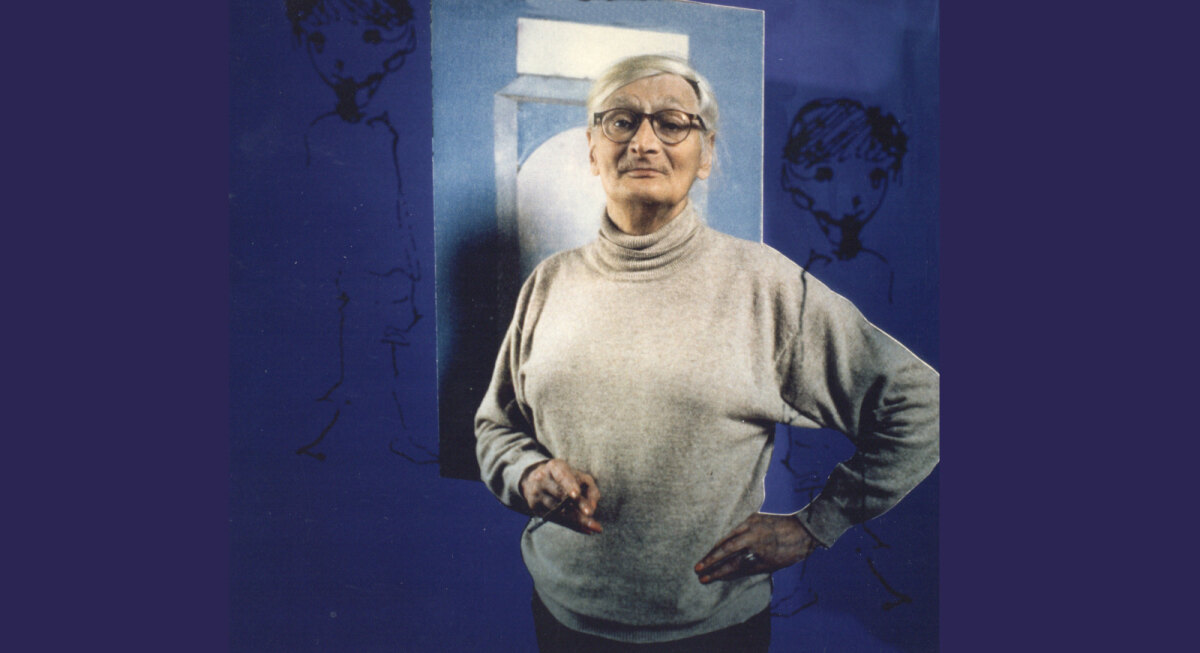
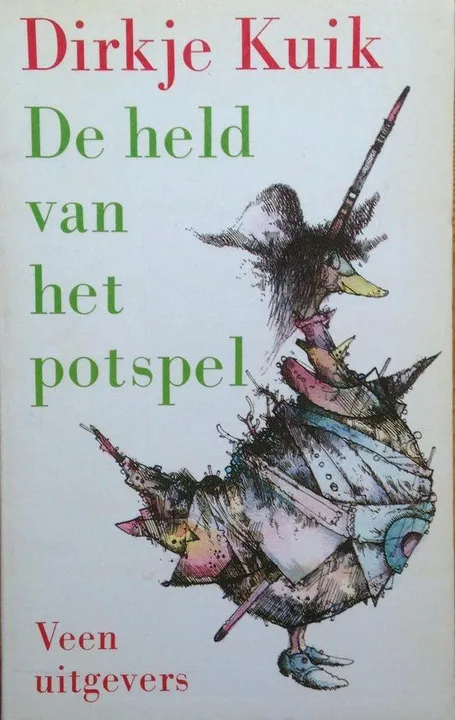
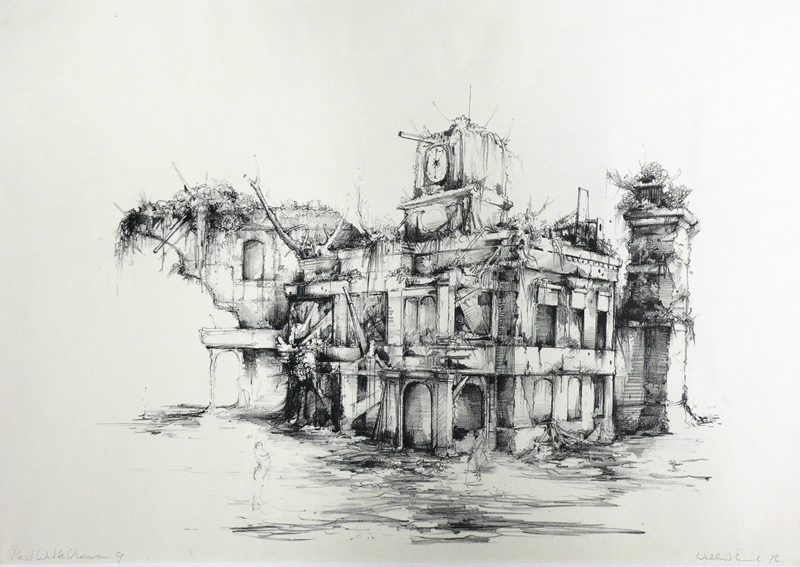
Photo credits
“Portrait of visual artist and writer Dirkje Kuik, 1995”
Year: 1995
Collection: Stichting Stedelijke Fotografie Utrecht (SFU), Het Utrechts Archief
Photographer: Daria Scagliola
Book cover “De Held van het Potspel”
Year: 1987 (first edition 1974)
Collection: IHLIA LGBTI Heritage
Lithograph “Post Witte Vrouwen 9”
Year: 1972
Collection: Grafiek & Curiosa Oom Willem
Creator: William D. Kuik
Transgender pioneer, writer, and artist Dirkje Kuik is an important historical figure for the city of Utrecht. In 1985, she secured the right for people in the Netherlands to change their legal gender and name.
Biography
Author: Maurice van Lieshout
Dirkje Kuik was not only one of the most important artists from Utrecht of the 20th century, but also that Dutch city’s best-known trans woman. “I never decided to become a woman. I should have been one from the beginning,” was one of her characteristic statements.
Train dresses and satin shoes
Dirkje, born in 1929 as William Diederich Kuik, had an unusual childhood. “I walked around the house in long train dresses and satin shoes, with luxuriant wigs on my head. No one ever said: ‘You mustn’t do that’ or ‘That isn’t appropriate,’” she recalled in a 1978 interview with Dutch journalist Bibeb. The Kuik family was not well off, but there was an open, almost bohemian atmosphere in their home. Kuik’s father was a woodworker and ornamental craftsman, and in the mid-1930s he settled with his wife and child at Oudekamp 1. Decades later, this modest house in Utrecht would become Dirkje’s own home and studio.
At primary school, William—as he was still known at the time—encountered a very different mentality from that at home. Classmates responded with mockery, insults, and fights to the boy who liked to wear girls’ clothes. Accordingly, those clothes were soon exchanged for boys’ clothing.
Artist and writer
Dirkje Kuik studied fine arts at the Rijksakademie in Amsterdam, worked as an art critic for the city’s daily newspaper Het Parool, and contributed drawings to the weekly magazine Vrij Nederland. Together with Joop Moesman and Henc van Maarseveen, she founded the graphic collective De Luis (The louse). From 1958 to 1972, with some interruptions, she was a member of the Utrecht art society Kunstliefde (Art love).
Dirkje Kuik was fascinated by the past and by urban decay. Various Italian cities, but also Utrecht, inspired her to create drawings and etchings in which existing buildings already reveal the ruins hidden within them. Her first book, Utrechtse notities (Utrecht notes), was published in 1968, and that was followed by around 20 others. Her body of work consists of a unique mixture of poetry, autobiographical sketches, stories, essays, and drawings. Her illustrations depict real and fantastical animals and human figures, often adorned with hats from the Italian Renaissance or Napoleonic France. Her work received multiple awards.
Gender diaspora
In 1958, Dirkje—also then still known as William—married Marieke van Vuren, who gave her the freedom to wear women’s clothing at home. The couple separated in the mid-1960s, and from 1977 onward, Dirkje wore only women’s clothing and went by her new name. This was the situation she described a year later to journalist Bibeb: “I am not one of those people who are destroyed by it, but I remain a man in disguise, and that bothers me. I cannot simply walk outside in my denim skirt to sweep the pavement as if nothing were unusual. It’s getting better all the time, but it all depends on me. It’s really up to you to gather all the courage yourself.”
At the time of her interview with Bibeb, Dirkje Kuik had already begun hormone therapy. In an earlier filmed interview, she described that: “From the moment I started those hormones, I improved, physically as well. I looked beautiful—at least quite decent—and it became pleasant. I began to flourish. It was really like a second puberty, but a favorable one.”
In 1979, Dirkje Kuik decided to undergo gender-affirming surgery, for which she traveled to London. She later wrote an extensive article about the operation and her new life as a woman that appeared in Dutch national daily NRC Handelsblad in 1980. In her collection of essays Huishoudboekje met rozijnen (Household notebook with raisins) from 1984, she described how a doctor had given her a “neo-vagina,” made from “penile remnants.” Dirkje preferred not to call herself transsexual (the common term at the time), but rather a “gender diaspora patient.”
A new life
After her transition, Dirkje felt reborn. Although she lost friends who could not accept her transition, she also made new ones, including bricklayer Jo Nijenhuis, with whom she shared a happy relationship for 15 years until his death in 2001. That some art collectors returned her work to galleries did not trouble her. Like other transgender people, it was only after a long legal struggle that Kuik able to change her gender on her birth certificate and official documents. It is partly thanks to her activism that the Dutch Parliament finally passed a law enabling legal gender change in 1985.
Dirkje was regarded as “a woman with a user’s manual”. Headstrong and sharp-tongued, she was someone with whom arguments could arise quickly. During the last 30 years of her life, she lived once again in her childhood home at Oudekamp 1. Due to illness, she gradually withdrew, until Jos te Water Mulder started taking care of her. He organized an exhibition and inspired her to create new work. After her death, he established the Dirkje Kuik Foundation and opened her house as a museum. Due to financial constraints, it had to close in 2012. Only a poem and a drawing on the facade opposite, along with a tile bearing a QR code on the street corner, still commemorate the remarkable resident of the house.
A source of inspiration
Dirkje Kuik and her work continue to inspire. In 2020, the German queer artist Philipp Gufler created a large silkscreened piece about Kuik’s life for the Centraal Museum in Utrecht.
In December 2024, a multi-day program honoring her took place in Utrecht, featuring lectures, an exhibition, and the unveiling of the commemorative tile with QR code. Since 2023, the Utrecht Queer Culture Festival has organized the annual Dirkje Kuik Lecture.
Literature and sources
‘1929-2008 Dirkje Kuik.’ Queer-U-Stories.
‘Dirkje Kuik,’ Erika Visser. Literatuurmuseum.
‘Dirkje Kuik,’ Lespakket Transgender pioniers. IHLIA LGBTI Heritage.
Een huishoudboekje met rozijnen. Dirkje Kuik, 1981.