
Rob Meijer
he/him1933 – 1990
As one of Europe’s pioneering leatherwear craftsmen, Rob Meijer sought to promote the visibility and social acceptance of the gay leather, fetish and BDSM communities with his RoB Amsterdam store and gallery.
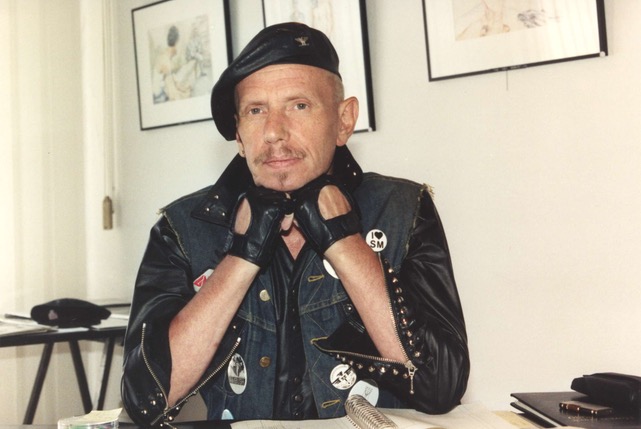
Photo credits
“Rob Meijer”
Year: 1989
Collection: JackFritscher.com
Photographer: Jack Fritscher
As one of Europe’s pioneering leatherwear craftsmen, Rob Meijer sought to promote the visibility and social acceptance of the gay leather, fetish and BDSM communities with his RoB Amsterdam store and gallery.
Biography
Author: Tom Johnston
Rob Meijer was born in Amsterdam in 1933. Having only just started primary school when the Germans invaded the Netherlands in 1940, he came of age during the difficult years of the Second World War and the period of reconstruction that followed. He learned tailoring and found employment as a dressmaker, specialising in the design and tailoring of dresses in large sizes. At a certain point he also got married – a move that many gay men made in those days. His marriage would only last eight months, however. As he began to explore his sexuality, it became clear that the marriage was viable.
In 1973 Rob met Nigel Kent (1933–2017), an Australian sculptor his same age who had only recently moved to Amsterdam from London. Having left Australia in his twenties, Nigel had been living in the UK for well over a decade. He married at the age of 30 and divorced five years later. In moving to Amsterdam as he entered his forties, he hoped to be able to explore life as a gay man more easily. Nigel is credited with having introduced Rob to BDSM and for encouraging him to put his talents as a tailor to use for the leather scene. After first creating a pair of leather trousers for himself, Rob soon began doing the same for friends and acquaintances – paying customers – in his free time. Within a few months, he quit his job as a dressmaker and went into business for himself. He opened his first store on Rozengracht, the westward extension of Raadhuisstraat (the street on which the Walk of Pride can be found).
‘God made man, Rob the leatherman’
Rob saw how a leather outfit could be transformational, liberating for the one who wears it, imbuing them with confidence and pride. He would wear his leathers virtually everywhere, for any occasion. That included to dinners in restaurants and performances in theaters. In doing so, he helped make it easier for others to dress in the way they wished as well. He also recognized that leather had a wider appeal than just in BDSM circles. The market for his leatherwear was also wider. Besides leather clothing, he also promoted tattoes and piercings, providing safe and quality opportunities for both in his store. In 1978 he moved his store from its address on Rozengracht to one on Weteringschans, a road on the edge of the old city center.
Art was wear his heart was
The new store, located in the basement of his home, was now accompanied by the RoB Leather Gallery. It was the first art gallery in Europe that was dedicated entirely to promoting fetish-inspired male erotic art to a wider, international audience. For the first show, in 1978, Meijer invited homoerotic artist Tom of Finland to exhibit his work in Amsterdam. That show also featured new works by Rob’s then partner Nigel Kent, who had become inspired by Tom of Finland’s work. Martijn Bakker, Rob’s successor in the business, described Rob’s relationship with erotic art as follows:
He was known for the quality of his leather trousers, and people would come to his store from all over Europe, but I think the art was where his heart was.
RoB gallery had a lasting effect on the queer visual culture of the 1980s and 1990s by helping to legitimize erotic imagery as an artistic language. As Betty van Garrel put it in her review of a show the Amsterdam gallery had in 1981:
By exhibiting ‘Erotic Male Art,’ Mr. Rob is waging a fight on two fronts: for the acceptance of his fellow gay men and the return of the male model to art.
There was considerable interest in both the leatherwear Rob produced and the erotic art he promoted. In 1980, he opened a gallery in New York as well. In 1988 the Amsterdam store and gallery moved a few houses down on Weteringschans, and in the 1990s Rob also had corporate franchises in Berlin, Brussels, London, Manchester, New York, Paris, San Francisco and Zurich. There are currently two locations: one on Warmoesstraat in Amsterdam (the Amsterdam neighborhood traditionally most associated with the queer leather community) and one in Berlin (in Schöneberg).
Meijer died from medical complications caused by AIDS in 1991, less than three months after his then partner, Dai Evans, had succumbed to the same disease. Rob’s legacy lives on in the leather community and BDSM communities. A couple of years before his death he received the M/V Award for Emancipation from the KRO in 1989 in recognition of his art gallery and leather shop, deemed of importance as a place where the gay community could come together. In 2023 he was posthumously inducted into the Leather Hall of Fame in Los Angeles for his enduring contribution to the international leather community and the pioneering role he plaed in promoting visibility, acceptance and pride.
Literature and sources
Bartels, Thijs & Versteegen, Jos. “Kent, Nigel” en “Meijer, Rob” in Homo Encyclopedie van Nederland, Amsterdam 2005, p. 288-89, 291-92.
Fritscher, Jack. “Rob of Amsterdam” (interview) in Profiles in Gay Courage: Leatherfolk, Arts and Ideas. 2024.
Garrel, Betty van. “Male erotic art” in NRC Handelsblad, 21 August 1981, p. CS 6.
Liang, Michelle. “Leather nostalgia: Constructed histories of Dutch leathermen through national discourses of tolerance and white innocence,” in Sexualities, 28 (2025) 1832–51.
Moll, Maarten, “Leerfetisjwinkel RoB Amsterdam is al vijftig jaar een begrip” in Het Parool, April 14, 2025.
“Nigel Kent,” Tom of Finland Foundation.