
Tania Ruth Naomi Leon
zij/haar1945 – 1996
South African activist and feminist Tania Leon was a instrumental in founding several Dutch organizations dedicated to the equality and emancipation of women in general and Black lesbian women in particular.
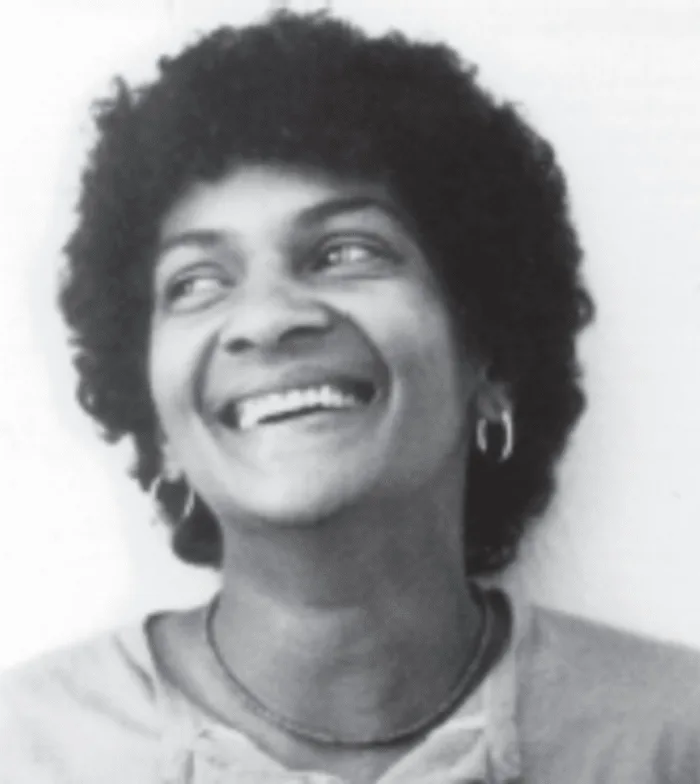
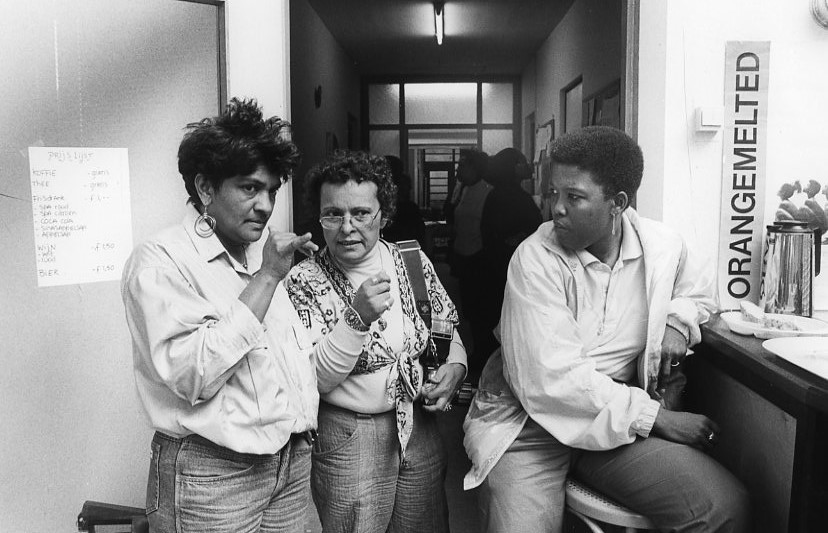
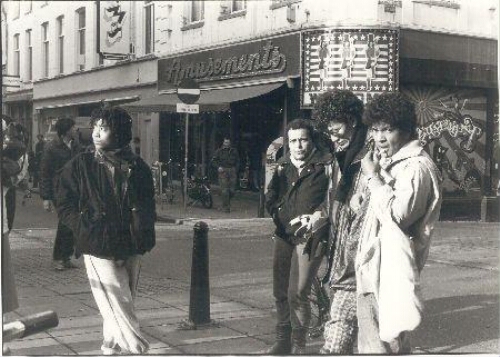
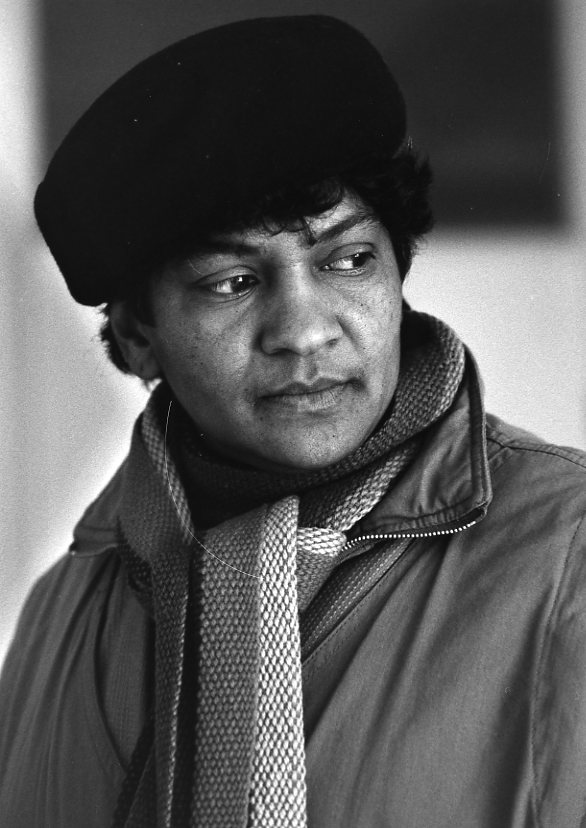
Photo credits
“Three women at the opening of the Women’s information and documentation center for Black and migrant women Flamboyant. On the far right co-founder Tania Leon, José Maas in the middle and Marlene Babel on the right.”
Year: 1989
Collection: IHLIA LGBTI Heritage
Photographer: Marian Bakker
Portret “Tania Leon”
Collectie: Tania Leon Studiefonds
Fotograaf: Onbekend
“Sister Outsider, genoemd naar een essaybundel van Audre Lorde, een zwarte lesbische groep 1984”
Jaartal: 1984
Collectie: Atria
Fotograaf: Robertine Romeny
“Portrait of Tania Leon donning a baret”
Year: 1985
Collection: IHLIA LGBTI Heritage
Photographer: Gon Buurman
South African activist and feminist Tania Leon was a instrumental in founding several Dutch organizations dedicated to the equality and emancipation of women in general and Black lesbian women in particular.
Biography
Author: Amber Redegeld
Tania Ruth Naomi Leon was born in Wellington, South Africa, in 1945, the youngest in a family of nine children. The family belonged to the Black middle class during apartheid. Initially, her mother—who came from the Colored community of the Western Cape—worked as a domestic servant. Her father had immigrated from India in the 1930s and began as a factory worker in the Western Cape. By the time Tania was born, the family’s financial situation had improved significantly; her father had opened a fish shop and earned enough to allow the children to pursue an education.
Leon trained as a physical-education teacher. After obtaining her diploma, she began teaching at Bergrivier High School in Wellington in the late 1960s and later at Lückhoff High School in Stellenbosch. She continued to live in Wellington and was socially very active, especially in the field of sports.
From South Africa to the Netherlands
In 1972, at the age of 27, Tania Leon left South Africa. She later described the situation as suffocating due both to apartheid and to the taboo surrounding homosexuality. She already knew she was a lesbian while in secondary school, but felt she had to keep it hidden. When she began working as a teacher and fell in love with another woman, she struggled with secrecy. It became increasingly difficult to conceal her lesbian identity. After her mother died, she decided to leave South Africa. She bought a return ticket and indicated on all official documents that she was going on holiday to visit South African friends in Denmark, knowing all along that she would not return.
After arriving in Denmark, she worked for a few months in a restaurant. In 1973, she moved from Denmark to the Netherlands, where she decided to retrain as a nurse. She later specialised in obstetrics and gynaecology and completed training in public health care. Once she had finished her studies, Leon began working as a district nurse in Amsterdam.
In Amsterdam, Tania Leon eventually became involved with the feminist movement. From there, things gained momentum: she came out as a lesbian and became politically active. She also became more actively engaged in the anti-apartheid struggle in the Netherlands. At the same time, she realised that once she became politically active, she could no longer return to South Africa. Since she had already booked a trip there in 1976, she decided it would be her farewell journey to South Africa under apartheid. Upon returning to the Netherlands, she immediately joined the women’s group of the Dutch Anti-Apartheid Movement and became a member of the Dutch branch of the ANC.
In 1984, Leon obtained Dutch citizenship. She later spoke about the freedom of movement she experienced with a Dutch passport. Returning to South Africa in 1986, she no longer had to identify according to the racial classifications of the apartheid regime—thanks to her Dutch passport. From the Netherlands, Leon also worked on behalf of women of color in South Africa. In 1986, with the support of several Dutch friends, she established a scholarship fund for Black women in South Africa. Throughout her life, Leon spoke about her love for South Africa and her rejection of the racism and apartheid system that had forced her to leave.
After apartheid had been abolished, she felt immense pride and fulfilment when she was able to cast her vote in the first democratic South African elections in 1994. Although she had become a Dutch citizen, she was recognised as eligible to vote thanks to her old South African passport.
A movement for Black, migrant and refugee women
Leon moved through life guided by a strong moral compass, shaped by her experiences with apartheid and her upbringing in a migrant family. This background influenced her deep commitment to her community. She was involved in various different emancipation movements, which she did not consider to be mutually exclusive. Her struggle against apartheid and racism went hand in hand with her fight for women’s emancipation and her activism for (Black) lesbian women—she was a truly intersectional activist. Leon said that she would only consider herself liberated when all oppressed groups were liberated. She was involved in the founding of several important organizations and was active within the ZMV movement—a Dutch women’s movement for and by Black, migrant, and refugee women.
In 1982, Leon helped found Mama Cash, together with Marjan Sax, Dorelies Kraakman, Patti Slegers, and Lida van den Broek. The organization initially focused on providing financial supporting to small initiatives by and for women in the Netherlands. Today, it supports projects worldwide aimed at equality and strengthening the position of women, girls, trans, and intersex people.
In the Netherlands, Leon did not feel entirely at home within the feminist and lesbian movement. She was often the only Black woman present at meetings and events. That led her to place an ad to find other Black lesbians. Gloria Wekker had the same plan at the same time. Through a mutual acquaintance, the two women met and together they founded the first group for Black lesbians in the Netherlands in 1979. That group existed for two years.
Together with Gloria Wekker, Joice Spies, and Tieneke Sumter, Leon established a new collective in 1984. They called themselves Sister Outsider after the collection of essays published by American poet and activist Audre Lorde , and they focused on creating a distinct Black lesbian culture. Sister Outsider also hosted Audre Lorde in Amsterdam in 1984 and 1986. The collective remained active until 1986.
Later work and legacy
In the mid-1980s, Tania Leon began practical training in bookkeeping. She left district nursing and returned to teaching, first at an Amsterdam organisation for women working in the field of IT and from 1987 onward, a vocational school targeting the same group.
Also in that period, Leon helped found Flamboyant, a documentation center focusing on Black, migrant, refugee women in the Netherlands. The center organised lectures, courses, and cultural events. It expanded knowledge about such women and helped this group further develop a shared identity. Unfortunately, the center was not long-lived; funding ended, and Flamboyant had to close in 1990.
Legacy
Tania Leon died at home on August 15, 1996 in the Dutch town of Nigtevecht, where she had been living with her partner, Renée Römkens. She was only 51 years old when she lost her battle against breast cancer. She was buried in Paarl, South Africa. The scholarship fund she had founded earlier for Black women in South Africa was renamed in her honor and in 2024 it was incorporated into the South African scholarship organization REAP. Mama Cash continues to operate to this day. The Faculty of Health at the Amsterdam University of Applied Sciences (HvA) named one of its buildings after her.
Tania Leon was a central figure in a network of organizations. Through her efforts, opportunities were created for (queer) women of color, and spaces emerged in which these intersecting identities could be discussed. Her legacy continues to inspire younger generations of activists to understand that struggles for emancipation are interconnected—that fighting one form of oppression does not exclude fighting another.
Literature and sources
Leon, Ruth Naomi (1945-1996),’ Marloes Huiskamp, Digitaal Vrouwenlexicon van Nederland, 2018.
‘Flamboyant laat zich niet temmen,’ Chandra Frank. Atria, 2018.
‘Wie was de vrouw naar wie het Tania Leonhuis is vernoemd?‘ Maja de Goede, HVANA, 2022.
Website: Mama Cash.