
Jillis Bruggeman
hij/hem1755 – 1803
Jillis Bruggeman, a merchant from Waddinxveen, was the last person in the Netherlands to be convicted and sentenced to death for sodomy or sexual acts with someone of the same sex. The execution took place in Schiedam.
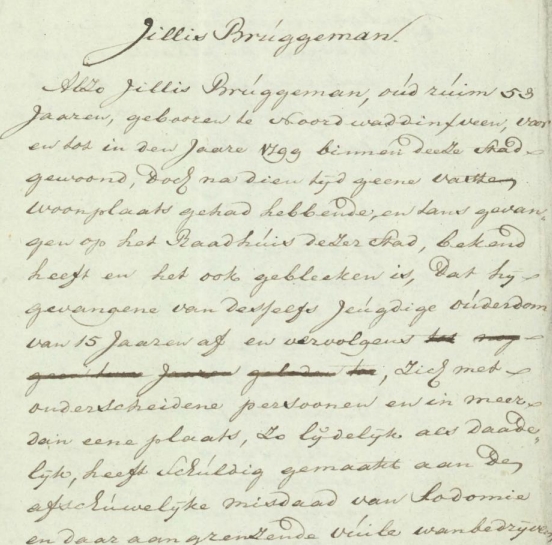
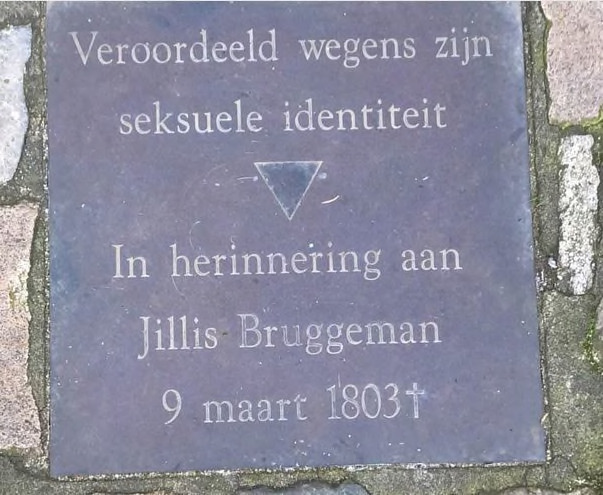
Photo credits
Excerpt from the verdict against Jillis Bruggeman
Source: LGBTI Jillis Bruggeman Foundation
Photo of Jillis Bruggeman monument in Schiedam
Photographer: Unknown
Source: LGBTI Jillis Bruggeman Foundation
Jillis Bruggeman, a merchant from Waddinxveen, was the last person in the Netherlands to be convicted and sentenced to death for sodomy or sexual acts with someone of the same sex. The execution took place in Schiedam.
Biography
Author: Tom Kniesmeijer
Trigger warning: this text refers to homophobic violence
They hanged Jillis Bruggeman right in front of Schiedam’s city hall. His crime? Homosexual behavior—or “filthy debauchery” as they called it in 1803. Jillis was the last victim of this cruel application of the law—in the Netherlands, that is. We will not let him sink into history. Because Jillis is still relevant today.
Schiedam, March 9, 1803
There he stood on that Wednesday: blindfolded, his hands bound behind his back, the noose already around his neck. He didn’t know—he couldn’t have known—that he would be the last one. Was he alert to the movements of the executioner behind him? Did he hear the jeering and cheering of the crowd that had gathered? Or had he already withdrawn into himself before the noose tightened?
Men and women—and Scheurkogel
Jillis Bruggeman was probably born in 1755. He was 15 when he first had sex with a man. It is very possible that Jillis would have identified himself as bisexual. As an adult, he married and started a family. Shortly after his wife’s death, he married again, this time to Jannetje van Wassenaar. Several children were born from this marriage as well. Around 1785, the Bruggeman family settled in Schiedam, a few kilometers west of Rotterdam.
Jillis earned his living as a peddler, traveling to surrounding villages and towns to sell his wares. After work, he could enjoy himself—or so it appears. One day in 1791, Jillis was sitting in an inn in Rotterdam and noticed a man by the name of Scheurkogel. They struck up a connection. We do not know how or where, but the two had sex.
It was most likely a one-night encounter—and hopefully a good one. What followed, however, was dreadful. Years later, when Scheurkogel ran into financial trouble, he saw only one way out: to blackmail Jillis.
Hunting sodomites
Same-sex relations had never been legal, but from the Middle Ages onward, the number of places—ranging from inns to haylofts—where like-minded people met increased. Fortunately, prosecution was rare. That changed in 1730–1731, when 40 men were convicted in Utrecht, 18 of whom were punished by strangulation. Clergymen preached hell and damnation: God would punish the Republic… unless Dutch society eradicated sodomy. Across the Netherlands, a hunt began in search of people who engaged in homosexual behavior (women were also arrested for lesbian behavior, but because they could not technically commit sodomy, they received lighter prison sentences). More than 200 men were executed in the Netherlands between 1730 and 1803. The executions drew large crowds; the verdicts and summonses were printed and sold in great numbers.
On the run
Jillis faced a devil’s choice: pay or die. He gave Scheurkogel money, but then he discovered that people in his surroundings were aware of the blackmail and that the authorities were watching him. At that point, he fled Schiedam. He remained in contact with his wife and children through letters. After several years, Jannetje, as an “abandoned housewife,” demanded a divorce and Jillis was summoned to Schiedam to attend the court ruling. He may have been naïve, or he may have acted out of loyalty to this wife, but either way he showed up—only to be arrested immediately upon arrival.
The crime of sodomy
During interrogations, Jillis confessed to “the crime of sodomy”—not only with Scheurkogel, but also with others. The details of his confession were considered so shocking that the legal records were stored in a separate, sealed file. It was only in 2014 that this file was rediscovered in Schiedam. The official charge was “filthy debauchery.” Jillis was to be “punished by the executioner with the rope, resulting in death.” He was publicly hanged on Schiedam’s main market square on Wednesday, March 9, 1803.
Jillis is not forgotten
Since Jillis, no one else in the Netherlands has ever been sentenced to death for their sexual or gender identity. Standing there on the scaffold, he could not possibly have known that he would be the last one. Nor could he have imagined this: that he would not be forgotten. Who still knows the name of the sheriff—or the executioner?
It is a small consolation, but Jillis is the one for whom a memorial was created. It was placed in 2015—on the 212th anniversary of his death—in front of Schiedam’s old city hall. The municipality has also named a medal of honor after him. Presenter and model Loiza Lamers received it in 2025. Others honored with the medal include musician and presenter Raven van Dorst and Sandro Kortekaas (founder of LGBT Asylum Support). There is also a regional award, the Opsteker (boost), three of which are presented each year to people who contribute to combating discrimination against LGBTQIA+ people.
Jillis is now
“Although we see Jillis as a figure from the past, that is unfortunately incorrect. Jillis is now,” reads the website of the Jillis Bruggeman Foundation, which advocates using his legacy as inclusively as possible. LGBTQIA+ discrimination has by no means been eradicated and in recent years even appears to be increasing. Lest we forget: there are still more than 60 countries where same-sex relations are criminal, and in roughly ten countries as of 2026, homosexual behavior is punishable by death. You may recall that in 2021, the teenagers Mahmoud Asgari (16) and Ayaz Marhoni (18) were publicly hanged in Iran. In Yemen and Mauritania, homosexuals are executed by means of stoning.
In Ghana, severe new anti‑LGBTQ laws were adopted in 2026. Niger, Senegal, and Uganda, all have anti-LGBTQ laws in place. The United States and the United Kingdom are actively restricting the rights of trans people. Where authorities neglect the rights of minorities, the queer community is directly at risk. Violence against trans people is increasing, and suicide rates are rising. Free gender identity, sexual orientation, and gender expression remain a struggle we must continue to fight.
Speak his name
Jillis Bruggeman was the last victim of a cruel Dutch legal practice. Speak his name. How long will it be before we can mourn the last LGBTQIA+ person killed worldwide for their identity?
Literature and sources
Stichting Jillis Bruggeman – genderdivers erfgoed.
‘Schiedamse inzending Stuk van het Jaar bekend,’ Schiedam.nl, 5 september 2014.
‘Gedood om zijn geaardheid,’ Lambert Teuwissen, Kijk geschiedenis, 2025.