
Rik Henning
he/himTransgender pioneer Rik Henning offered up his privacy in 1971 when he became the first transgender person to tell his story on Dutch television. Henning was the first trans man in the Netherlands to receive a valid gender registration.
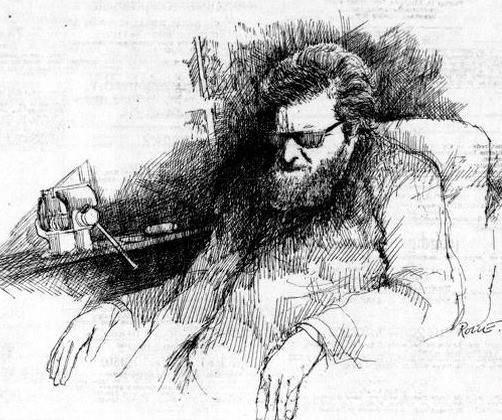
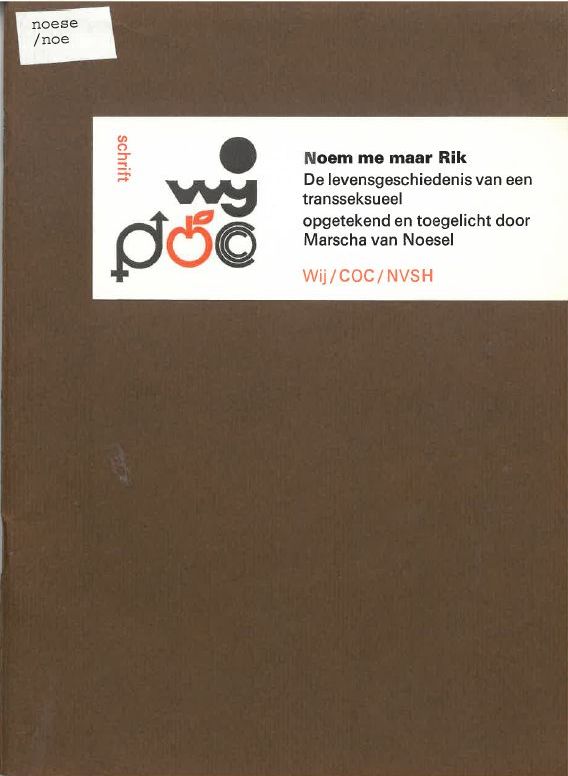
Photo credits
“Rik Henning”
Year: 1973
Collection: De Telegraaf (January 13, 1973)
Creator: Rozie (?)
Book cover of Noem me maar Rik (Just call me Rik)
Year: 1972
Collection: IHLIA LGBTI Heritage
Author: Marscha van Noesel
Transgender pioneer Rik Henning offered up his privacy in 1971 when he became the first transgender person to tell his story on Dutch television. Henning was the first trans man in the Netherlands to receive a valid gender registration.
Biography
Author: Dewi Vrenegoor (with special thanks to Alex Bakker)
Rik Henning was born to an unwed mother in or around 1935. Although doctors observed at birth that Henning had both male and female sex characteristics, it was decided, as was the case for many intersex people at the time, that Henning would be raised as a girl.
Henning had a lonely childhood. He was raised by foster parents, with whom he had a good relationship. Nevertheless, they were not entirely sure how to handle him. They sent him to a girls’ boarding school and later to various state institutions for observation.
When I was young, I felt more at home with boys than with girls. I also preferred playing with boys. Pretty clothes held no appeal for me. But there is really nothing unusual about that. There are plenty of girls like that.
A medical search
At 16, Henning gained a great deal of weight in a short period of time. Within ten years, he weighed as much as 154 kilograms (340 pounds). The cause was hormonal fluctuations, but this went unrecognized. As his body size increased, he became increasingly uncomfortable with himself.
He moved to England to complete his studies in remedial education and to work with children with disabilities.
It was in England that he realized he was attracted to women. Because he was still living as a woman at the time, Henning briefly adopted the label “lesbian.”
Only later did I understand that something entirely different from being a lesbian was involved. I did not love a woman as a woman. I loved a woman as a man.
After years of searching for medical assistance to lose weight, Henning came into contact with the Dutch endocrinologist Otto de Vaal. Once De Vaal prescribed testosterone for him, Henning lost dozens of kilograms. For him, it was a revelation: testosterone immediately made his body more masculine, something that felt profoundly right. It was then that he realized that he was, in essence, a man.
Visibility
At the time, transgender people were barely visible in the media. Self-representation was virtually nonexistent. People talked about transgender individuals, often in a sensationalized way that reinforced negative stereotypes and prejudice. They were also frequently viewed through a medical lens, as though they were medical abnormalities.
Trans men such as Henning were almost entirely absent from public view. While trans women had an openly visible role model in Christine Jorgensen from 1952 onward, trans men had no comparable public figure. The first publicly known gender-affirming surgery in the Netherlands took place in 1959 and involved a transgender man from Germany whose identity has remained unknown.
Rik Henning, however, chose to come out publicly as a trans man. In 1971, he appeared on a Dutch TV talk show known for its bold treatment of controversial issues. He was accompanied there by Otto de Vaal, his endocrinologist. De Vaal had written a groundbreaking book, Man or Woman? The Dilemma of the Transsexual Person, in which he discussed his experiences in treating 30 trans women and four trans men, including Henning. The book helped generate wider media attention for the subject.
De Vaal was also one of the founders of the Gender Foundation, together with attorney Frans van der Reijt, who represented a number of transgender clients, including Henning.
Correcting his legal sex registration
With the support of a team from the medical faculty in Rotterdam, Henning found the courage to seek legal recognition of his male identity. After several years of legal proceedings before the court in Breda, he finally succeeded in having his birth certificate amended at the end of 1972.
Henning, then 38 years old, was henceforth legally recognized as a man. He became the first trans man in the Netherlands whose legal sex registration accurately reflected his gender.
To achieve this, his attorneys relied on the so-called “error provision” (now Article 1:24 of the Dutch Civil Code), which allowed mistakes in birth records to be corrected. In the early 1970s, Van der Reijt handled dozens of such cases, many of which were granted on grounds of equity.
In 1975, the Dutch Supreme Court prohibited the use of this provision to alter the sex registration of transgender individuals. A commission was subsequently appointed to consider whether a specific legal provision for transgender people should be introduced. It took another ten years before the so-called Transgender Act (Article 1:28 of the Dutch Civil Code) came into force in 1985. In the intervening years, it was impossible to request a change of legal sex registration. Intersex people, however, can still invoke Article 1:24.
I myself have finally been liberated from a socially and legally marginalized existence. I can now continue my life as a person recognized as normal. But what about the hundreds of others? What are they supposed to do?
Education and advocacy
Henning’s experiences inspired him to become active in public education and outreach. In 1973, the Dutch LGBTQ organization COC and the Netherlands Association for Sexual Reform (NVSH) jointly published a booklet about him entitled Just Call Me Rik.
The message Henning hoped to convey through his openness was:
Through the information I have been able to provide, I hope people will understand that surgery is not the only thing of primary importance; returning to society is an even greater ‘operation.’ One must realize that an operation may last only a few hours, during which the patient is under anesthesia, whereas reintegration into society takes place without anesthesia. The transsexual person will be continuously confronted with harsh reality.
Henning recognized the need for social support and psychological counseling, and he wanted to draw attention to both. What struck him most in his contacts with other transgender people, particularly trans women, was the extent of their psychological suffering. It made him skeptical, and at times he questioned whether gender-affirming medical treatment was being initiated too quickly in some cases.
Nevertheless, Henning’s decision to be publicly visible as a trans man had a positive impact on many others. After a mother from a small village in West Friesland saw his television interview, she contacted De Telegraaf. She had a nine-year-old child who had been assigned female at birth but identified as a boy.
In a feature story about the family, a journalist quoted the mother as saying:
Perhaps there are other children in the Netherlands like our child, and perhaps their parents do not know what to do. (…) I am willing to help these parents with advice if they would like it.
Rik Henning’s courageous decision to live openly as a trans man helped others find the confidence to do the same.
Quotations are taken from: Sluysmans, C., ‘The Ordeal of the Woman Who Became a Man,’ De Telegraaf, January 13, 1973.
Literature and sources
Bakker, Alex. “Rik Henning,” on With Pride – IHLIA LGBTI Heritage.
Noesel, Marscha van. Noem me maar Rik. Een vrouwelijke transseksueel vertelt zijn levensgeschiedenis: psychiaters, een arts en een jurist geven een toelichting op de problematiek van de transseksuele mens, COC/NVSH, 1972.
Sluysmans, C. ‘De lijdensweg van de vrouw, die man werd,’ De Telegraaf, January 13, 1973.
Sluysmans, C. ‘Transseksueel kind knokt voor zijn mannelijkheid,’ De Telegraaf, February 17, 1973.
Vaal, Otto de. Man of Vrouw? Dilemma van de transseksuele mens, 1971.
‘Begrippen’, Seksediversiteit.nl, NNID, Center of expertise on sex diversity .