
Marielle Franco
she/her1979 – 2018
In 2016, Marielle Franco became both the first bisexual woman and the first Black woman to be elected to Rio de Janeiro’s city council. In that role, she advocated for laws against gender violence and for social equality.
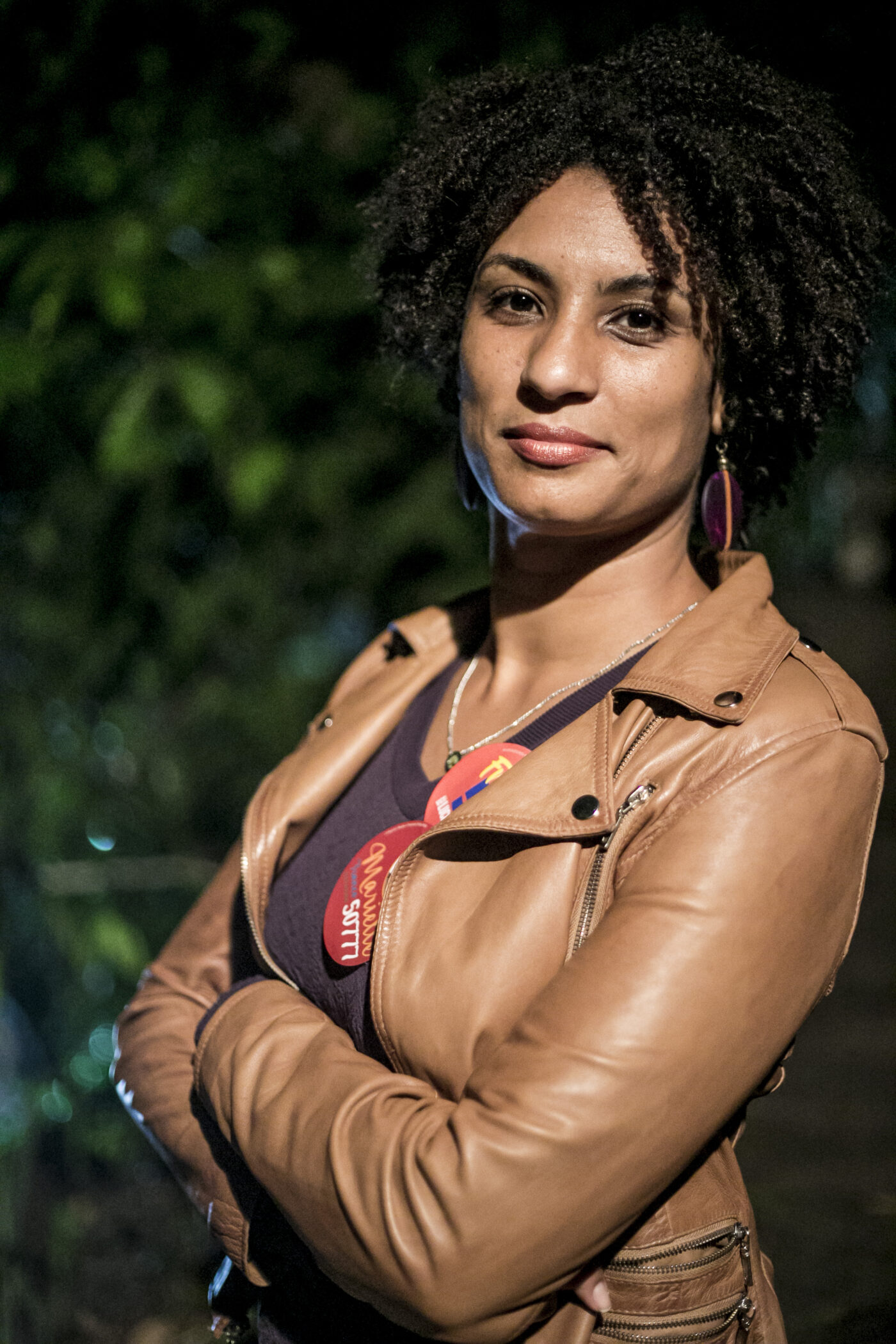
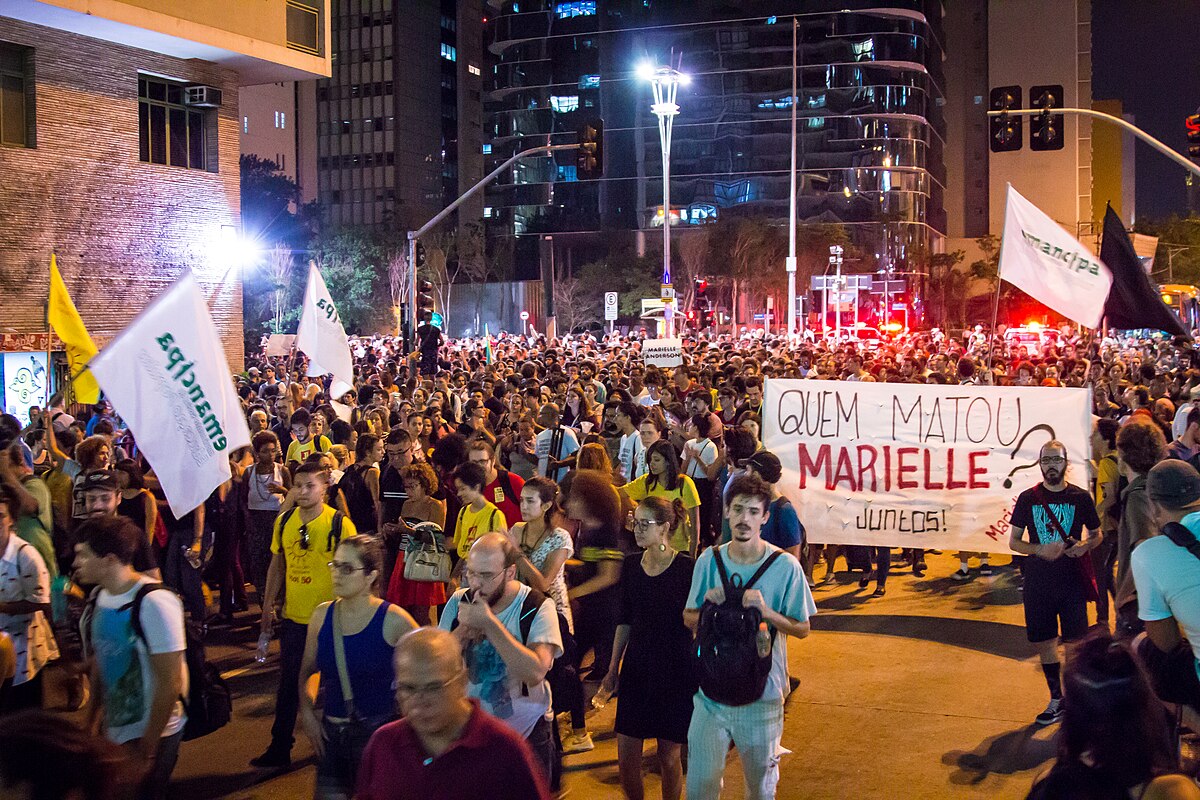
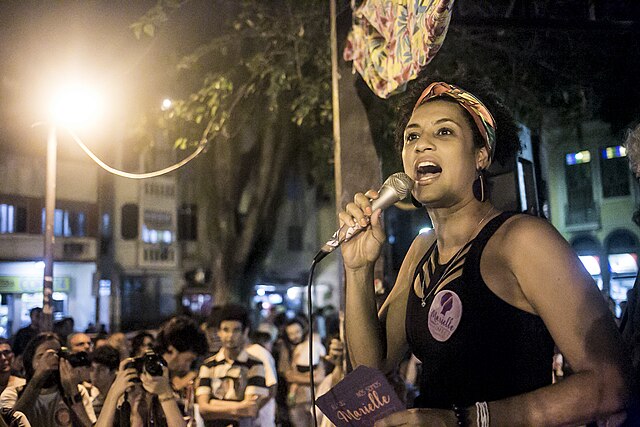
Photo credits
“Marielle Franco”
Year: 2016
Collection: Public domain
Photographer: Mídia Ninja
“Marielle Franco addressing the crowd”
Year: 2016
Collection: Public domain
Photographer: Mídia Ninja
“Demonstration for Marielle Franco”
Year: 2018
Collection: Public domain
Photographer: Romerito Pontes
In 2016, Marielle Franco became both the first bisexual woman and the first Black woman to be elected to Rio de Janeiro’s city council. In that role, she advocated for laws against gender violence and for social equality.
Biography
Born on July 27, 1979, Marielle Franco grew up in Maré, an expansive complex of favelas (slums) on Rio de Janeiro’s northside. Along with the other Black and mixed-race residents that made up the majority of the population of the favelas, her family faced poverty and discrimination. The frequent skirmishes between drug-trafficking gangs and police or state-sanctioned paramilitary groups made the area particularly dangerous for its inhabitants. Outbreaks of violence, including shoot-outs that left corpses on neighborhood streets, frequently led to school closures as she was growing up.
Having completed only a few years of schooling, Marielle began working at the age of eleven in order to help her mother make ends meet at home. In 1998, at the age of 19, she became a mother herself. A single mother, she raised her daughter while working at a preschool for a minimum wage. In 2000 she enrolled in a community college to prepare for admission to university. Two years later she received a scholarship to Rio’s Pontifical Catholic University, where she studied social sciences. From there she went on to earn a Master’s in Public Administration from Fluminense Federal University.
Marielle’s experiences of living in a favela informed her studies but also her subsequent work in politics. For her master’s thesis, she researched the government’s law enforcement program aimed to wrest control of the favelas from gangs. As Luciana Boiteux, a professor of criminal law and criminology at the Federal University of Rio de Janeiro, described her:
She had an intersectional perspective in which gender, race and class are connected and can’t be disentangled.
It was the death of a close friend in 2000 that activated Marielle to work on strengthening and defending human rights. Her friend had been hit by a stray bullet fired during a battle between gangs and the police. She eventually joined the PSOL (Socialism and Liberty Party), a offshoot of the Brazilian Workers’ Party. In 2007, she organized PSOL’s first assembly in the favela of Maré, where she lived, and helped coordinate Rio’s legislative Committee for the Defense of Human Rights and Citizenship. She also worked for civil society organizations, including the Brazil Foundation and the Maré Center for Solidarity Studies and Action. Besides advocating for the rights of the poorest inhabitants of the favelas – very often Black women and LGBTQIA+ people – she also worked to counter systemic racism. She spoke out against the violence and extrajudicial executions that often resulted from actions by the police and security forces in the favelas.
In 2004, when she was 24, she had become romantically involved with a woman, Mônica Tereza Benício, who was 18 when they met. For both women, it was their first relationship with another woman. The negative reactions they experienced from their respective families and from society in general took a toll on their relationship, but by 2017 they had moved in together, along with Marielle’s then 18-year-old daughter. The couple had plans to get married by the end of the 2018.
In 2016, she ran for a seat on Rio de Janeiro’s city council and won by a landslide, receiving the fifth highest number of votes out of over 1,500 candidates. She was the first Black and bisexual woman to be elected to such a position. Indeed, she was the only Black woman among the 51 members of the city council, despite the fact that over 50% of the Brazilian population is Black or mixed race. Her own staff included many young black women and the first transwoman to work as city council aide.
As a city councillor, Franco fought to stop violence against women, and she advocated for reproductive rights and the rights of favela residents. Working together with the Rio de Janeiro Lesbian Front, Franco presented a bill to create a day of lesbian visibility in Rio de Janeiro in August 2017, although the bill was narrowly defeated. Her popularity continued to grow and her star was clearly rising. The PSOL had asked her to run as its candidate for the office of deputy governor of the state of Rio de Janeiro in the elections of October 2018.
In early March 2018, she became a leading member of a city council committee set up to monitor the federal government’s military intervention in Rio de Janiero. The federal government had sent in the military to police parts of the city but the soldiers were not being properly held accountable for their actions. There had been a hundred deaths just in the previous month. Franco was outspoken in her opposition both to the military intervention and to recent cuts in social services that so many were dependent on, signalling both as a threat to democracy. She wrote: “The police state is aimed at the repression and control of the poor” and later tweeted: “How many more need to die for this war to end?”
On March 14, 2018, Marielle took part in the “Young Black Women Moving [Power] Structures” roundtable discussion. There she quoted Audre Lorde: “I am not free as long as another woman is a prisoner, even if their chains are different from mine.”
Within two hours of leaving the event, while Marielle, her press officer and their driver were on their way back home, another car suddenly drove up beside them and fired at them. Both Marielle and her driver, Anderson Pedro Gomes, were shot dead. Her press officer, who had been sitting next to her in the back seat, was injured but survived. It soon became clear that the bullets that murdered Franco had been created specifically for use by the federal police. It would be nearly six years before her assassins were convicted.
Across Brazil, but also in various cities around the world, people took to the streets to mourn Marielle Franco and protest against her assassination. NGOs including Amnesty International and Human Rights Watch issued statements condemning her killing. The day after her murder, her friend Glenn Greenwald – an American journalist and the husband of David Miranda, Marielle’s fellow PSOL member and another LGBTQIA+ member of the city council – characterised the impact she had been having on Brazilian politics. He referred to “her relentless and brave activism against the most lawless police battalions, her opposition to military intervention, and, most threateningly of all, her growing power as a black, gay woman from the favela seeking not to join Brazil’s power structure, but to subvert it.”
Her wife, Mônica, took over Marielle’s role as an activist for social justice and was elected to the Rio de Janiero’s city council in 2020. In 2022, Brazilian president Lula appointed Marielle’s sister as Minister of Racial Equality. The Marielle Franco Institute, established in 2020, aims to “inspire, connect, and empower Black women, LGBTQIA+ individuals, and people from marginalized communities to continue challenging the structures of society in pursuit of a more just and equitable world.”
As an openly bisexual woman who fought for the rights of Black women, the LGBTQIA+ community and the poor in Rio’s favelas, Marielle Franco inspired people all over the world. Her impact as a politician has led hundreds of Black queer and favela-born Brazilian woman to run for political office.
Literature and sources
Carneiro, Julia. “Marielle Franco: Vivacious fighter shaped by the favela” on bbc.com/news, 2018.
Molinuevo, Luis. “Marielle Franco” on Women in Latin America.commons.gc.cuny.edu, 2021.
Oliveira, Anastácia Flora (trans. by Evelin Rodrigues) “Marielle Franco’s Legacy Spread Around The World: An interview with Diane Mendes, Director of Strategies at the Marielle Franco Institute,” [s.d.].
Sullivan, Zoe, “The Life and Death of a Dangerous Woman,” on nextcity.org, 2018.
“Marielle Franco, HRD” on Frontlinedefenders.org, 2018
“Marielle Franco: Brazilian Human Rights Activist” on weteachnyc.org, [s.d.]