
Stelly Hoeben
zij/haar1955 – 1999
Developtmental psychologist Stelly Hoeben was actively involved in founding Women’s house Gaotika and the Lesbian Archive in Nijmegen. With her presence in both institutions, she was a driving force behind lesbian and women’s emancipation in Nijmegen.
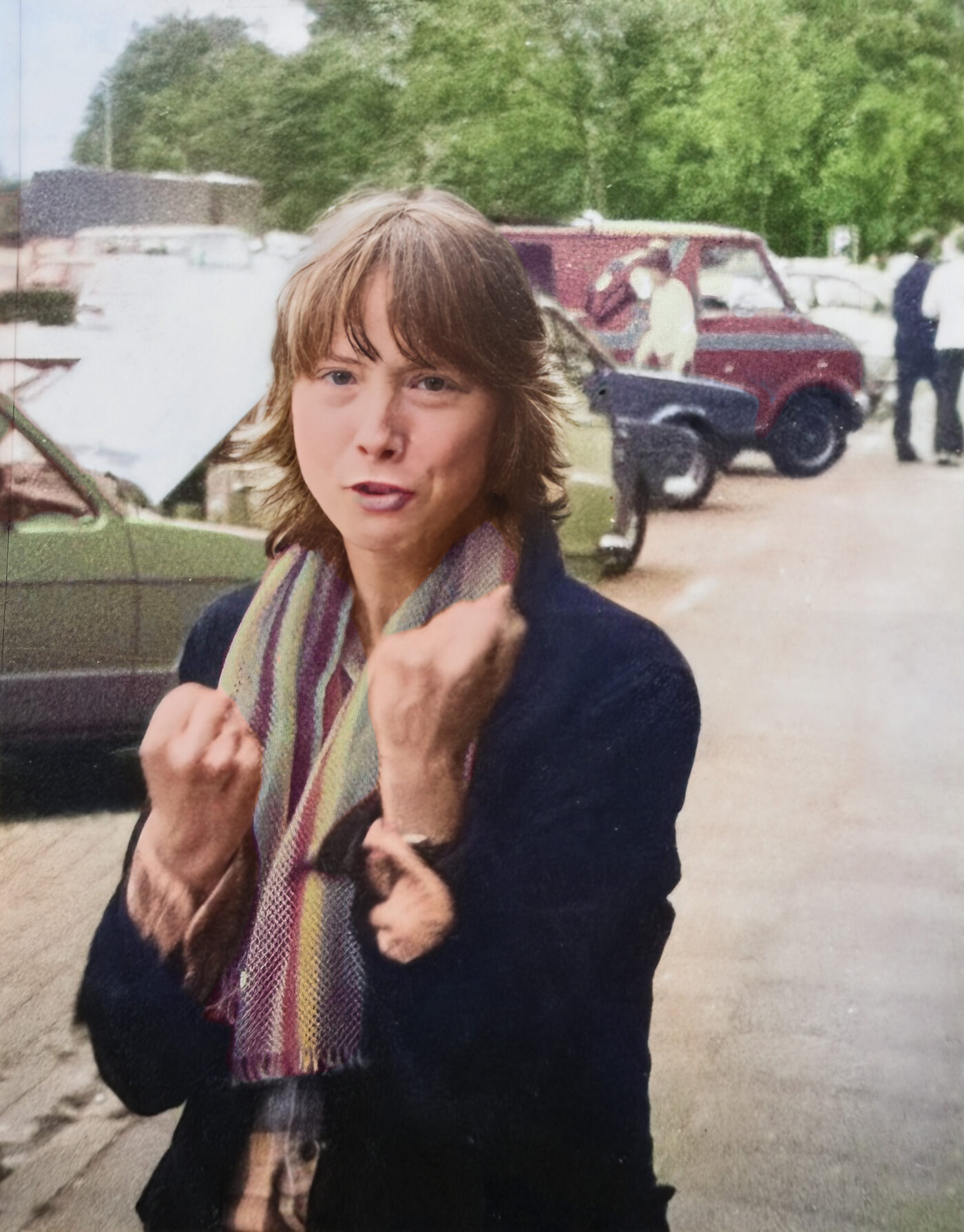
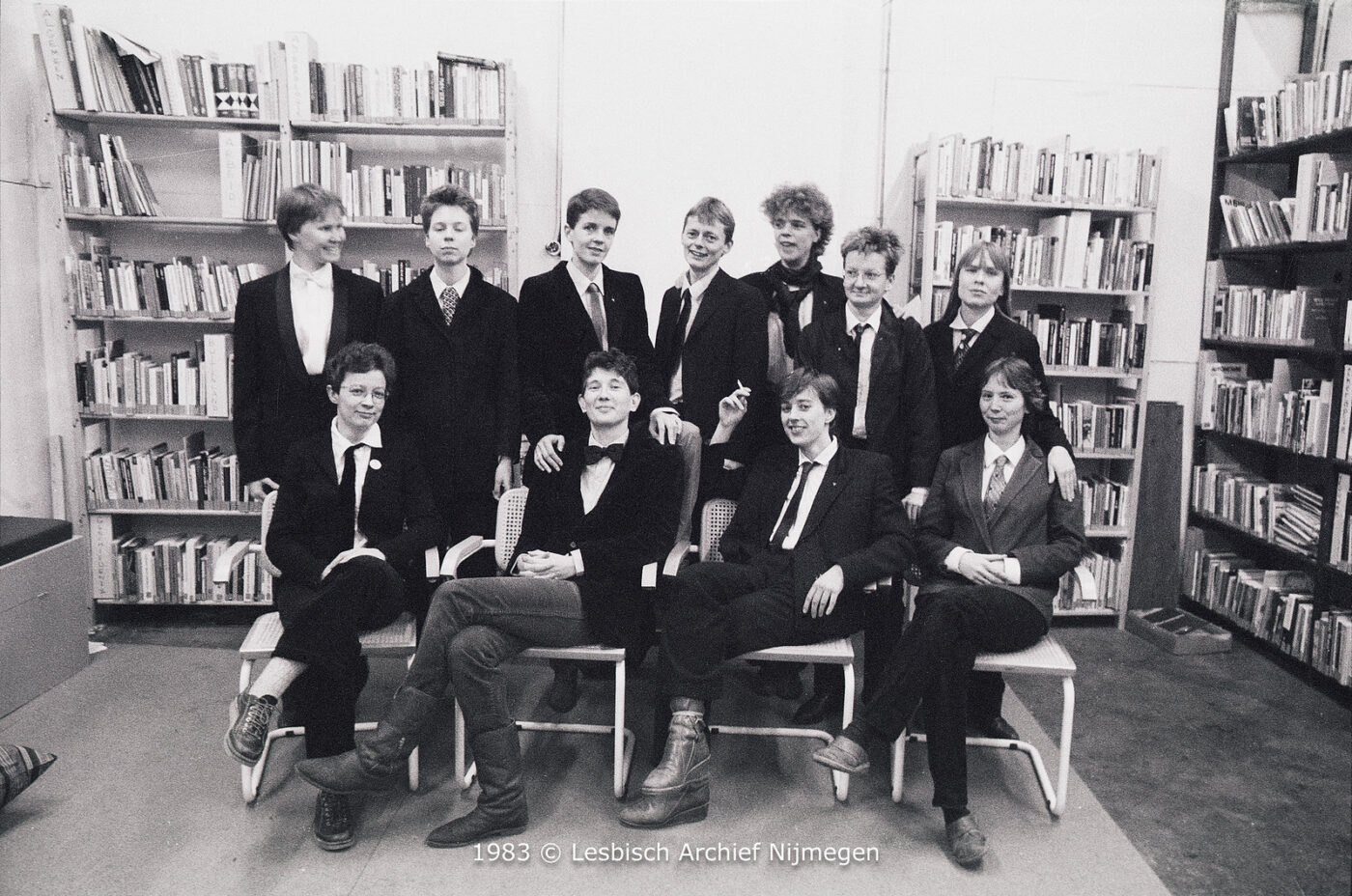
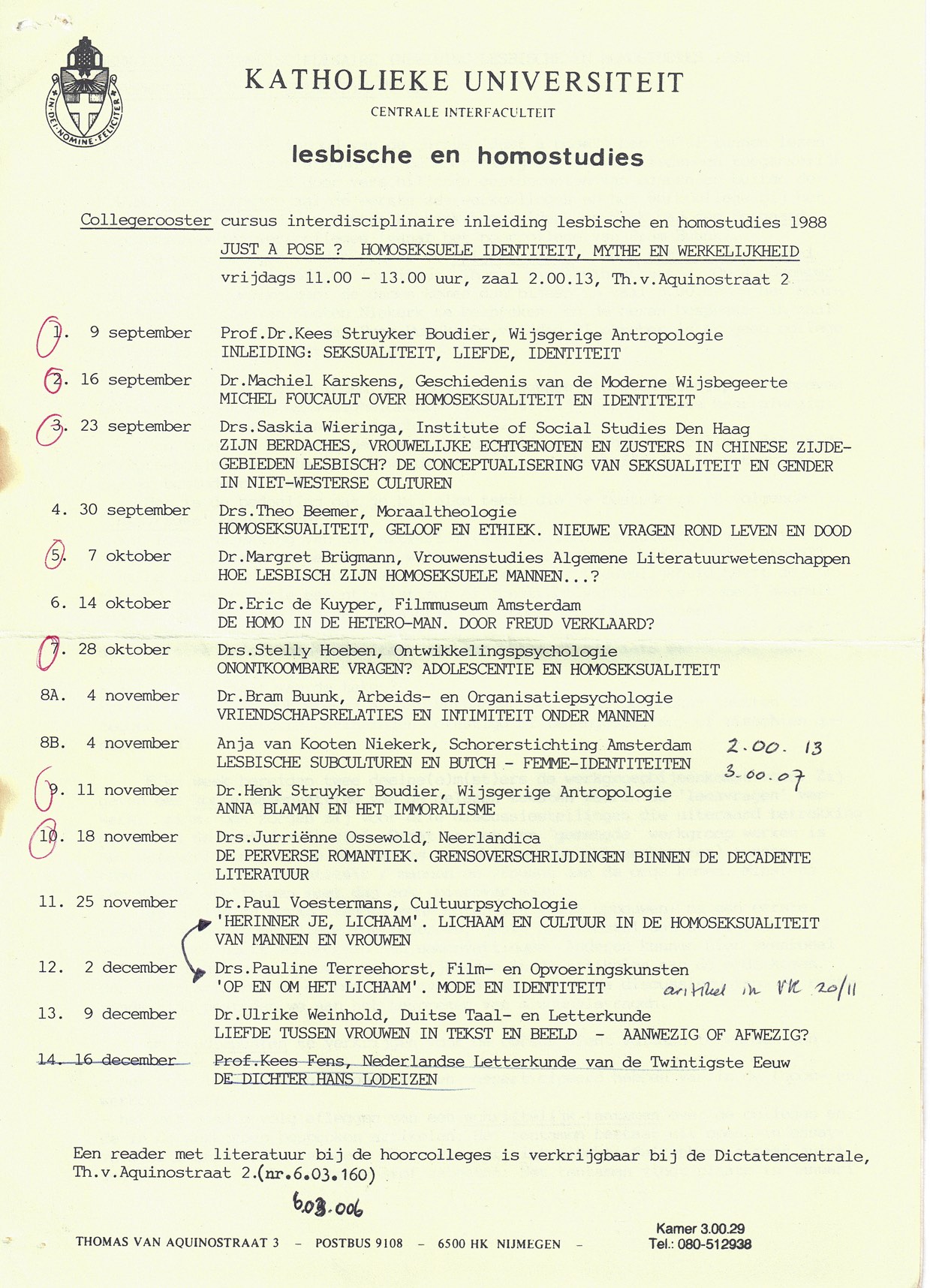
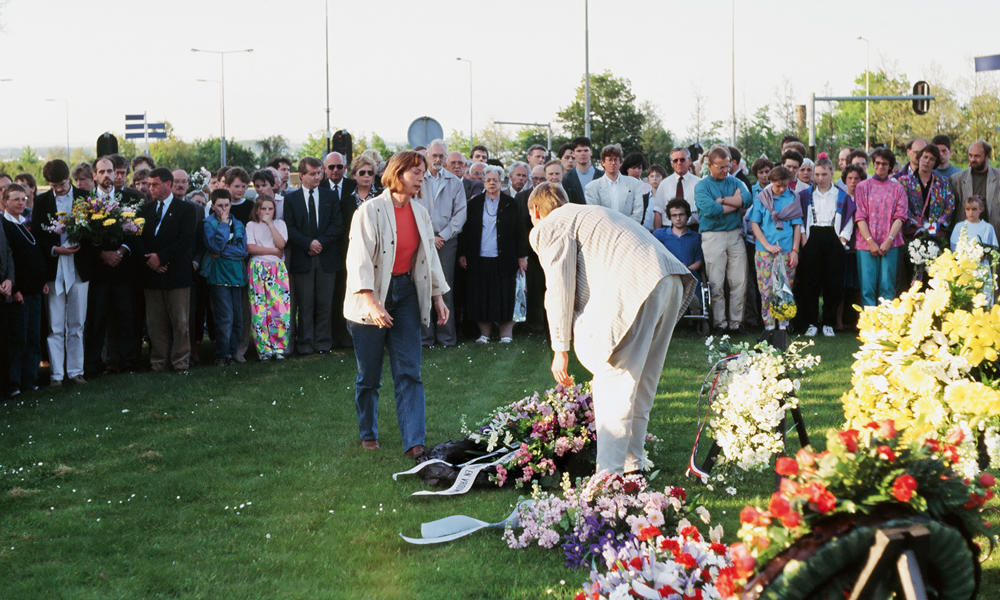
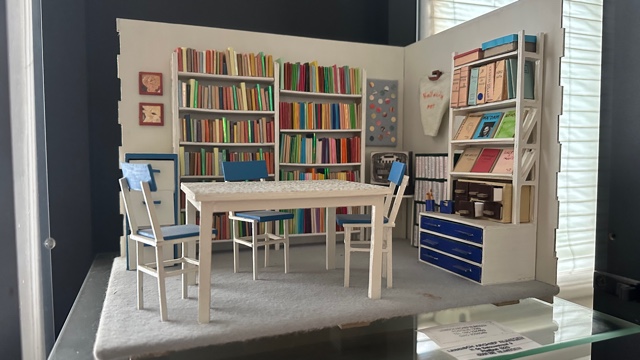
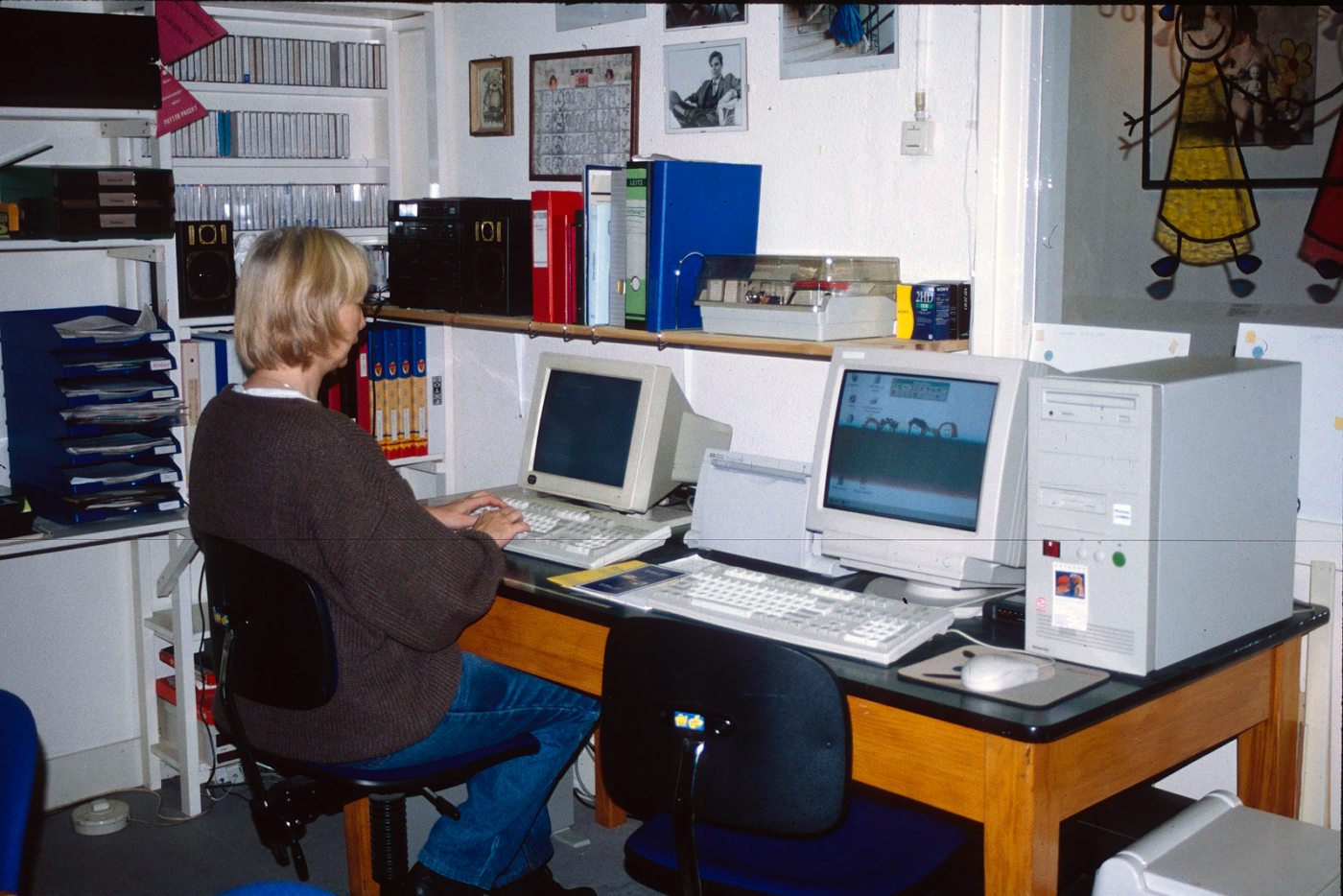
Photo credits
“Stelly Hoeben in Berlin”
Photographer: Renée Schoffelen
Year: June 1984
Collection: Private collection
‘January 1983: Initiative group for the Nijmegen Lesbian Archive in the squatted premises of the Women’s Documentation Centre De Feeks.’ Stelly Hoeben is on the right.
Year: 1983
Collection: Nijmegen Lesbian Archive, © LANijmegen
Photographer: Dorian Hiethaar / CC BY-NC-ND 4.0
“KUN Timetable for Lesbian and Gay Studies 1988–1989”
Year: 1988
Collection: Private collection of Stelly Hoeben/Agnes Goldenbeld
‘4 May 1989. Traianusplein, Stelly Hoeben [† 1999] of the Nijmegen Lesbian Archive, together with Frans Stam of COC Nijmegen, lays a wreath on behalf of ‘gay men and women in Nijmegen and the surrounding area’.’
Year: 1989
Collection: LANijmegen
Photographer: Hans Dircks
‘Model of the Lesbian Archive made by Stelly Hoeben’
Year: early 1990s
Collection: LANijmegen
Photographer: An Stalpers
‘Stelly at work at the Nijmegen Lesbian Archive’
Year: 1998
Collection: LANijmegen
Photographer: © LANijmegen
Developtmental psychologist Stelly Hoeben was actively involved in founding Women’s house Gaotika and the Lesbian Archive in Nijmegen. With her presence in both institutions, she was a driving force behind lesbian and women’s emancipation in Nijmegen.
Biography
Author: Agnes Goldenbeld
Stelly Hoeben was born in Eindhoven in 1955, the middle child in a working-class family. Her childhood included challenges, but also warm relationships, especially with her mother and sister.
As Stelly wanted to become a teacher, she attended a teacher training college. When she finished her studies, unemployment was high, and it was not easy to find work. When she showed up at the school where she was set to begin teaching, she was sent home directly, being told that the position would be given to a married man, for whom it was considered more important. When she returned home that day, she found her proud mother waiting for her with a bouquet of flowers to congratulate her.
Stelly then chose to study psychology in Nijmegen. In that city, she found not only her professional calling as a developmental psychologist, but also her place within the lesbian community. There, she lived openly as a woman who loved women. Her father found that unacceptable and let her know in the harshest terms. Stelly refused to let that discourage her and committed herself to promoting acceptance and visibility.
The 1980s and 1990s were a period in which lesbian women became visible for the first time as autonomous, self-aware women who loved women and wanted to share their lives with other women. Stelly was actively involved in this movement—at a time when the struggle for recognition and acceptance was in full swing.
Creating space for lesbian life
Stelly knew from personal experience what it felt like not to be accepted—whether by family, at work, or in society. Those experiences motivated her to create spaces where women could feel welcome and safe.
In June and July 1981, Stelly took part in the Summer University for Women’s Studies (ZUV) in Amsterdam, where she noticed little about lesbian topics in the program. That struck her as odd, since lesbian women often played an active within the women’s movement and at demonstrations, including those for abortion rights.
When the lesbian women who were present at the ZUV decided to organize their own workshops, they soon realized that the historical record of lesbians and their lives was very limited. The idea arose to establish local lesbian archives across the Netherlands, including one in Nijmegen. The first meeting to discuss setting up a lesbian archive in that city was held at women’s center Gaotika on May 28, 1982. An important aim of the meeting was to collect material to make sure the lives of lesbian women would no longer be erased from history.
Stelly’s contributions to the lesbian and feminist movement in Nijmegen
Stelly’s contributions were groundbreaking. As co-founder and driving force behind the Nijmegen Lesbian Archive (LAN), she laid the foundation for an archive that preserves the history of lesbian women while also making that accessible. Begun as an informal collection in a small spare room in a co-worker’s home, the archive officially opened its doors in Villa Lila, a hub for LGBTQ activities, in 1985. Stelly was not only involved in its development but also took the lead in digitizing the collection.
Already in the period when computers were still far from widespread, she recognized the potential of digitization and the emerging internet. Using a computer with a DOS operating system and barely 1GB of memory, she managed to organize the collection and make it accessible. This pioneering role demonstrated her forward-looking vision.
At the LAN’s ten-year anniversary in 1995, Stelly organized the first public exhibition in Nijmegen’s city hall, opened by Alderman Marja Alofs. Due to high water levels in the Rhine and the evacuation of the river region at that time, the city hall had become a press center, and the exhibition was broadcast worldwide as a backdrop to news reports.
Before the archive was established, Stelly had already been active at Gaotika, women’s center in Nijmegen. She had also participated in numerous demonstrations, including abortion protests and the Pierson Street riots of 1981 between squatters and the Nijmegen police. She served on the board of feminist bookstore De Feeks (The shrew) for several years. Stelly initiated Juffrouw Kip (a Sunday afternoon “salon” for older lesbians) and Lena’s Evening (a regular get-together for women at the Villa Lila) and organized film afternoons under the name Lavender Screen, where lesbian films were screened and discussed. These were all gatherings where lesbian women could meet in a relaxed environment. They continued for many years and offered a safe haven for many women.
From 1987 onward, Stelly gave lectures in Lesbian and Gay Studies at in Nijmegen’s Radboud University, focusing primarily on adolescence and homosexuality. As a developmental psychologist, she worked as a researcher and methodology developer on the project “Socio-emotional development of students in special education” at Radboud. She translated the book Bullying at School by Dan Olweus and co-authored Socio-emotional Development: The Trust Relationship as a Foundation (1992). She also co-developed the diagnostic personality instrument known as the Nijmegen-California Children’s Sorting Technique (NCKS).
Warm, open, and full of humor
Stelly was known for her warmth, enthusiasm, humor, openness, and her ability to love people. She had a special gift for putting others at ease. In difficult situations—for example, when emotions ran high during meetings—she remained calm and connected. She was modest, patient, and the opposite of a know-it-all.
Stelly believed it was important that the Nijmegen Lesbian Archive (LAN) should be a place not only for academic women, but for all women, regardless of background or class. She maintained warm relationships with people and organizations across the entire queer community in Nijmegen, including Pinkeltje, Villa Lila, and Brown Blossom. As some of the founders of the LAN were women who were deaf or hard of hearing, Stelly learned sign language to be able to better communicate with them.
Stelly was creative and practical. Origami was one of her hobbies, but she also built many things, including the bookshelves in the archive. She even crafted a detailed scale model of the archive, with everything in accurate proportions.
The LAN regularly had a stand at events such as the Nijmeegse Potten en Flikkersdag (Nijmegen dykes and fags day) and Roze Zaterdag (Pink Saturday, original national Pride event in the Netherlands). The scale model was also displayed, and when small children passed by, Stelly would ask: “Do you know what’s in that drawer?” She would then open a tiny drawer and produce a miniature poster. The surprised expressions of the children and the awkward looks she got from some of the parents were unforgettable.
Stelly took serious matters seriously, but she was also able to put things into perspective. Everyone who knew her remembers her exuberance and her peals of laughter.
A sudden farewell
When Stelly died suddenly of cardiac arrest in August 1999, it came as a shock to many. A sculpture by Nijmegen artist Vera Verkooijen stands on her grave at Nijmegen’s Rustoord Cemetery.
Stelly had numerous deeply rooted friendships, and she shared her life first with Mariëtte Fikkert and later, until her death, with Agnes Goldenbeld. With both women, she shared her dedication to lesbian emancipation.
Stelly Hoeben left behind a loving foundation for the lesbian and feminist movement in Nijmegen and beyond. Her work with the archive, her commitment to visibility, and her ability to love and connect people ensure that her presence is still felt today.
This text came into being thanks to Anja Hoeben, Renée Schoffelen, An Stalpers, Ineke Duursema, Marian Prins, and Jennie Noppers.
Literature and sources
Website: Lesbisch Archief Nijmegen (LAN).
Website: Online collectie LANijmegen.
‘Herdenken in gure tijden,’ Regenboogroutes Nijmegen.
Archief periodiek Pink / Pink&Zo, COC Nijmegen, 1976-2018.